Illustrated · 1 min

Proportions

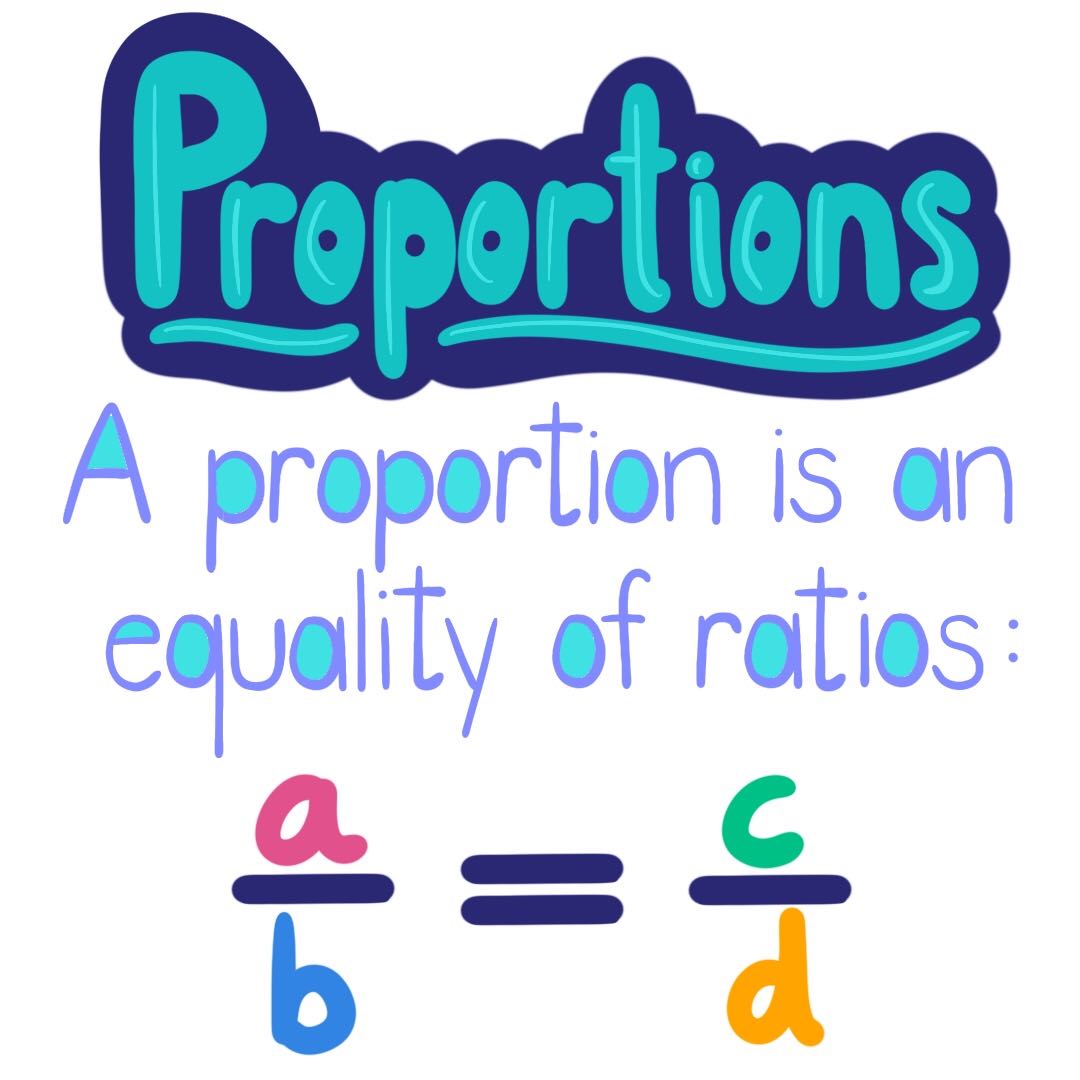
A proportion is an equality of ratios. Example: a/b = c/d

Image Source: Caroline Kulczycky

(Here is a refresher on ratios if you need it!)

Examples of Proportions

wx=yz12=243224=43\begin{align} \dfrac{w}{x}&=\dfrac{y}{z}\\ \\ \dfrac{1}{2}&=\dfrac{2}{4}\\ \\ \dfrac{32}{24}&=\dfrac{4}{3}\\ \end{align}

Proportions can include numbers or variables, or even both. We are really just setting two ratios equal to each other. We can use proportions to help with conversions between the same or different measurement systems, such as converting hours to minutes, minutes to days, minutes to seconds, feet to meters, kilometers to miles, Celsius to Fahrenheit, meters to centimeters, and grams to kilograms.

Preparing for a math contest?

Working through past problems on one idea at a time is one of the most effective ways to prepare. These are real problems from the AMC 8, AMC 10, AMC 12 and AIME, the national math competitions for middle and high school students, each with a worked solution on LIVE by Po-Shen Loh.

Video · + 1 min read

(Video) Proportions

by mathman1024

This video by mathman1024 explains proportions.

Summary\large{\text{Summary}}

A proportion is a pair of two equal fractions. This can be seen when looking at equivalent fractions. 45=810\frac45=\frac8{10}

In proportions, the cross products are equal. This means if you take the product of the numbers diagonal to each other, they will be the same number. In other words,

ab=cd⇒a×d=b×c\frac{\color{#8925AE}{a}}{\color{#29A603}{b}}=\frac{\color{#29A603}{c}}{\color{#8925AE}{d}}\Rightarrow {\color{#8925AE}{a}}\times {\color{#8925AE}{d}}={\color{#29A603}{b}}\times {\color{#29A603}{c}}

In our example above, if we take the cross products we multiply the pairs of positive numbers:

4⋅10=5⋅8.4\cdot10=5\cdot8.

This simplifies to 40=4040=40. This tells us that we had a proportion, since the cross products are equal. What we have is a quick way to check whether two fractions are equivalent.

An Example in Solving Equations\large{\text{An Example in Solving Equations}}

We can use this formula to help solve for unknown numbers or quantities. For example, say you can grade 55 exams in 1010 minutes. How long would it take to grade 2020 exams?

Let's set up a proportion as follows: 5 exams10 minutes=20 examsx minutes 510=20x\begin{align} \frac{5\text{ exams}}{10\text{ minutes}}&=\frac{20\text{ exams}}{x\text{ minutes}}\\\ \frac5{10}&=\frac{20}x \end{align}

Now that we have a proportion, we can use the cross product to easily solve for xx. This first step is also called cross-multiplying.

510=20x5x=10⋅205x=2005x5=2005x=40\begin{align} \frac5{10}&=\frac{20}x\\ 5x&=10\cdot20\\ 5x&=200\\ \frac{5x}{\color{#8925AE}{5}}&=\frac{200}{\color{#8925AE}{5}}\\ x&=40 \end{align}

In the last step we are dividing both sides of the equation by 55.

In summary, it would take 4040 minutes to grade 2020 exams.

Here's a sanity check. Based on our calculation, it takes less time to grade 55 exams than it did to grade 2020 exams.

Read · 1 min

What are Ratios and Proportions?

A ratio is one thing compared to or related to another thing; it is just a statement or an expression.

A proportion is two ratios that have been set equal to each other, which means that proportions can be solved. For instance: 510=12\frac{5}{10} = \frac12

This is a proportion because these two fractions are equivalent. In this particular case, 510\frac{5}{10} can be reduced to 12\frac{1}{2}.

Solving Proportions

Solving a proportion means that you are missing one part of one of the fractions, and you need to solve for that missing value. For example: 12=x6\frac12 = \frac{x}{6}

These can be solved with cross multiplication. We're going to multiply the numerator of the first fraction by the denominator of the second, and the denominator of the first fraction by the numerator of the second. From there we solve for xx the same way we would in any other equation. 12=x66⋅1=2x2x=6x=3\begin{align} \frac12 &= \frac{x}{6}\\ 6\cdot 1 &= 2x\\ 2x&=6\\ x&=3 \end{align}

Type a concept, like “slope” or “photosynthesis”.

↑ ↓ to choose · Enter to openSearch explanations and problems