
Illustrated · 2 min
Radial Velocity
Radial velocity is currently the most effective method for detecting exoplanets and brown dwarfs. About half of known exoplanets have been detected using this method.
The radial velocity method is also known as doppler spectroscopy because it uses the doppler effect to observe shifts in the spectrum of the planet's parent star as the planet and star orbit the center of mass. If the spectrograph used is powerful enough, over a long period of time, it is possible to detect the small changes in a star's velocity as it orbits the center of mass.
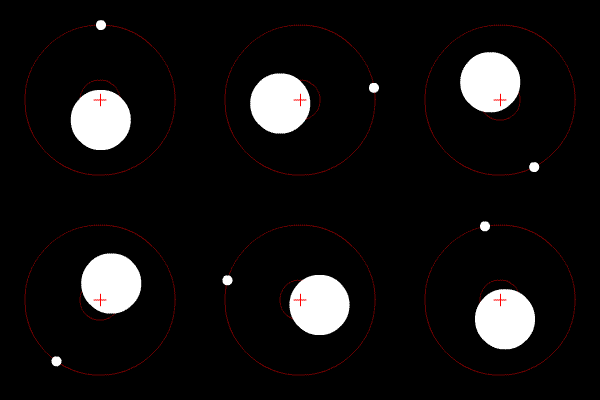
Star-Planet orbit
Because of doppler shift, as the star is moving toward earth, its light spectrum is shifted toward the blue end, and as the star is moving away from earth, its light spectrum is shifted towards the red end.
If we notice strong periodic shifts in the spectrum, then we have successfully detected a planet!!
Example
Example Curve
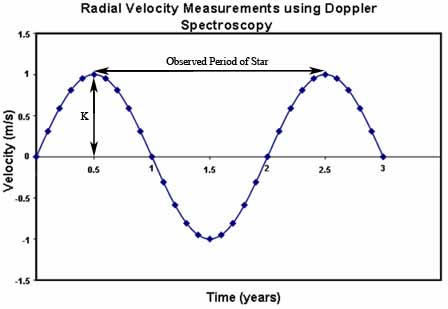
This graph displays a sine curve created using Doppler Spectroscopy of an imaginary star.
The velocity of the planet towards Earth shows a periodic variance of 1 m/s, meaning that there is likely to be a mass orbiting this star.
Using Kepler's third law of planetary motion, we can determine the planet's distance from the star.
After determining , the velocity of the planet can be calculated using Newton's law of gravitation and the orbit equation.
The mass of the planet can then be found from the calculated velocity.
Drawbacks
Although the radial velocity method has been very successful in detecting many faraway exoplanets, its main drawback is that it cannot accurately determine the true mass of the exoplanet, and can only estimate a lower bound. It is also hard to distinguish whether the observed planet is actually a planet, or a low mass star or brown dwarf.
Furthermore, the radial velocity method only works accurately when the exoplanet is on the same plane as the Earth and the star. This is very rarely the case, as the planet usually orbits at a different inclination.
One more drawback of the radial velocity method is that it is unlikely to find planets that are hosts to life. This is because it usually detects high-mass planets that have an orbit close to the parent star.