Solving a Simple Arithmetic Recursion
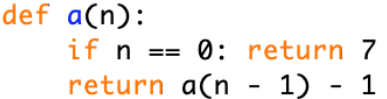
While there is unfortunately no method that can solve every recursive formula, it can be easy to solve simple arithmetic recursive formulas (which can describe arithmetic sequences). By "arithmetic recursive formula" we mean that the only operation involved is addition. The example above was an arithmetic recursive formula:
hn=hn−1+2
However, we're going to use a slightly more complicated answer, so we can illustrate the power of solving a recursive formula. Suppose that on day one, a company makes 1 dollar, and every day the company makes 23 more dollars than the day before. We could describe their income on the nth day as:
an=an−1+23
While it may be easy to calculate their profit for a few days or a week with the above formula, it would be difficult to estimate their profit after a few years. To do that, we have to solve it. We do this by listing some terms, finding the difference, d, between each term, and then fitting the final formula to the sequence. The formula to find the nth term in an arithmetic sequence is:
an=(n−1)d+a1
Let's try it. With the formula above, the first 5 terms are as follows:
a1a2a3a4a5=1 (given to us as the base case)=a1+23=24=a2+23=47=a3+23=70=a4+23=93
From there, we can easily see that the difference between each term is 23, and so we know d. This is important, because we know that d will appear as the coefficient on the n term in the final formula.
We then have to fit this d to the final formula. Since we know that the formula for the nth term in an arithmetic sequence is an=(n−1)d+a1, we can come up with the following formula to describe the sequence:
an=23(n−1)+1
We now can easily find how much money the company will make in 10,100,1000, or any other amount of days by substituting for n.
This formula is also interesting because it illustrates a pattern common to all arithmetic recursive formulas. We can see that our base case makes it into the final formula as the final term being added on, and given the initial formula, we can see that d was there all along:
an=an−1+23d is the term being added
With these two facts, we can find a general solution to a recursive formula of the form an=an−1+d with a1=k, for any constant k:
an=d(n−1)+k
To see this formula in action, try some examples for yourself!