Illustrated · 1 min
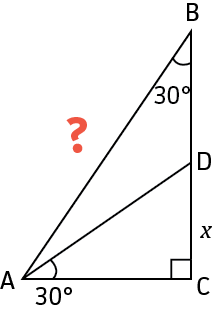
A special type of right triangle is the -- right triangle. As you can tell from the name of the triangle, this right triangle has interior angles of , , and .
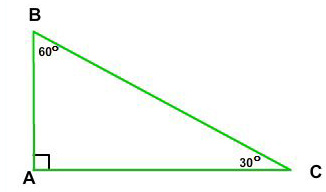
Figure 1: A 30-60-90 right triangle.
Unlike the 45-45-90 right triangle, the side ratios of the triangle are not as straightforward. We need to prove the ratio of the length of the shortest leg to the length of the hypotenuse before we are able to determine all the side ratios.
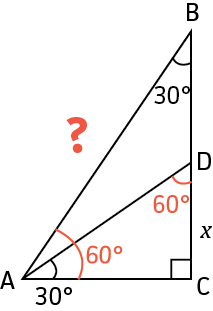
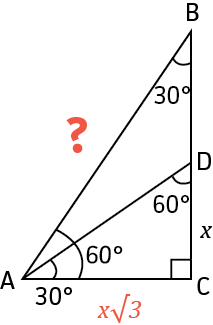
Let us create a diagram in which we reflect the -- triangle along the longer leg. Since the two angles fit together on the same line, we have created a larger triangle - that resembles an equilateral triangle!
We can easily prove that it is an equilateral triangle by noting our larger triangle's angles. One of the angles of our original -- right triangle is , so there are two angles. The third angle is also because it is the sum of two angles.
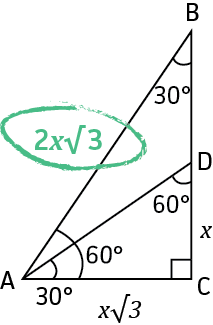
Suppose the length of the shortest side of one -- triangle is unit. Therefore, the length of a side of the equilateral triangle would be units!
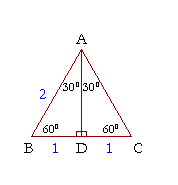
Figure 2: Proof of the 1:2 ratio.
This means that the ratio of the lengths of the shortest side to the hypotenuse of any -- right triangle is .
If the length of the shortest leg is units and the hypotenuse is units, we can use the Pythagorean Theorem to derive the length of the longer leg, denoted as :
Therefore,
If a triangle is a -- right triangle, the ratio of the sides (short leg:long leg:hypotenuse) is .