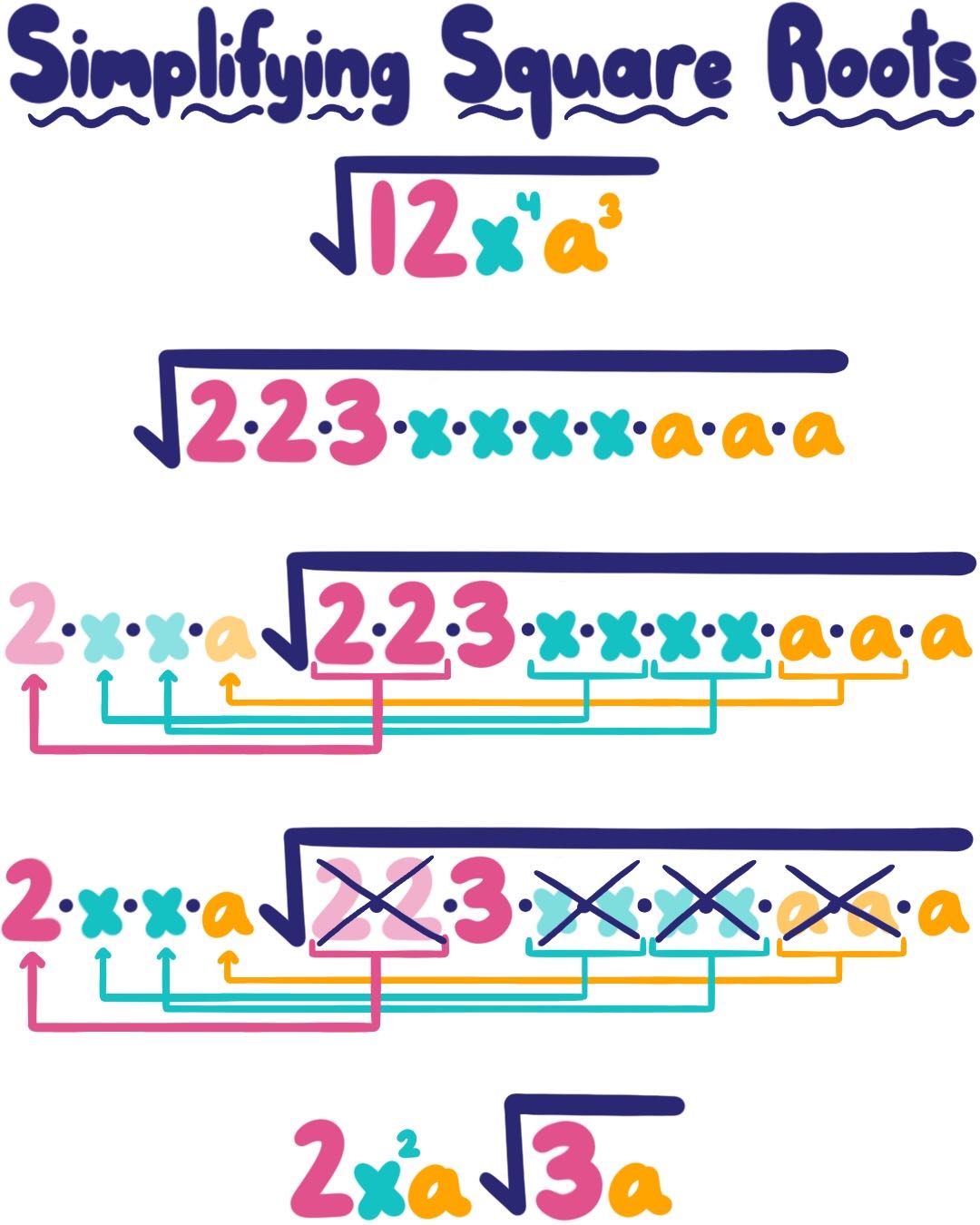
There are many different techniques you can use to simplify square roots. In this explanation, we will learn a slightly different method. Don't worry, you'll get the same answer either way.
Step One:
Rewrite the number or expression under the square root in terms of its factors. You may even want to break these factors down into THEIR factors...this might help you later. For example, you might want to rewrite the square root like this:
72=12⋅6=(4⋅3)⋅(2⋅3)=((2⋅2)⋅3)⋅(2⋅3)=2⋅2⋅2⋅3⋅3
Step Two:
Since we are taking the square root(i.e., 298), we want to look for perfect square factors. Every time we see a pair of the same factors, we write one copy of that factor outside of the square root sign. Here's how it works:
2⋅2⋅2⋅3⋅3→2⋅2⋅2⋅3⋅3, where 2 and 3 are perfect square factors→2⋅32⋅2⋅2⋅3⋅3
Step Three:
Next, remember the pairs of perfect square factors we found under the square root? Eliminate them from under the square root, like this:
2⋅32⋅2⋅2⋅3⋅3→2⋅32⋅2⋅2⋅3⋅3→2⋅32
This result is equivalent to the square root we are trying to simplify! In this example, 72=2⋅32.
Step Four:
Simplify everything!
72=2⋅32=62
Here's a graphic that goes through the steps, but with a different expression underneath the square root!
Image by Caroline Kulczycky
(It is important to note that this method applies to monomials. You cannot split up radicals with sums and differences in the same way.)
Let's do one more example!
Simplify 27x6yz2.
Step One: Break down the expression into its factors
27x6yz2=3⋅3⋅3⋅x⋅x⋅x⋅x⋅x⋅x⋅y⋅z⋅z
Step Two: Every time you see a pair of the same factors, write one copy of that factor outside the radical
Here's a video by Friendly Math 101 showing you how to simplify radicals.
Summary
To simplify radicals, we need to find the prime factorization of the number. Prime factorization is the breaking up of a number into its prime factors.
Let's look at an easy example: 36. We know the answer will be 6 but let's use prime factorization to show this. Start by making a table and putting the number up top.
36
Next we divide this number by the lowest prime number that will go into it. For this example the lowest prime is 2.
23618
Again, the lowest prime is a 2.
2236189
Now a 2 will not go into this evenly so we move to the next smallest prime that will, 3.
22333618931
Once you have a 1 at the bottom, you know you reached the end. The numbers on the left—2, 2, 3, and 3—are the prime factorization of 36.
To get the answer, we need to look at the pairs we have. As you see, we have a pair of 2's and a pair of 3's.
22333618931
We take one number from each pair and multiply them together to get our answer.
2×3=6
Try it yourself!
1,008
Let's try this by going straight down the line!
So, starting with 1,008, the lowest factor is 2, which pairs with 504. In general, if we have an even number, then the lowest factor will be 2 and something else. So continuing with this, 504 can be broken down into 2 and 252. Following this pattern, we have 252 into 2 and 126, then 126 is broken into 2 and 63.
Now, we have 63, which is not an even number, so it cannot be broken down into a factor containing 2. So, we can check if it is divisible by 3, which it is! 63 is broken down into 3 and 21, and 21 is broken into 3 and 7.
Now, 7 is a prime number, therefore it can only be broken into 1 and itself. As stated above, once we hit a 1, we can stop! So, with everything in the left column, we see that 2×2×2×2×3×3×7=1,008
22223371,008504252126632171
Try it yourself!
875
875
First, let's break down 875 into its smallest factoring pair. The pair containing the smallest factor is 5 and 175.
5875175
Next, we'll break down 175 into its smallest factors, which are 5 and 35.
5587517535
Lastly, we'll break down 35 into its smallest factors, which are 5 and 7.
55587517535755578751753571
We have a 1 at the bottom, so we know that our prime factors (shown in the left column) are 5,5,5 and 7
Simplifying square roots is just what it sounds like: taking a square root and breaking it down into its smallest pieces. In order to make this task easier, it is a good idea to try and memorize the first 12 perfect squares!
Usually, when we want to simplify a square root, we are simplifying the square root of a non-perfect square. To do this, we need to factor the number under the square root sign (often called the radical sign). Simplifying a square root takes a look at specifically the factors that include perfect squares. Let's look at an example!
For example, let's look at 40. 40 is not one of our perfect squares, so we must next look at its factors. The factors of 40 are 2 and 20, 4 and 10, and 5 and 8. Of those factors, the only pair that contains a perfect square is 4 and 10. Therefore, we can write:
40=4⋅10=4⋅10=210
10 cannot be broken down into any factors containing perfect squares, therefore this is our final answer! We can double check it by performing the operation, then comparing it to 40, which can be calculated exactly with a calculator.