用代数方法求解对数方程式

Before this, know对数方程式

Read · 2 min

Solving log equations

The main principle of solving log equations is to always get rid of the logs. The main tool for doing that is simply raising both sides to a power.

After this lesson, we will know how to solve log⁡5(x)=2\log_5(x)=2!

We raise both sides to the 55th power: 5log⁡5(x)=525^{\log_5(x)}=5^2 x=25x=25

At the end of solving every log equation, you should always check to see if your solutions are valid, since logs cannot accept nonpositive values. (As a bonus, checking will also uncover any possible mistakes you made.) We check that log⁡5(25)\log_5(25) is in fact equal to 22.

Multiple logs

Let's think about the situation with multiple logarithms. Clever usage of logarithm rules can help a lot here. The most important rules are log⁡k(ab)=log⁡k(a)+log⁡k(b)\log_k(ab)=\log_k(a)+\log_k(b) and log⁡k(ab)=blog⁡k(a)\log_k(a^b)=b\log_k(a), because with those, you can handle both addition and multiplication.

Now try solving log⁡7((x+1)2)+log⁡7((x−1)2)=4\log_7((x+1)^2)+\log_7((x-1)^2)=4.

We can combine the logs first by multiplying the arguments. log⁡7(((x+1)(x−1))2)=4\log_7(((x+1)(x-1))^2)=4

Although we could expand ((x+1)(x−1))2((x+1)(x-1))^2, it's much easier to remove the power: 2log⁡7((x+1)(x−1))=42\log_7((x+1)(x-1))=4 2log⁡7(x2−1)=42\log_7(x^2-1)=4 log⁡7(x2−1)=2\log_7(x^2-1)=2 And now we can remove the log and solve a much easier quadratic: x2−1=49x^2-1=49 x=±50x=\pm \sqrt{50}

Checking, we see that both solutions are valid, since squared numbers cannot be negative and none of them are 0.

Change of base

In some harder problems, the logarithms have different bases. You can use the change of base formula to deal with those. Of course, make sure you are changing the bases to something you can deal with reasonably. For example, if the bases are 16 and 32, it would not be useful to change them both to 7. (They are both powers of 2, so 2 makes much more sense.)

Now try solving log⁡2(x3)+log⁡8(x)=10\log_2(x^3)+\log_8(x)=10.

We can change the log⁡8(x)\log_8(x) to log⁡2(x)log⁡28=13log⁡2(x)\frac{\log_2(x)}{\log_2{8}}=\frac{1}{3}\log_2(x). The equation becomes log⁡2(x3)+13log⁡2(x)=10\log_2(x^3)+\frac{1}{3}\log_2(x)=10 3log⁡2(x)+13log⁡2(x)=103\log_2(x)+\frac{1}{3}\log_2(x)=10 103log⁡2(x)=10\frac{10}{3}\log_2(x)=10 log⁡2(x)=3\log_2(x)=3 x=8x=8

You should check that this is valid by substituting x=8x = 8 into the original equation.

Video

(Video) Solving Logarithmic Equations

by Fort Bend Tutoring

Fort Bend Tutoring has a good video explaining how to solve logarithmic Equations.

Now after watching the video, try this problem.

Solve the equation for real values of xx.

log⁡7x+log⁡7(x2+2)=2log⁡7(x2+2)\log_7 x + \log_7 (x^2 + 2) = 2\log_7(\sqrt{x^2 + 2})
Choose one answer

Illustrated · 1 min

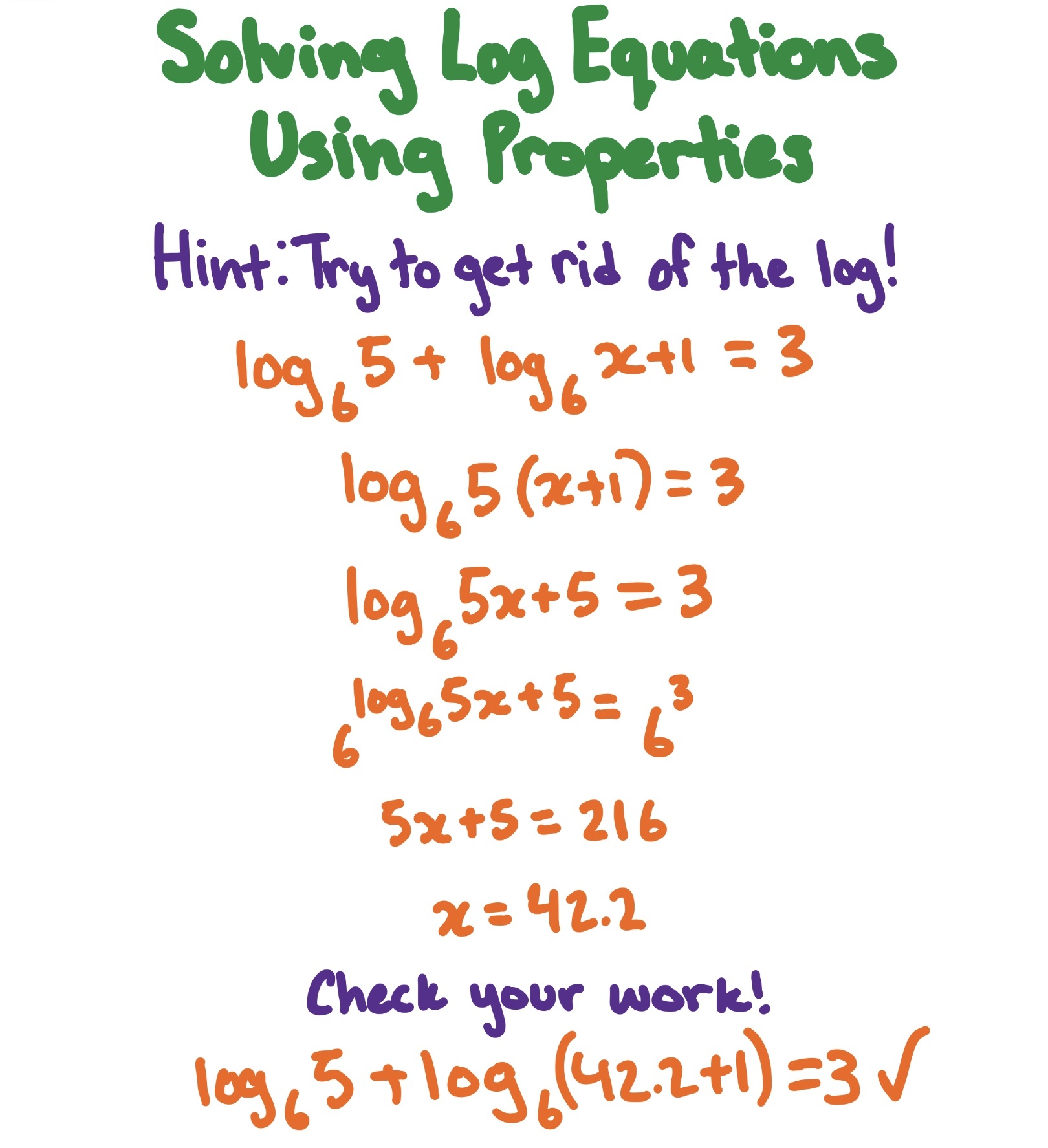
Solving Log Equations Using Properties

We've covered how to solve log equations with the same base.

In this next lesson on logarithmic expressions and equations, we will learn how to solve log equations using properties. We already have a solid foundation on the properties of logarithms, such as the product rule, quotient property, power rule, and natural logs. These important properties will help to solve the problem.

The biggest hint I can give you: try to get rid of the log!

Solving Log Equations Using Properties
Hint: Try to get rid of the log!

log (base 6) 5 + log (base 6) x+1 = 3
log (base 6) 5*(x+1) = 3
log (base 6) (5x+5) = 3
6^(log(base 6) (5x+5) = 6^3
5x+5 = 216
x=42.2
Check your work!
log (base 6) 5 + log (base 6)(42.2+1) = 3 (checkmark)

Image source: by Trisha

In the next lesson, you'll learn how to solve exponential equations with logs.

Type a concept, like “slope” or “photosynthesis”.

↑ ↓ to choose · Enter to openSearch explanations and problems