使用圆规和直尺的“基本”构造

Read · 1 min

Constructions basically consist of constructing various geometric figures using only a straightedge and a compass. That means no rulers, protractors; more generally, no measurements. The straightedge is assumed to be infinite, have only one side, and have no markings, though using a ruler and disregarding the ticks on the side will suffice. The compass is assumed to collapse when taken off a page, though using a regular compass will suffice due to the compass equivalence theorem

The apparent lack of numbers may make it seem like a whimsical pastime of mathematicians--it is, in fact--but as one dives beneath the tip of the iceberg, one will see that construction is a very deep and subtle topic, producing problems known to Greeks, Indians, and Egyptians that stood for millennia, only being solved by 18th century mathematicians equipped with modern mathematical tools. Such problems are the doubling the cube problem and the angle trisection problem problem.
Interactive · 2 questions

What are compass and straightedge constructions?

A (mathematical) straightedge is thought of as an infinitely long ruler with no markings - so that you can connect any two points with a straight line, but you can't measure distances numerically.

A (mathematical) compass is a tool for constructing circles of any radius centered at any chosen point.

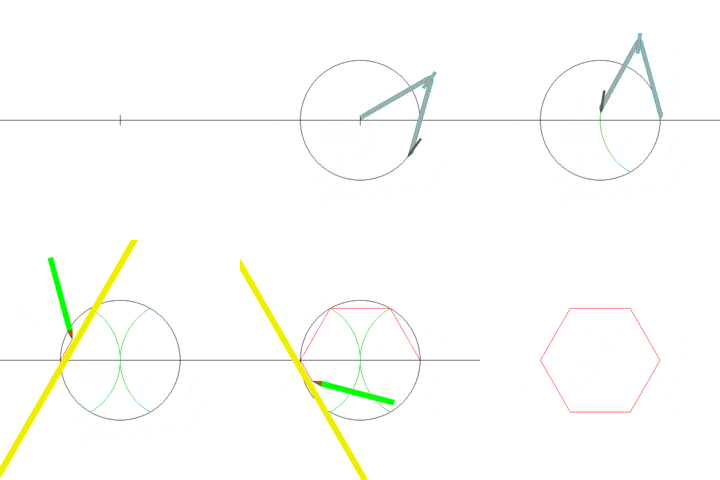
A great demonstration from the Wikipedia page on constructions

There are two types of compasses: collapsible and non-collapsible, the latter of which you can use to copy a radius from one center to another as well, without the compass "collapsing". It turns out that it doesn't matter whether we use a collapsible or non-collapsible compass as far as what things we can construct, so for simplicity we'll assume our compass is non-collapsible.

Which tool would you use to copy a length of a line segment from one line onto another?

Choose one answer

Read · 1 min

Although we have integrated many constructions throughout the Expii geometry curriculum, you may enjoy Euclid: The Game.

Interactive · 1 question

In straightedge and compass constructions, we make things using only lines and circles. This is what is in Euclid's Elements, and is the most basic type of construction. The straightedge is like an infinitely long ruler that has no markings and is only good for drawing lines, and the compass can create circles but collapses when lifted off of the page and has no markings either. Straightedge and compass constructions must follow Euclid's first 3 postulates.

What is the difference between a straightedge and a ruler?

Choose one answer

Type a concept, like “slope” or “photosynthesis”.

↑ ↓ to choose · Enter to openSearch explanations and problems