半角恒等式

Before this, know二倍角恒等式

Read · 1 min

We have the following double-angle identity: cos⁡(2A)=cos⁡2A−sin⁡2A=2cos⁡2A−1=1−2sin⁡2A\cos(2A) = \cos^2 A - \sin^2 A = 2\cos^2 A - 1 = 1 - 2\sin^2 A Replacing AA with A2\frac{A}{2}, we get: cos⁡A=cos⁡2A2−sin⁡2A2=2cos⁡2A2−1=1−2sin⁡2A2\cos A = \cos^2\frac{A}{2} - \sin^2\frac{A}{2} = 2\cos^2\frac{A}{2} - 1 = 1 - 2\sin^2\frac{A}{2} Rearranging, we get: sin⁡2A2=1−cos⁡A2\sin^2\frac{A}{2} = \frac{1 - \cos A}{2} cos⁡2A2=1+cos⁡A2\cos^2\frac{A}{2} = \frac{1 + \cos A}{2} Dividing the first equation by the second gives: tan⁡2A2=1−cos⁡A1+cos⁡A=sin⁡2A(1+cos⁡A)2\tan^2\frac{A}{2} = \frac{1 - \cos A}{1 + \cos A} = \frac{\sin^2 A}{(1 + \cos A)^2} From these, we get the half-angle identities: sin⁡A2=±1−cos⁡A2\sin\frac{A}{2} = \pm\sqrt{\frac{1 - \cos A}{2}} cos⁡A2=±1+cos⁡A2\cos\frac{A}{2} = \pm\sqrt{\frac{1 + \cos A}{2}} tan⁡A2=±sin⁡A1+cos⁡A\tan\frac{A}{2} = \pm\frac{\sin A}{1 + \cos A} To determine the sign, you will have to check which quadrant the angles AA and A2\frac{A}{2} lie in.

Video

(Video) Half Angle Formulas & Identities - Evaluating Trigonometric Expressions

by The Organic Chemistry Tutor

Check out this video by the Organic Chemistry Tutor!

Let's follow their example of how to derive the sin⁡θ2\sin{\frac{\theta}{2}} identity.

Start with the trig identity:

sin⁡2θ=1−cos⁡2θ2\sin^2{\theta} = \frac{1-\cos{2\theta}}{2}

Which we can manipulate further to find the half angle identity by dividing both angles (θ\theta) by 2.

sin⁡2θ2=1−cos⁡θ2\sqrt{\sin^2{\frac{\theta}{2}}} = \sqrt{\frac{1-\cos{\theta}}{2}} sin⁡θ2=±1−cos⁡θ2\sin{\frac{\theta}{2}} =\pm \sqrt{\frac{1-\cos{\theta}}{2}}

We can follow a similar derivation to find the half angle identity of cos⁡θ\cos{\theta}.

cos⁡2θ=1+cos⁡2θ2\cos^2{\theta} = \frac{1+\cos{2\theta}}{2} cos⁡2θ2=1+cos⁡θ2\sqrt{\cos^2{\frac{\theta}{2}}} = \sqrt{\frac{1+\cos{\theta}}{2}} cos⁡θ2=±1+cos⁡θ2\cos{\frac{\theta}{2}} =\pm \sqrt{\frac{1+\cos{\theta}}{2}}

Now, let's derive the tangent half angle identity following the example in the video.

The derivation of $\tan{\frac{/theta}{2}}$ in terms of \cos{/theta}.

Image Source: By Trisha

Try solving the example problem given in the video! Use the half-angle identities to solve for cos⁡(15∘)\cos(15^{\circ}).

Choose one answer

Illustrated · 1 min

Trigonometry: Half-Angle Identities

There are six negative angle identities you need to memorize!

Half angle identities are trig formulas use to find the sine, cosine, or tangent of half an angle. They are called "half angle" identities because the angle inside the trig function is divided by 22.

The half angle identities are derived from the double angle identities.

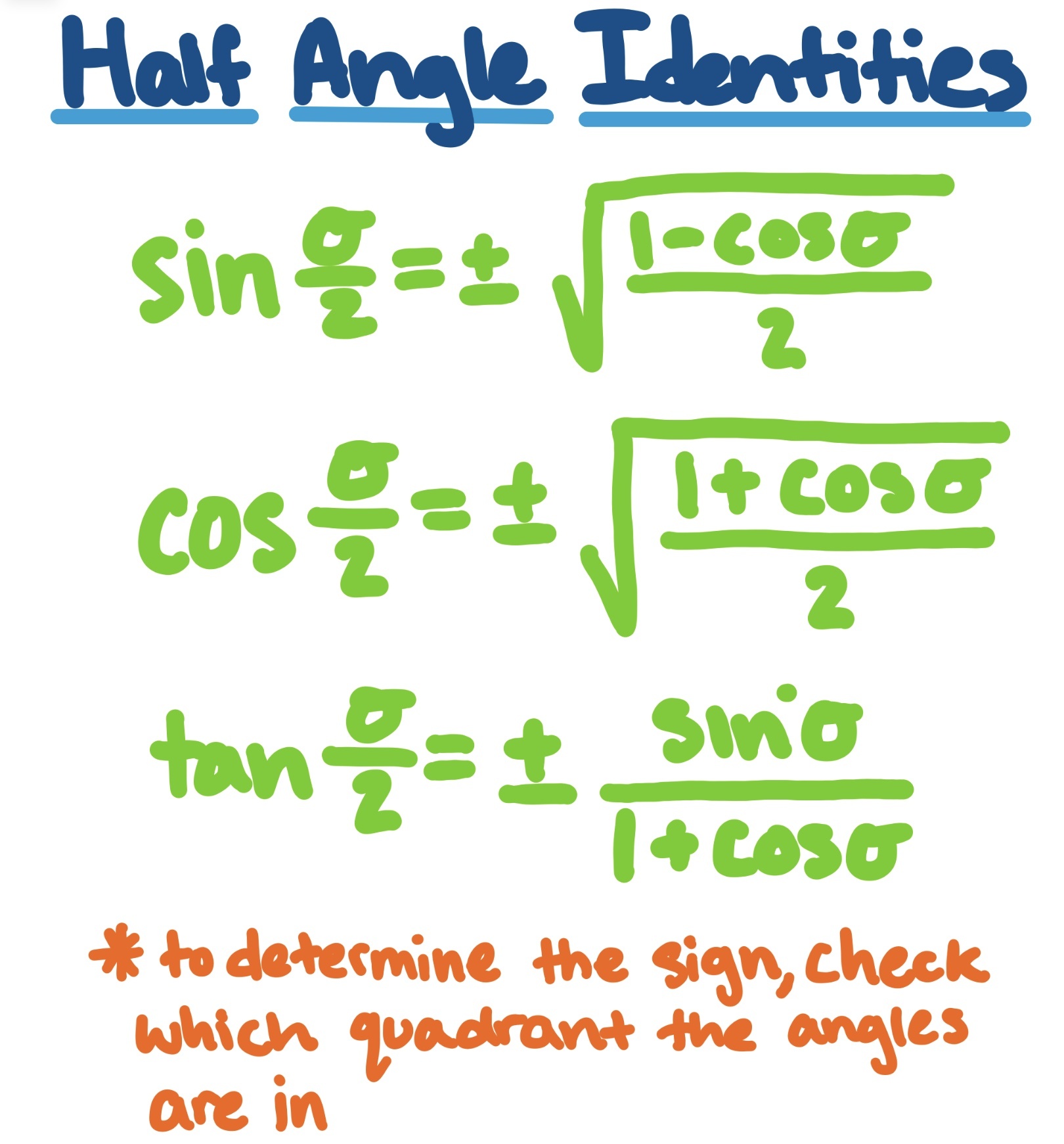
Half-Angle Identities

Sin (x/2) = +- square root ((1-cosx)/2)
cos (x/2) = +- square root ((1+cosx)/2)
tan (x/2) = +- (sinx)/(1+cosx)
* to determine the sign, check which quadrant the angles are in

Image source: by Trisha

The sine and cosine formulas include ±\pm because the square root alone does not tell you whether the value should be positive or negative. To choose the correct sign, you need to figure out which quadrant the angle x2\frac{x}{2} is in.

  • Quadrant I: sine and cosine are both positive
  • Quadrant II: sine is positive, cosine is negative
  • Quadrant III: sine and cosine are both negative
  • Quadrant IV: sine is negative, cosine is positive

One of the most common mistakes is forgetting the ±\pm sign. Always check the quadrant before choosing positive or negative.

Looking Further

In the next series, we will learn about Definition Identities in trig, including the tangent identity and the pythagorean identity.

Type a concept, like “slope” or “photosynthesis”.

↑ ↓ to choose · Enter to openSearch explanations and problems