使用单位圆求角的正弦值

Interactive · 3 questions

Consider the following diagram:

A circle centered at the origin in the Cartesian coordinate system. A segment r is drawn from the origin to point (a,b) on the circle in the first quadrant, and the altitude is dropped to the x-axis, thus forming a right triangle.

Image source: by Ruiran Xun

Here, we can see that having picked the point (a,b)(a,b) in the first quadrant of the plane, the line from the origin to (a,b)(a,b) forms a hypotenuse of a right triangle. This line has length rr.

The length of the adjacent is just the distance of the right angle from the origin, so its value is just aa. Similarly, the length of the opposite is bb.

Therefore, from our definitions of sine and cosine, sin⁡θ=oppositehypotenuse=ar\sin\theta = \frac{\text{opposite}}{\text{hypotenuse}} = \frac{a}{r} and also cos⁡θ=adjacenthypotenuse=br.\cos\theta = \frac{\text{adjacent}}{\text{hypotenuse}} = \frac{b}{r}.

Now, consider the following diagram. In this one, r=1r=1.

The same diagram as before, but with 1 in the place of r and (cos(theta), sin(theta)) in the place of (a, b).

Image source: by Ruiran Xun

It turns out that now the value of the coordinate on the circle is just (cos⁡θ,sin⁡θ)(\cos\theta, \sin\theta)!

Recall that in our first graph, sin⁡θ=ar\sin\theta = \frac{a}{r} and cos⁡θ=br\cos\theta = \frac{b}{r}. When r=1r = 1, a=sin⁡θa = \sin\theta and b=cos⁡θb = \cos\theta. Therefore, the xx coordinate is just cos⁡θ\cos\theta and the yycoordinate sin⁡θ\sin\theta.

Given any unit circle and an angle θ\theta, you can just draw that angle in. At the point where the angle meets the unit circle, the values of cosine and sine can be read straight from the xx and yy coordinates!

Thinking about sines and cosines in a visual manner like this can make your life much easier, especially when you're dealing with special angles like π6\frac{\pi}{6}, π4\frac{\pi}{4}, π3\frac{\pi}{3}, etc. This is because the only possible values for sines and cosines of these special angles are ±12\pm\frac{1}{2}, ±22\pm\frac{\sqrt{2}}{2}, and ±32\pm\frac{\sqrt{3}}{2}.

As an example, if you picture the angle π3\frac{\pi}{3}, the point on the unit circle would be further up than it is to the right, so sin⁡π3=32\sin\frac{\pi}{3} = \frac{\sqrt{3}}{2} and cos⁡π3=12\cos\frac{\pi}{3} = \frac{1}{2}.

Now for a few practice questions, and we're done!

What is the value of sin⁡(5π6)\sin(\frac{5\pi}{6})?

Choose one answer

Illustrated · 2 min

Visualising Sine, Cosine, and Tangent in a Unit Circle

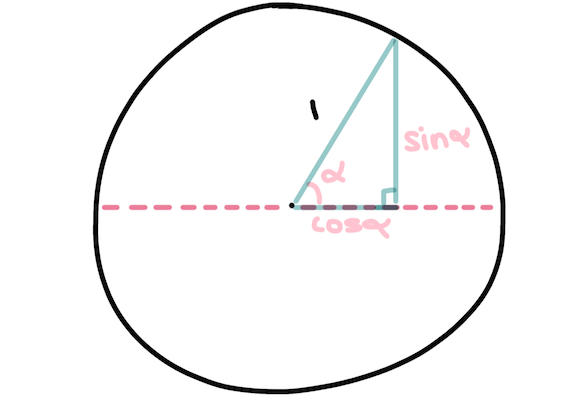
Mathematicians came up with a way to neatly represent sin⁡\sin, cos⁡\cos, and tan⁡\tan of an angle, by inscribing it in a unit circle:

The hypotenuse of the triangle is the same as the radius of the triangle!

Image source: by Harshita Singh Chauhan

Looking at this triangle, we can observe that the hypotenuse of the triangle is the length of the radius of the circle, which is one unit. To find sin⁡\sin and cos⁡\cos in terms of the given angle α\alpha (alpha, the angle in pink), we can use SOH and CAH.

So sin⁡α=opposite1\sin\alpha = \frac{\text{opposite}}{1} and cos⁡α=adjacent1\cos \alpha = \frac{\text{adjacent}}1. In other words, the length of the adjacent side is the value of cos⁡α\cos \alpha and the length of the opposite side is the value of sin⁡α\sin \alpha.

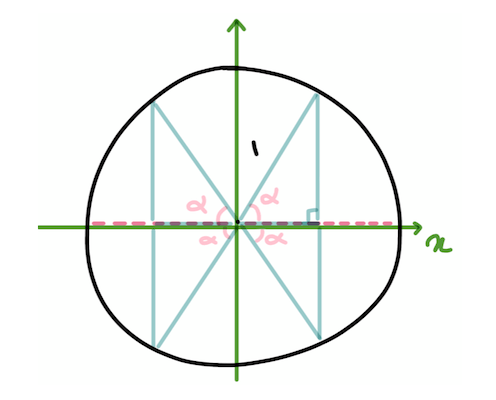
Now if we bring this circle to a cartesian plane, where the radius of the circle is the origin, we will get something like this:

Circle with triangle inscribed on a cartesian plane where the radius of a circle is the origin

Image source: by Harshita Singh Chauhan

With this, we can now say that the coordinates of the point where the triangle in the first quadrant touches the circle is (cos⁡α,sin⁡α)(\cos \alpha , \sin \alpha). With this representation, we can now proceed to find the values of angles that are larger than 9090 degrees or even negative!

So if we want to find the values of sin⁡\sin and cos⁡\cos of the angle 180∘−α180^{\circ} - \alpha, we can consider the triangle in Quadrant II\text{II}. The coordinates of the point of intersection between the circle and the triangle in Quadrant II\text{II} will give us the values of sin⁡\sin and cos⁡(180−α)\cos (180 - \alpha).

Since the angle α\alpha is the same, the values of sin⁡\sin and cos⁡\cos remain the same but since they are on the negative xx side, the value of cos⁡(180−α)\cos (180- \alpha) will be −cos⁡α-\cos \alpha instead of cos⁡α\cos \alpha and since the point is still on the positive yy-axis, sin⁡(180−α)=sin⁡α\sin (180-\alpha) = \sin \alpha.

Now let's think about reflex angles. Try your hand at finding the values of sin⁡\sin and cos⁡\cos of angles in the third and fourth quadrant! Be careful with the signs of the values, and have fun!

Once you've mastered this topic, you can extend it to solving trig equations and inverses!

Interactive · 1 question

The unit circle is a circle with radius 1 centered at the origin of the Cartesian Plane.

In a pair of coordinates (x,y)(x,y) on the unit circle x2+y2=1x^2+y^2=1, coordinate xx is the cosine of the angle formed by the point, the origin, and the x-axis.

Coordinate yy is the sine of the angle.

The tangent of the angle is yx\frac{y}{x}.

Now you try:

What is the sine of the angle formed by the point (12,32)(\frac{1}{2},\frac{\sqrt{3}}{2}), the origin, and the x-axis?

Choose one answer

Video

(Video) Find Cos and Sin Values Using the Unit Circle Hand Trick!

by Paris Mielke

In this video by Paris Mielke, you will learn the hand trick to use the unit circle!

Type a concept, like “slope” or “photosynthesis”.

↑ ↓ to choose · Enter to openSearch explanations and problems