Interactive · 2 questions
What are compass and straightedge constructions?
A (mathematical) straightedge is thought of as an infinitely long ruler with no markings - so that you can connect any two points with a straight line, but you can't measure distances numerically.
A (mathematical) compass is a tool for constructing circles of any radius centered at any chosen point.
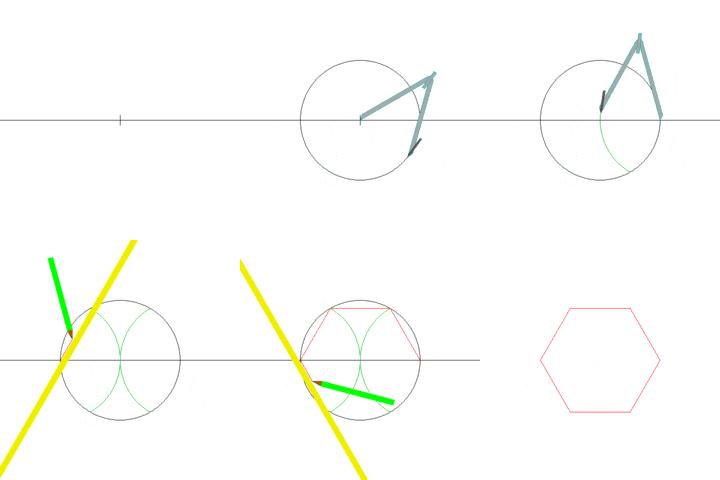
A great demonstration from the Wikipedia page on constructions
There are two types of compasses: collapsible and non-collapsible, the latter of which you can use to copy a radius from one center to another as well, without the compass "collapsing". It turns out that it doesn't matter whether we use a collapsible or non-collapsible compass as far as what things we can construct, so for simplicity we'll assume our compass is non-collapsible.
Which tool would you use to copy a length of a line segment from one line onto another?
Now, let's try to construct the perpendicular bisector of a segment using only a straightedge and compass.
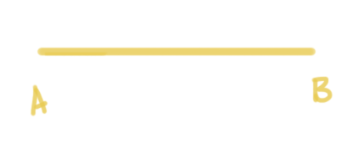
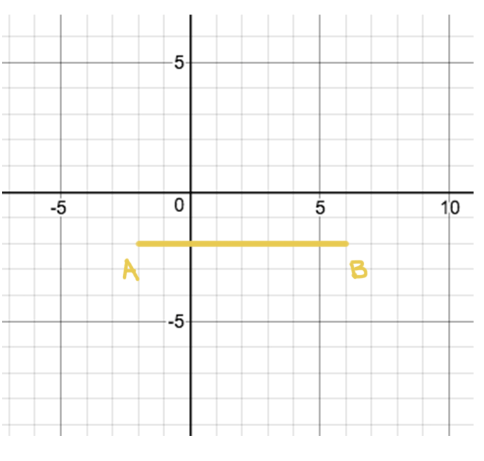
Start with a segment AB:
There's not much we can do here except draw the circle centered at A with radius B and draw the circle centered at B with radius A. Let's draw them both:
Now what can we do to form the perpendicular bisector?
We can use our straightedge to draw a line through the two points of intersection of the two circles:
The perpendicular bisector of AB is the locus of all points equidistant from A and B, and the two points C and D are equidistant because they are the radii of congruent circles! Therefore we can construct perpendicular bisectors using a straightedge and compass.