
Illustrated · 2 min
Electromagnetic waves are the synchronized oscillations of electric fields and magnetic fields. The acceleration of any charged particle can create electromagnetic waves.
In brief, if we want to understand how electromagnetic waves form, we have to look at the change of electric field due to the motion of charged particles. If a charged particle is in motion it will make e different electric filed in vacuum than the electric field which is created due to a stationary charged particle. The electric field due to a stationary charged particle is uniform at a distance r. But the value of electric field due to a charged particle which is in motion is not uniform in all orientations. You will find some denser electric intensity perpendicular to the motion of the particle than the points which stay along with the direction of motion.
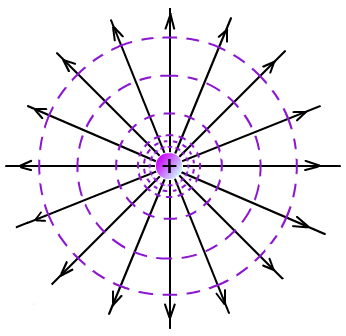
Electric field of a stationary charge particle
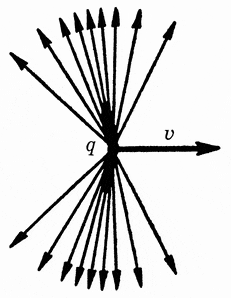
Electric field due to the motion of a charged particle
The electric intensity due to a stationary charged particle is completely different than that of the moving particle. Now if you think to move a stationary charged particle with a velocity v, a distant observer, who measures the intensity of the electric filed of the charged particle won’t suddenly feel the change of the electric intensity due to the motion of the particle. If he is ** ** m away from the particle, he will feel the change of field after 1 second. Wow!! This is the speed of light. So we can claim that the change of electric field due to the acceleration of any charged particle travels with the speed of light. This information not only travels at the speed of light but also this information is light itself.
Now if you decide to stop the particle and again move it and continue do this process, you will get something like the following picture-
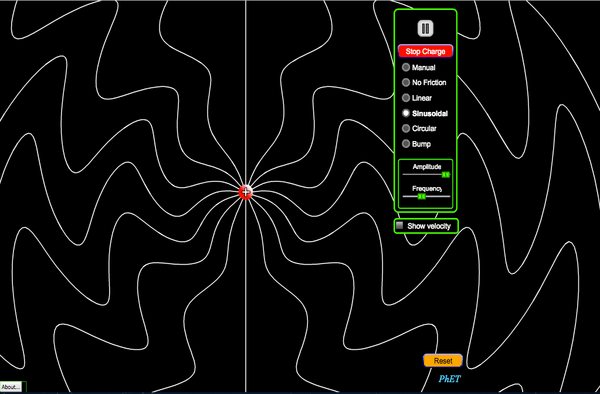
It looks like a wave!!
This oscillation is nothing but the electromagnetic wave where the visible light is one of the sub-sets of the electromagnetic waves.