登记表形式

Interactive · 2 questions

Sets and Roster Form

A set is a collection of distinct objects, and these objects are called elements of the set. These elements can be anything: numbers, shapes, symbols, animals, colors, even other sets. In later lessons, you will learn how to do cool things with sets, like find unions and intersections!

Here is an example of a set of shapes. Notice that each element is distinct, which means there are no repeats.

A set of distinct, different colored shapes. These shapes are within a circular region to indicate that they are members of the same set.

Image source: by Caroline Kulczycky

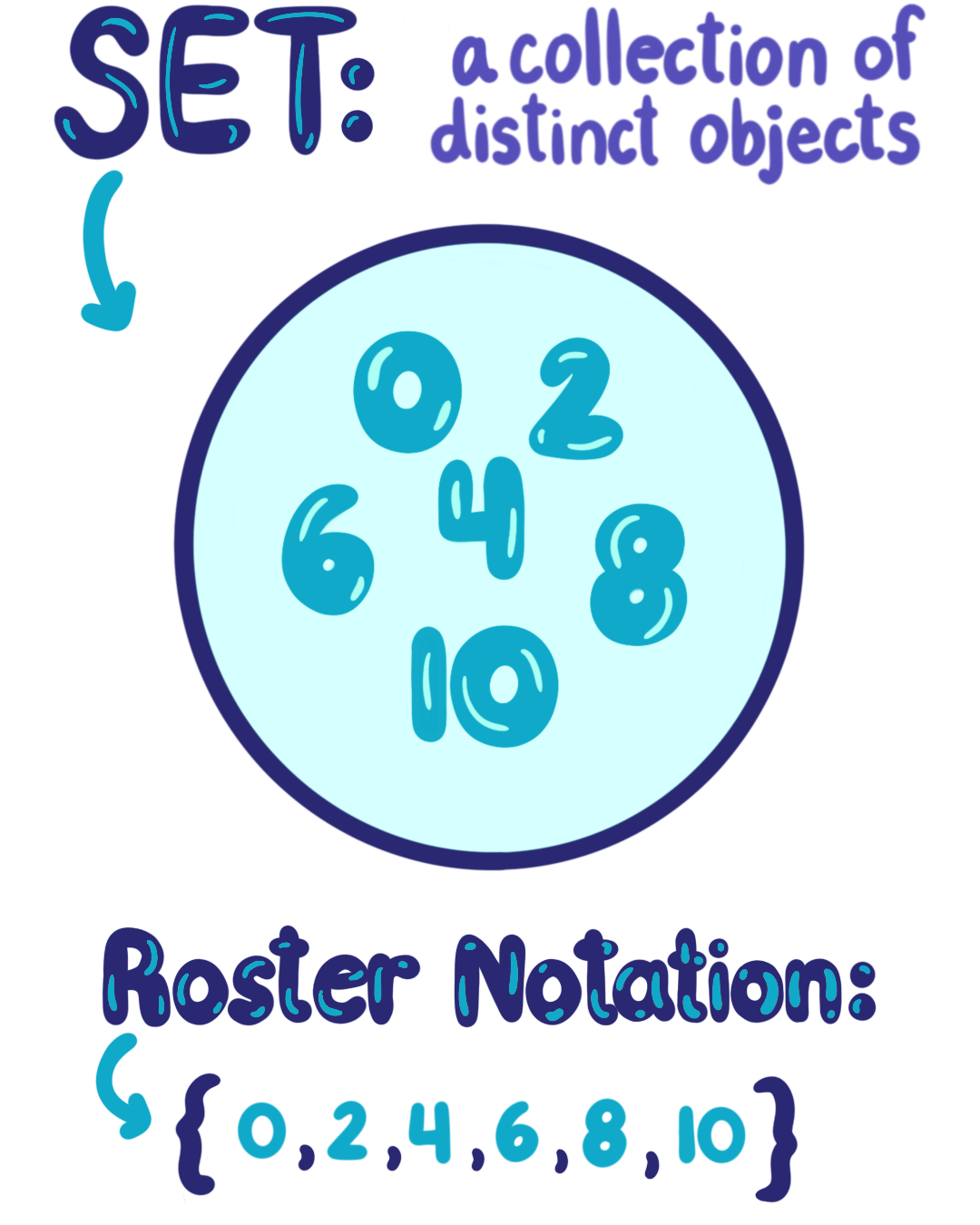
We can also have sets of numbers. Consider the set of even numbers between 00 and 10,10, inclusive. We can represent this set with a picture (like the above picture of a set of shapes), but we can also represent it in a different way: roster form.

To write a set in roster form, all you have to do is list each element of the set, separated by commas, within a pair of curly braces! Let's look at the example above of the set of even numbers between 00 and 10,10, inclusive. Let's call this set S.S. In roster form, we represent SS in the following way: S={0,2,4,6,8,10}S=\{0,2,4,6,8,10\} Each element of SS is included within the curly braces!

A set is a collection of distinct objects. Consider the set of even numbers from 0-10, inclusive. The roster notation is: {0, 2, 4, 6, 8, 10}.

Image source: by Caroline Kulczycky

Note: Sets are unordered, which means that you can write their elements in any order in roster form. Thus, we could have also written: S={10,8,6,4,2,0}S=\{10,8,6,4,2,0\} or S={8,4,6,10,0,2}S=\{8,4,6,10,0,2\} or any other way of ordering the elements of the set. All of these ways of writing SS in roster form are the same! However, when working with numbers, we usually just write the elements of the set in numerical order.

Here are some important sets in roster form: The Natural Numbers: N={1,2,3,4,5,… }The Integers: Z={⋯−5,−4,−3,−2,−1,0,1,2,3,4,5,… }The Even Numbers: {⋯−6,−4,−2,0,2,4,6,… }The Odd Numbers: {⋯−5,−3,−1,1,3,5,… }\begin{align} &\text{The Natural Numbers: } \mathbb{N}=\{1, 2, 3, 4, 5, \dots\}\\ &\text{The Integers: } \mathbb{Z}=\{\dots -5, -4, -3, -2, -1, 0, 1, 2, 3, 4, 5, \dots\}\\ &\text{The Even Numbers: } \{\dots -6, -4, -2, 0, 2, 4, 6,\dots\}\\ &\text{The Odd Numbers: } \{\dots -5, -3, -1, 1, 3, 5, \dots\} \end{align}

In roster form, the ellipses (… )(\dots) mean that the set is infinite. For example, in the roster form of the set of natural numbers, N={1,2,3,4,5,… },\mathbb{N}=\{1, 2, 3, 4, 5, \dots\}, we use ellipses to show that the natural numbers keep going and going after 5.5.

Let's do some examples to practice what you've learned about roster form!

Which of these sets is in roster form? Check all that apply.

Choose all correct answers

Read · 2 min

Sets are one of the fundamental objects in mathematics, under Set Theory. A set is hard to define precisely, so we will give a general idea of what a set is.

A set is a collection of objects. But it is considered to be an object itself. The set can contain any kind of object, such as numbers, or other sets.

One way we can describe a set is by just listing out the elements. For example: S={3,10,208}.S = \{ 3, 10, 208\}. This is a set called SS, and it has the elements 33, 1010, and 208208. The number of elements in this set is 33, so it is a finite set or definite set. We write the elements in curly brackets, and separate the different elements by commas. Sets are unordered, so the order of the elements doesn't matter. Thus, we could have written S={10,3,208}.S = \{ 10, 3, 208\}.

Capital letters and lowercase letters can make unique elements in a set. So, the following set is valid to write: S={M,m,N,n}.S = \{ M, m, N, n\}.

Every element in a set is also unique, so elements can only be in a set once. A set like {1,−2,1}\{1,-2,1\} would be redundant. Usually we say that this set is equivalent to the set {1,−2}\{1,-2\}.

Some sets are infinite. You can show an infinite set using ellipses. For example, we can write T={1,2,3,⋯ }.T = \{1, 2, 3, \cdots\}. The pattern is clear, so we know that this is the set of positive integers. But be careful when using this! The set {1,2,⋯ }\{1,2,\cdots\} is unclear, because there is no commonly used set that this uniquely defines. {1,2,⋯ }\{1,2,\cdots\} could represent the powers of two, the positive integers, or even the set of integers that satisfy some obscure property (like all integers not equal to 4). So, we should always be sure we're using enough elements that we clearly indicate what the pattern is.

Some sets are empty. These are also called null sets. If you have an empty set, you can show it like this: For example, we can write {}\{ \}.

We can also look at subsets. Subsets are a part of a set. So, if we go back to our example with capital letters and lowercase letters, we can see that the subset of capital letters, R, looks like this:

R={M,N}.R = \{ M, N\}.

Only if every element that satisfies the rule for the subset is included in the subset can we call this element a subset or the set. In other words, all capital letters from Set S must be included in subset R. Subsets of sets allow us to more closely examine our set, especially if it's a large set.

If you want to get more fancy with sets, you can explore set-builder notation.

Read · 1 min

Sets, Elements, and Roster Form

A set is a collection of things, called elements. I've used the vague word, "things," because the elements of a set can be whatever we want them to: numbers, words, people, or even sets! We often describe a set by listing its elements and putting brackets around them, for example:

  • {1,3,2,9}\{1, 3, 2, 9\} (read as "the set with elements 11, 33, 22, and 99")
  • {Barack Obama, Joe Biden}\{\text{Barack Obama, Joe Biden}\}
  • {red, orange, yellow, green, blue, indigo, violet}\{\text{red, orange, yellow, green, blue, indigo, violet}\}

(This "list in brackets" format is often called roster form.)


Here are some things we might say about a set, so that you can learn how to talk about a set and its elements:

Let S={1,3,2,9}S = \{1, 3, 2, 9\}. Then SS has four elements. For example, 11 is an element of SS. But 44 is not an element of SS. The set SS also contains 22, but it doesn't contain 55.


Here are a few other things you must know about sets:

  • The order in which we write the elements doesn't matter, so {1,3,2,9}\{1, 3, 2, 9\} is the same set as {1,2,3,9}\{1, 2, 3, 9\}. Because of this, there's no such thing as the "first" or "last" element of a set.
  • It's meaningless to list an element of a set multiple times. For example, {1,3,2,9}\{1, 3, 2, 9\} is the same set as {1,3,2,9,1}\{1, 3, 2, 9, 1\}; both describe the set with elements 11, 33, 22, and 99.

Why are sets defined this way? One reason is because most mathematicians think of sets as the most fundamental mathematical things, and they've found ways to describe everything else (even numbers!) in terms of sets. Because of this, sets are defined to be as simple as possible.

Video · + 1 min read

(Video) Sets and Set Notation

by primethinker

This video by primethinker explains sets and set notation.

Summary\large{\text{Summary}}

What is a set?

A set is a collection of objects.

The objects in the set are called the elements or members of the set. They are groups of numbers when used in math, but they can be groups of any type of object or word.

He then looks at some examples. The first is a bunch of CDs from The Beatles. These CDs form a set and each element is one of the CDs.

If we were asked how many elements are in our set, we just count them. This is the same as asking how many CDs do we have in our Beatles collection.

Sets are generally written in curly brackets. Here are some examples: N={1,2,3,4,5}N={x: x is a counting number less than six}N={red, blue, green, orange, yellow}\begin{align}N &= \{1,2,3,4,5\}\\ N &= \{x\text{: x is a counting number less than six}\}\\ N &= \{\text{red, blue, green, orange, yellow} \} \end{align}

Type a concept, like “slope” or “photosynthesis”.

↑ ↓ to choose · Enter to openSearch explanations and problems