级数:序列求和

Interactive · 1 question

At its core, a series is a sum of terms denoted something like this: S=∑i=1naiS = \sum\limits_{i=1}^{n}a_i This notation means that we are allowing the variable ii to iterate through all values from 11 to nn, resulting in ∑i=1nai=a1+a2+a3+a4+....+an−1+an\sum\limits_{i=1}^{n}a_i = a_1 + a_2 + a_3 + a_ 4 + .... + a_{n-1} + a_{n} so we can essentially think of a series as a sum SS of terms in a sequence {ai}i=1n\{a_i\}_{i=1}^{n}.

Let's look at a concrete example. Consider the series ∑n=1∞1n=11+12+13+14+15+⋯\sum\limits_{n=1}^{\infty}\frac{1}{n} = \frac{1}{1} + \frac{1}{2} + \frac{1}{3} + \frac{1}{4} + \frac{1}{5} + \cdots This is the sum of the terms in the sequence 11,12,13,14,15,⋯ ,\frac{1}{1}, \frac{1}{2}, \frac{1}{3}, \frac{1}{4}, \frac{1}{5}, \cdots, so we're just taking things to the next level here.

Series are some really cool things to investigate, and looking at the behavior of series comprises a large part of higher math. The reason is because we can consider how they behave as we add more and more terms of the series.

Let's look at a sequence of partial sums. True to their name, they are the sums obtained when you only add together part of a series. s1=a1s2=a1+a2s3=a1+a2+a3s4=a1+a2+a3+a4⋯sn=a1+a2+a3+a4+⋯+an\begin{align} s_1 &= a_1 \\ s_2 &= a_1 + a_2 \\ s_3 &= a_1 + a_2 + a_3 \\ s_4 &= a_1 + a_2 + a_3 + a_4 \\ &\cdots \\ s_n &= a_1 + a_2 + a_3 + a_4 + \cdots + a_n \end{align} For example, consider the series ∑n=1∞12n=12+14+18+116+⋯\sum\limits_{n=1}^{\infty}\frac{1}{2^n} = \frac{1}{2} + \frac{1}{4} + \frac{1}{8} + \frac{1}{16} + \cdots In order, the partial sums are 12,34,78,1516,⋯\frac{1}{2}, \frac{3}{4}, \frac{7}{8}, \frac{15}{16}, \cdots As we continue writing out these terms, it turns out that they get infinitely close to 22. Since they are approaching a specific number — 22 — we would call this series convergent (convergent series).

If a series does not end up approaching a specific number, we would call it divergent (divergent series).

Let's consider again the series ∑n=1∞1n\sum\limits_{n=1}^{\infty}\frac{1}{n}. Is it convergent or divergent?

Choose one answer

Video · + 2 min read

(Video) Intro to Series and Sequences

by Eddie Woo

Here is a fantastic video by Eddie Woo where he goes over the basics of sequences and series.

In this video he goes over:

∘ Sets∘ Sequences∘ Series∘ Terms∘ How to Define a Sequence or Series⋅ Show the Pattern⋅ Algebraic Expression⋅ Recursive Definition− Fibonacci Sequence\\\begin{align} &\circ\text{ Sets}\\ &\circ\text{ Sequences}\\ &\circ\text{ Series}\\ &\circ\text{ Terms}\\ &\circ\text{ How to Define a Sequence or Series}\\ &\quad\cdot\text{ Show the Pattern}\\ &\quad\cdot\text{ Algebraic Expression}\\ &\quad\cdot\text{ Recursive Definition}\\ &\quad\quad-\text{ Fibonacci Sequence} \end{align}

Sequences

A sequence adds order into the picture. You can call it an ordered set. Also, we drop the curly braces. Now, these two sequences are different: Descending: 9,7,5,3,1Ascending: 1,3,5,7,9\begin{align} &\text{Descending: }9,7,5,3,1\\ &\text{Ascending: }1,3,5,7,9 \end{align}

Series

A series is the sum of a sequence. In other words, a series is just the addition of all the terms in a sequence.

For example, the series of odd numbers less than ten is: 1+3+5+7+91+3+5+7+9

Terms

One way to describe sequences or series is to talk about their terms. A term is just each individual number. We denote each term with the letter TT and a number. Term 1:T1Term 2:T2nth term:Tn\begin{align} \text{Term }1:&\quad T_1\\ \text{Term }2:&\quad T_2\\ n^{\text{th}}\text{ term}:&\quad T_n\\ \end{align}

This is how we talk about each individual term. But now we need to look at how to talk about the whole sequence or series.

How to Define a Sequence or Series

There are three ways to define a sequence or series: clearly showing the pattern, using an algebraic expression, or using a recursive definition.

1. Show the Pattern

The first method is to just name enough of the terms so that the pattern becomes obvious. You don't have to name all the terms, just enough to get the idea of what is going on. Suppose we want to list the odd numbers under 100. We would write: {1,3,5,7,⋅⋅⋅,97,99}\{1,3,5,7,\cdot\cdot\cdot,97,99\} This would be enough to show the pattern. The dot dot dot expresses that this pattern continues up to 97.

2. Algebraic Expression

You can sometimes use a general algebraic expression to describe the nthn^{\text{th}} term of a sequence or series.

For example, say we wanted to find the sequence of even numbers. If we wanted to just show the pattern we would write: 2,4,6,⋅⋅⋅2, 4, 6, \cdot\cdot\cdot 2,4,6,⋅⋅⋅↑↑↑T1T2T3\begin{array}{cccc} 2,&4,&6,&\cdot\cdot\cdot\\ \uparrow&\uparrow&\uparrow\\ T_1&T_2&T_3 \end{array} What would the nthn^{\text{th}} term be? There's a very obvious pattern between nn (the number of the term) and the term itself. The term itself is just double whatever number of the term you're up to. So in this case we could express the sequence as: Tn=2nT_n=2n This is a general algebraic expression because it defines every single term.

Here's another example. Tn=n2⟹1,4,9,⋅⋅⋅T_n=n^2 \Longrightarrow 1, 4,9,\cdot\cdot\cdot

Illustrated · 1 min

Series

Oftentimes, students mix up the concepts of "series" and "sequence". You can think of "series" as an extension of "sequence".

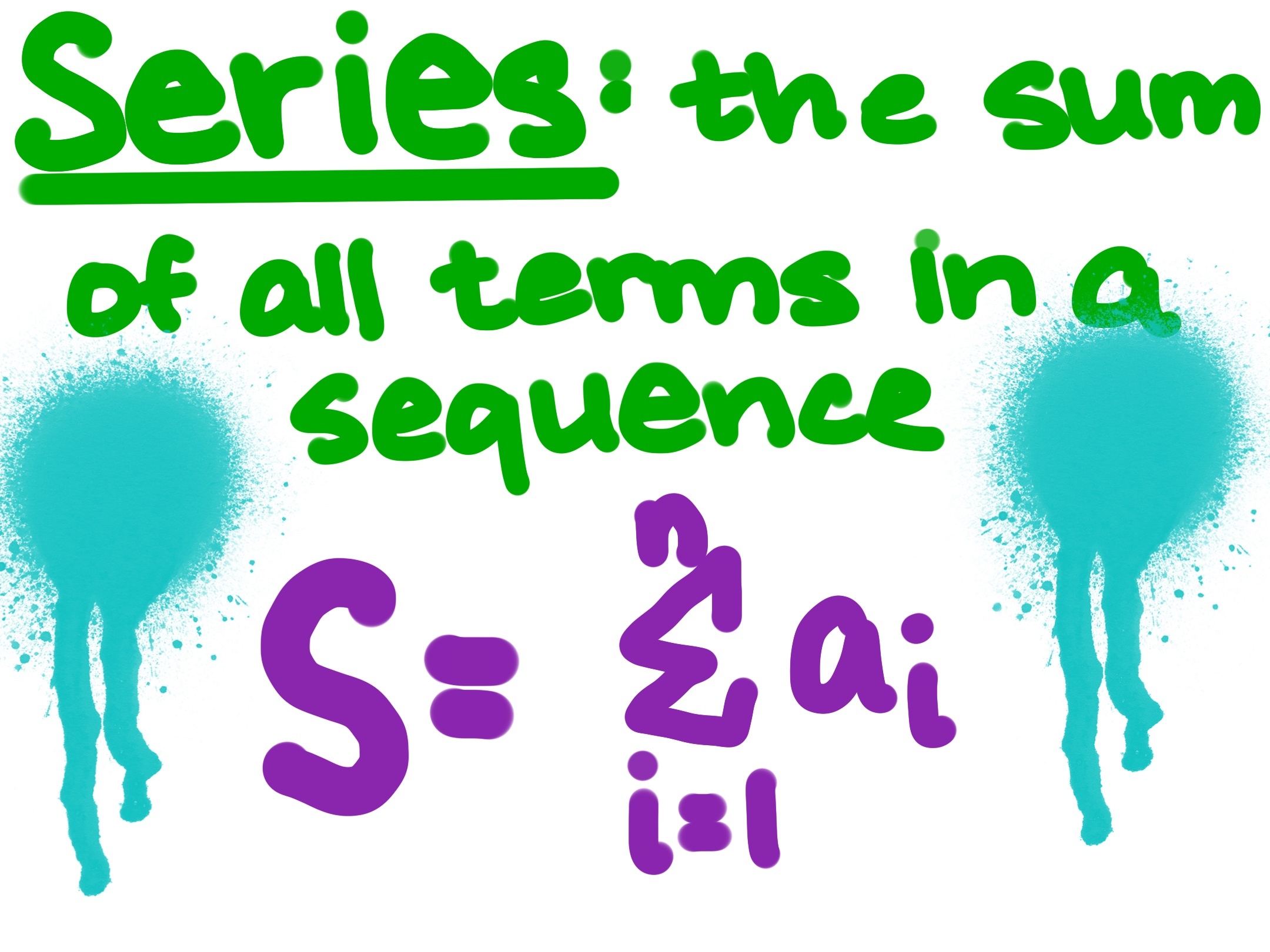
Series: the sum of all terms in a sequence
[the series formula]

Image source: by Anusha Rahman

A sequence is a list of numeric terms that follow a pattern. A series is the sum of the terms in a sequence. We can use summation notation to mathematically write out series.

So, given the following sequence: 3,6,9,12,153, 6, 9, 12, 15,

we can calculate that the finite series is: 3+6+9+12+15=453 + 6 + 9 + 12 + 15 = 45.

####Looking Further

In the next lesson, we will learn a shortcut to evaluate series by adding. At the end of this section, we'll cover a really fun topic: triangular numbers!

In math, we can also have an infinite series, which is the sum of all terms in an infinite sequence. This concept gets into more complicated math that we don't know quite yet, but keep an eye out!

Video

(Video) What is a Series?

by PatrickJMT

In the above video by PatrickJMT he explains the concept of a series. It is important to understand what a sequence is first, before attempting to understand what series are.

Type a concept, like “slope” or “photosynthesis”.

↑ ↓ to choose · Enter to openSearch explanations and problems