质因数分解

Video · + 1 min read

(Video) Prime Factorization

by mathman1024

This video by mathman1024 covers prime factorization.

Summary\large{\text{Summary}}

A prime is a number with only two distinct factors: 11 and itself. In other words, it only has two numbers that can divide into it evenly which are 11 and itself.

A composite is a number with more than two distinct factors.

Let's list the factors of the number 1212. These are the numbers that can divide evenly into 1212. 1,2,3,4,6,121,2,3,4,6,12 The number 1212 has more than two distinct factors, therefore we can say it's a composite number.

Let's look at the number 77 now. 1,71,7 The only numbers that go into 77 evenly are 11 and itself. Therefore, 77 is a prime number.

The number 11 is a special case. It is neither prime nor composite.

Prime factorization is when you break a number down into its prime factors.

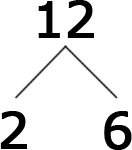
Let's find the prime factorization of the number 1212. One way to do these is to make a factor tree. We start by putting 1212 at the top and creating two branches for two factors of the number. For the number 1212 we can choose 33 and 44 or 22 and 66. Let's choose 22 and 66.

12 branching off to 2 and 6.

Now, we continue branching until all the numbers are primes. Since 22 is a prime number, we're done with that branch. 66, on the other hand, is not a prime, so we have to factor that one.

The 6 branching off to 2 and 3.

Both branches of the 66 are prime numbers so we are done with our prime factorization. You just take the digits at the end of each branch and they are your answer. The prime factorization of 1212 is: 12=2⋅2⋅312=22⋅3\begin{align} 12&=2\cdot2\cdot3\\ 12&=2^2\cdot3 \end{align} You do not have to write it using exponents but it is usually a good idea to do it, especially when the numbers get larger.

Try finding the prime factorization of this next number on your own. Then, watch the video to see the answer!


  1. 5454

Stretch your creativity

Contest problems rarely look like the examples you studied. Solving one means finding your own way in. These are real problems from the AMC 8, AMC 10, AMC 12 and AIME, the national math competitions for middle and high school students, each with a worked solution on LIVE by Po-Shen Loh.

Read · 1 min

As you may already know, a number can have a lot of factors. A bunch of factors multiplied together to represent a number is called factorization.

What is Prime Factorization?

Well prime factorization just a unique way of showing the factorization of a number-by reducing the number into a series of only prime numbers multiplied together.

Let's take the number 6060. A random factorization of 6060 could be 2×3×102\times3\times10 or 5×4×35\times4\times3. However the prime factorization of 6060 would be 2×2×3×52\times2\times3\times5 (Note how 22, 33, and 55 are all prime).

By convention, the prime factors are written in numerical order and common factors are expressed as exponents.

Finding Prime Factors

One way is to divide the number by prime factors until you are left with a prime number. Personally, I start dividing by the lowest prime factor each time and work my way up.

Instead of me explaining through text all the time, let us do one example. We have the number 6060. To find the prime factorization of 6060 we start off by looking at the smallest prime 22.

Is 6060 divisible by 22? Yes. So 22 is a prime factor of 6060. Then we divide 6060 by 22.

Now we have 3030. Again we have to check 22 because a prime factor can be counted more than once.

Is 3030 divisible by 22? Yes. So 22 is a prime factor of 6060. Then we divide 3030 by 22.

Now we have 1515. After checking 22 again, we find that 22 is no longer a factor so we go onto the next prime 33.

Is 1515 divisible by 33? Yes. So 33 is a prime factor of 6060. Then we divide 1515 by 33.

Now we have 55. Since 55 is already a prime number we are done.

Multiplying the prime factors we obtained previously, we have 2×2×3×5=22×3×52\times2\times3\times5=2^2\times3\times5.

Interactive · 1 question

Before we begin with prime factorization let's review the concepts of prime numbers and factoring.

Factoring is a way to break a number down by finding smaller numbers that can be multiplied together to get that number. i.e. 33 and 1212 can be multiplied together to get 3636 so they are factors of 3636.

Prime Numbers are numbers that only have two factors, one and itself i.e. the only factors of 77 are 11 and 77 so seven is prime.

When we are asked to find the prime factorization of a number we are being asked to break a composite number down into only prime numbers. This is done by finding a factor pair of the given composite number and then factoring that factor pair until we are left with only prime numbers.

I like to use a visual called a factor tree to help me find all of the prime factors of a number. Below, I used a factor tree to find the prime factorization of 3636.

A tree with 36 at the top. It branches out to 6 and 6. Each 6 branches out to 2 and 3.

Image by Caroline Kulczycky

At the top of the tree is the number we are given, in this case 3636. Next, we find a factor pair. I chose to use 66 and 66. Since six is composite, we must find the factors of six. The next factor pair is 22 and 33. Since both 22 and 33 are prime, we can not factor anymore. Thus, the prime factors of 3636 are 2,2,3,32,2,3,3.

A tree with 36 at the top. It branches out to 6 and 6 (since 6*6=36). Each 6 branches out to 2 and 3 (since 2*3=6). the 2s and 3s at the bottom are highlighted.

Image by Caroline Kulczycky

We can check if we have the correct prime factorization by multiplying all of the prime factors together; if the product is the original number then you are done and you found all of the prime factors. Indeed, in our example, 2×3×2×3=22×32=36.2 \times 3 \times 2 \times 3 = 2^2 \times 3^2 = 36.

Try it! What are the prime factors of 7272?

Choose one answer

Type a concept, like “slope” or “photosynthesis”.

↑ ↓ to choose · Enter to openSearch explanations and problems