
Illustrated · 6 min
+1 contributors

Obviously, the geologic time scale is just a scale of all time on Earth.
Okay, maybe there's a little bit more to it than that. The devil is in the details. There is more to learn. The geologic time scale is a useful tool that geologists use to categorize and compare different eras of time. And in order to use this tool, one first has to understand it. After all, let's say you get hired for some job, only to have your boss ask for the definition of a supereon (hint: nobody knows for certain).
See, the geologic time scale was first invented by William Smith (Not that one), who is now regarded as the "Father of English Geology". William Smith was an amazing pioneer of the relatively new field of geology. He had created the first geologic map of the entirety of Britain. He never received credit during his lifetime, because he was never formally educated, but that didn't stop him from achieving amazing things. And one of his achievements was an offhand observation of stratifications, namely, they seemed to be in bands. His map established the fact that fossils, and therefore organisms, could be grouped into distinct periods of time.
I have been throwing around a few words a bit carelessly. Up above, I used the words "era" and "period". It turns out these words have precise definitions in the field of geology. Let's get that out of the way.
There are 5 main distinctions of geologic time: the eon, era, period, epoch, and age. These are in order from largest to smallest, or least to most specific. In other words, the eon is the longest period of time. There have only been four: the Hadean, Archean, Proterzoic, and Phanerozoic. If you look a time line (and there are many), you may notice that the divisions of time get progressively shorter, yet you probably haven't heard of the Archean eon. This is because more and more important things happen faster and faster. There are two key things to remember for geology: geologic time dwarfs and sense of scale you may have (a billion years? How long is a billion years? Probably somewhere around a million), and two: information and developments speed up by an order of magnitude every time. The last 10 years have probably impacted Earth as much as the entire Hadean eon (unless you count the Late Heavy Bombardment, a period of violence so heavy and vigorous, the only evidence of this period comes from the Moon).
Speaking of the Late Heavy Bombardment, this event happened near the end of the Hadean and in fact bleeds into the next eon. What eon is it also a part of?
What's with all of the "-zoic" endings? It just means animal, so the Protoerzoic means "earlier animal", the "animal" here just referring to all complex life on Earth. Why might the development of animals start at the third eon, and why might it be important enough to warrant its own eon?
There are, in fact more divisions of time, most achieved through just adding an affix. For example, a supereon is a period of time larger than an eon. There is only one--the Precambrian--which is demarcated by the first formation of Earth and ends the Cambrian Explosion, when life on Earth suddenly proliferated orders of magnitude faster than ever before. For some, reason the beginning of life (known as the Abiogenesis event), does not have its own boundary, although, I have seen this great article.
There are other geologic divisions. The geon, ("g[eologic ]eon") or Geon is usually defined as the average length of an average period of time, which is precisely 100 million years, defined backwards from now. Therefore, the start of Earth is located at 45 Geon. Another unit is the chron, which is very closely related, in that both are averages. The chron is a generic word for any defined period of time that shares some common characteristic. It also happens to the amount of time between two magnetic reversals (not the "World go BOOM!" commonly touted), so keep an eye out.
Remember that Cambrian Explosion? It happened around 540 million year ago. What Geon is this?
The main things to remember are all of the eons, eras, and periods, and what they mean and represent. The others are important, too, but not to the same degree. We will talk about almost every nitty-gritty geologic event and groundbreaking period in some other article. For now, continue for some extraneous notes.
So time can be divided up [insert generic word meaning interval of time]s. The point is...?
Suppose I am an up-and-coming geologist. Who happens to be living in the 19th century. Now I have a problem, how do I communicate with others about exactly when something occurred. Just saying 3.2719 million years ago doesn't exactly give me context, nor can I possibly be so exact. I need some sort of chron (remember? any period of time that shares a common characteristic) marker. Thus, the geologic time scale was born.
And what do all the intervals represent? They represent the start of something new, or perhaps the dominance of one particular trait or organism.
And so, without further ado, here is the full geologic time scale (as of 2015):
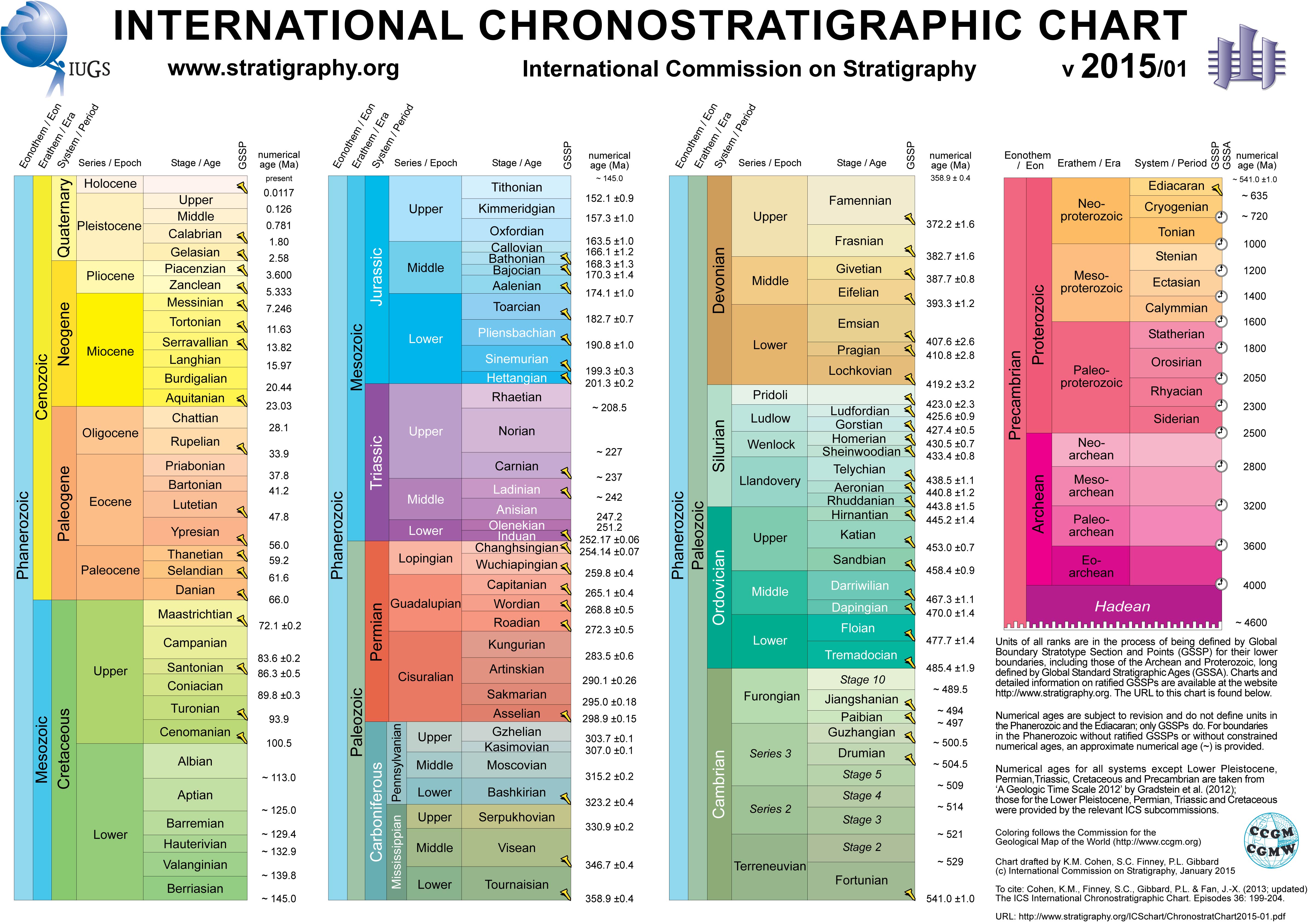
From the International Commission on Stratigraphy. I think it's just slightly too large.
And this isn't even complete. There are numerous events in Earth' history inside each of these events, but we cannot possibly list every single small event in the history of the world that impacted some small area of the world. For one, there are no glaciations here, despite the fact that I could literally stick a pencil on the left side of this chart and touch a glacial period.
Another observation is how international the diagram is. Do you love America? Let's name two stages after one single part of a single basin in the US (Roadian and Wordian, in the Permian)! Or maybe you lean more towards China. Don't worry! We have the Furongian, which also contains the Jiangshanian and the Paibian (along with some unnamed Stage 10). Sweden? Some random Flo Parish gets the honor of the Floian Age in the Ordovician.

Who keeps track of this chart? Well, the chart says the International Commission on Stratigraphy. This is usually abbreviated to the ICS. The ICS is in fact part of the International Union of Geological Sciences, or IUGS. The chart is updated nearly every year, and keeps track of the latest developments in the geologic time scale. What developments? See the Cambrian, for example. There are unnamed Stage 2s and unnamed Series 3s. And this is just the tip of the iceberg, because the ICS has plans to include the aforementioned glaciation periods, and some "local" geologic events, like the formation of the Himalayas.
Finally, if you're wondering about the headings up there that say "Eonothem/Eon" or "Stage/Age", don't worry. Those are just the stratigraphical terms for the same thing. They are literally perfect synonyms and are almost interchangeable, so you do not need to worry.