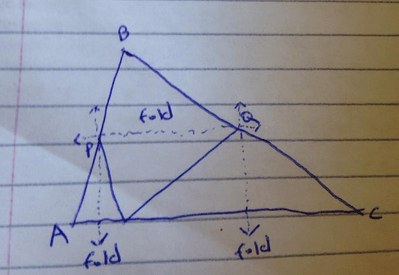
Congratulations! We have now proved that the sum of the angles of a triangle is 180 degrees. Or have we?
There are two or three things that might worry us if we think hard about this supposed proof. First of all, if it works at all it only works for the one triangle that we cut out of the paper. It does not say anything about all the other triangles that we might have cut out instead. Of course, if we try it for three or four different triangles and it works for all of them, we might suspect that it will always work. But it is hard to be sure. Maybe the triangles that we tried were special in some way! And however many we did try there would always be infinitely many more that we did not.
But, secondly, can we be certain that the proof works even for one triangle? Surely we would have noticed if there was a gap of 10 degrees when we fitted the angles together. But would we have noticed a gap of 1 degree?? Of 101 degree? Of 1001 degree? The best we could say would be that the angles added up to 180 degrees within the limits of accuracy of our observation. Moreover, even if the angles seemed not to fit together properly, we would be unlikely to conclude that the theorem that the angle sum is 180 was wrong. Instead, we would look for some other cause of error: for instance, we might wonder whether we had really cut the sides straight. This is rather mysterious, since it suggests that we have some idea in our head of an "ideal" triangle, to which the paper triangle is just an approximation. So how could approximate results about approximate paper triangles ever prove exact results about these "ideal" triangles?
A third question might also worry us. How does we know that the angles of the triangle do not change when we fold the paper over? The whole proof depends on the assumption that the angles A, B, and C are the same when they are sitting at the three corners of the triangle as they are when they are folded to the center. Of course this seems reasonable (as long as we do not tear the paper); but it would not be so reasonable if the paper was replaced by a sheet of gum (a sheet of gum...?). It seems an unavoidable conclusion that to our idea of an "ideal" triangle we must add the idea of an "ideal motion" or congruence of such a triangle, moving it from one place to another while preserving lengths and angles.
Even to formulate questions of this kind is a considerable achievement, and it is natural that when we first study geometry we do not worry to much about them. Certainly the ancient Egyptians, who as far as we know were the first people to "do geometry," seem not to have been concerned by them. It is often said that, in Egypt, geometry met the need for an accurate surveying system whereby the ownership of land in the fertile valley of the Nile could be traced after boundary markers had been washed away by the annual floods, and this is perhaps confirmed by the literal meaning of the word "geometry," which is "earth measurement." The historian Herodotus relates that in 1300 BC "if a man lost any of his land by the annual overflow of the Nile, he had to report the loss to Pharaoh who would then send an overseer to measure the loss and make a proportionate abatement of the tax."
If we want to make progress, though, we must eventually face questions like those raised above, and the first people to do this seem to have been the Greeks. They made two vital contributions to geometry. The first is that they made geometry abstract. For the Egyptians, a "line" perhaps meant the line of a stretched cord, a "point" a peg in the ground. Greek thinkers took seriously the fact that no physical peg or pencil mark can ever be more than an approximation to what we mean by a point (for it will always have some size) and similarly no physical cord can ever be more than an approximation to what we mean by a line (for it will never be completely straight). They introduced the idea of considering "idealized" points and lines, inhabitants of some abstract space to which our physical space merely aspires. The laws of geometry apply with perfect accuracy only to this idealized world; there is always some approximation involved in applying them to messy physical reality. In the language of modern applied mathematics we might say that geometry provides "mathematical model" which can apply with greater or lesser accuracy to a given physical situation. The Greek philosopher Plato (circa 400 BC) put the emphasis rather differently. "The objects of geometric knowledge are eternal," he wrote; "geometry compels us to contemplate true reality rather than the realm of change."
But how were we to obtain any information about this idealized world? The Greeks had an answer to this question, and that answer was their second great contribution: they made geometry deductive. The way to find out about geometric truth, they said, was to build up our conclusions systematically on the basis of unquestionable premisses or axioms. Starting from things which nobody could deny, and basic laws of thought, they would reason and prove their way towards previously unguessed knowledge. This whole process was codified by Euclid around 300 BC, in his book the Elements, the most successful scientific textbook ever written. Euclid, who was a teacher at what we might now call the University of Alexandria, brought together many of his own and his predecessors' results in this wonderful book. In it, on the basis of five "postulates" and five "common notions," he deduced step by step the whole of geometry as it was known in hi day. Euclid's work was so successful that for hundreds of years it was regarded as the supreme example of human reasoning. Philosophers who wished to commend the rationality of their systems of thought used to say that they were built up more geometrico—in the (Euclidean) geometric manner.
Here is an outline of the way Euclid's deductive system worked. He began with two kinds of fundamental concept:
- Undefined terms are things like "point," "line" and so on. These are the basic building blocks of geometry. Obviously we cannot define everything so we have to begin somewhere, and it is only sensible to begin with the most basic and elementary terms.
(With regards to the statement "obviously we cannot define everything," perhaps it's not so obvious. At any rate, it appears that Euclid himself tried to define everything. The first definition in the Elements says, "A point is that which has no parts." But what is a part? Euclid doesn't say, and since he makes no further mention of the concept in this context, he leaves the term "point" practically undefined.)
- Axioms (also known as postulates) are the basic assumptions about the terms of geometry. For instance, "Through any two points there is exactly one line." A more famous example is the "parallel axiom." Given any line L and any point P, there exists exactly one line through P parallel to L.
From this starting point he went on to build up systematically:
-
Defined terms such as "isosceles triangle:" an isosceles triangle is defined to be one that has two sides of equal length.
-
Theorems such as "The base angles of an isosceles triangle are equal" or "The perpendicular bisectors of the sides of a triangle meet at a point." Each theorem has to be accompanied by a proof, which gives the reason why it is true in terms of previous definitions, theorems, and axioms.
(Theorems are also known as propositions, corollaries, or lemmas, among other things. There is a slight distinction among these terms: theorems are really first-class results, propositions are more run-of-the-mill, corollaries are subsidiary results easily deduced from a theorem. Which name you use for any particular result is large a matter of taste).
A deductive system of this kind is also known as an axiomatic system. Euclid's work has had such influence that some would say mathematics is nothing more than the axiomatic systems.
The force of the axiomatic method is this: if we believe the axioms, we have to believe the theorems too. There is an amusing illustration of this principle in John Aubrey's Brief Life of the philosopher Thomas Hobbes (1588-1679):
"He was 40 yeares old before he looked on Geometry; which happened accidentally. Being in a Gentleman's Library, Euclid's Elements lay open, and 'twas the 47 libri 1. He read the Proposition. By G—, sayd he (he would now and then sweare an emphaticall Oath by way of emphasis) this is impossible! So he reads the Demonstration of it, which referred him back to such a Proposition; which proposition he read. That referred him back to another, which he also read. Et sic deinceps [and so on] that at last he was demonstratively convinced of that trueth. This made him in love with Geometry."
(The "'twas" in the above quote refers to Euclid's proof of the theorem of Pythagoras.)
Here is the deductive method working to perfection; Hobbes believes the axioms, and so (eventually) he has to believe the theorems too. But why should he believe the axioms? It is possible that the old geometers would have answered that you "just see" that they are true. But eventually this simple point of view had to be modified, and some modern mathematicians would say that the axioms are no more than "rules of the game;" we can change them if we want, but then we are playing a different game. What do you think?
In these posts on Geometry we will follow the Greek deductive method. However, the axioms we use will be slightly different from Euclid's. Our axioms are designed to build on our knowledge of algebra, which is a subject of which the Greeks knew very little. By using this knowledge, we can make more rapid progress than Euclid did: he more or less had to invent some parts of algebra as he went along.
Hobbes, incidentally, would not have approved. Aubrey goes on:
"He would often complain that Algebra (though of great use) was too much admired, and so followed after, that it made men not contemplate and consider so much the nature and power of Lines, which was a great hinderance to the Groweth of Geometrie; for that though algebra did rarely well and quickly, and eaisly in right lines, yet 'twould not bite in solid Geometry."
The algebra that Hobbes might have been looking for which will 'bite' in solid geometry is of course the algebra of vectors. We will develop vector algebra in these posts.
There are two ways of looking at vector algebra. One way is to see its rules as convenient summaries of geometrical facts which have been proved by Euclidean methods. The other is to regard its rules as fundamental axioms in themselves, and derive the rest of geometry from them.