Word Problem: Example
You are a contractor for the city, and you have been asked to find the quadratic equation of an arch in one of the city parks. You only know the width of the base and the height. The base width is 40m, and the height is 30m.
Find the equation of this arch.
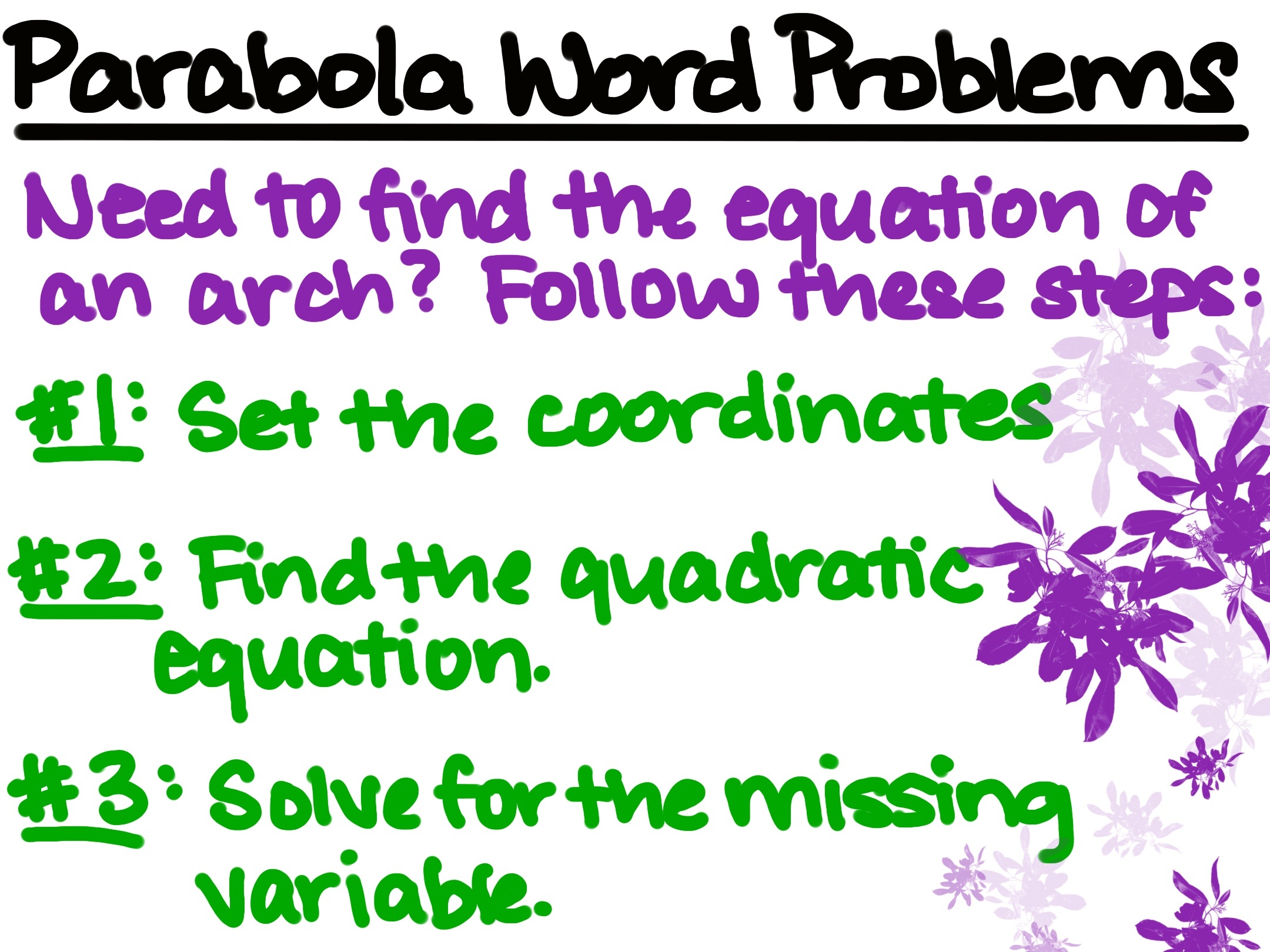
There are two main steps to tackle this type of problem. First, you are going to set the coordinates of the arch. Second, you will plug in the known values into an equation to solve for the missing values.
Let's first establish what we know. We know that since this is an arch, it will follow a parabolic shape. That means that we will use a form of the quadratic equation. Since the arch is parabolic, we also know that it has a vertex and is symmetrical.
Step 1: Set Coordinates
To make this problem easy to handle, we will set the vertex of the parabola. Since the vertex is at the parabola, we know that the y-intercept is dissecting the parabola (cutting it in half).
Therefore, the vertex is at the coordinates (0,30).
The base of the entire arch is 40m, and we know that the y-axis splits the parabola in half. Therefore, the distance between each leg of the arch and its axis of symmetry is 20m.
We can conclude that the x-intercepts are: (20,0) and (−20,0).
That's a lot more information that we had before!
Step 2: Find the Quadratic Equation
Now that we have all of this information, we can plug in what we know into the quadratic equation. We will use intercept form. We know the x-intercepts, so let's see what our equation looks like.
y=a(x−20)(x+20)
Because the parabola is upside down (it's an arch!), we know that a will also be negative. We can plug in the vertex as our point in order to solve for a.
30303040−3=a(0−20)(0+20)=a(−20)(20)=a(−400)=a
We have confirmed that a is negative! Let's look at what our simplified quadratic equation for the city's arch is:
y=40−3(x2−400)