Interactive · 5 questions
+2 contributors

Induction (Part 1)
Table of Contents of the induction series :
So, what is induction?
You might wonder, what is induction?
This is what induction is :
A type of mathematical proof used to establish a given statement for all (or some) positive integers.
It consists of steps :
. Establishing the base case.
. Inductive Step.
I can hear you screaming. What is base case? What is the inductive step. I'll explain these in a moment.
Analogy
Here's a simple analogy :

A row of dominoes. Image credits to wikipedia.
Consider a row of dominoes, when you push the first domino, what will happen?
That's right, then when the second domino fall, what will happen?
That's correct. This process continues until the last domino fall.
This is very like induction. But instead of pushing dominoes, you're proving statements. You prove it for the first case (or the so-called base case) and then prove that if you prove it for some case, then the next case is true. (the inductive step)
Now that you know what induction is, we'll look in detail what the base case and inductive step is.
Base Case
So, what is base case? Let's assume you want to prove a statement involving a positive integer holds for all , where is some integer.
Now, the base case is usually the statement for . So, you usually want to start your induction by proving the statement for .
Now, we look at the inductive step.
Inductive Step
Prove that if a statement holds for some positive integer , then it holds for . (This is the "usual" inductive step)
Some of you might be dizzy or discouraged after seeing this seemingly complicated explanation. That's why I'll continue with a simple example to show the power of induction.
Prove that for all positive integers ,
.
I believe most of you have seen this identity before, but if you haven't, try to prove it (with or without induction). There's a nice proof without words. (Which I will demonstrate after the proof by induction)
What should we start with?
We start with the base case.
The base case is true since .
So, what should be our next step?
Next, we proceed with the inductive step.
In the inductive step, we'll have to make use of the inductive hypothesis, which is the truth of the statement for .
Our strategy is to proof the statement when given that the statement is true for . (the statement for is called the induction hypothesis.) Note that this assumption can be made because by the base case, the statement is true for , and thus, we can assume that the statement is true for , and we use it to prove the statement for . Continuing this process, we prove the statement for , , and thus, we can prove it for all natural numbers. (Note : The base case not neccesarily equals , it may equal to other integers.)
Now you should see the power of induction, and this is why induction works.
So, let us assume that the statement is true for , i.e.
.
We'll prove that the statement is true for , i.e.
.
Indeed,
, as desired.
This works like magic, isn't it? So, what have we learnt from this example?
To prove a statement, we have to
But wait, I did promise a proof without words solution for the statement, so take a look below :
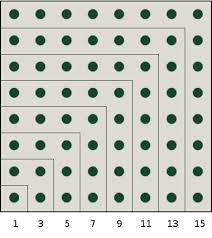
Proof without words of the statement.
Fascinating, isn't it?
Practice makes perfect, so try out these simple induction exercises to make sure you understand this material.
Prove that for all positive integers ,
-
.
-
.
-
.
That's all for this part. We'll look into more induction in the next part.