বহুুপদীর যোগ

Before this, knowএকপদীর যোগ ও বিয়োগ

Read · 1 min

Adding Polynomials

In order to add polynomials together, add together the coefficients of terms with the same exponents. You'll also add constants (terms without variables) together.

Let's take a look of adding polynomials:

(x2+3x−9)+(2x2−4x+3)+(−7x2−6x+2)(x^2+3x-9)+(2x^2-4x+3)+(-7x^2-6x+2)
=x2+3x−9+2x2−4x+3−7x2−6x+2=x2+2x2−7x2+3x−4x−6x−9+3+2=−4x2−7x−4\begin{align} &=x^2+3x-9+2x^2-4x+3-7x^2-6x+2\\ &=x^2+2x^2-7x^2+3x-4x-6x-9+3+2\\ &=-4x^2-7x-4 \end{align}

A reliable step-by-step approach to adding polynomials together is to:

  1. Remove the parentheses and distribute the "++" sign (essentially, you are distributing a positive 11) (OR distribute the "−-" sign)
  2. Rearrange the equation so that like terms are near each other
  3. Add the like terms together

Now that you've learned how to add single-variable polynomials, you can learn how to add multi-variable polynomials!
Interactive · 2 questions

Adding polynomials is pretty straightforward; add the coefficients of corresponding terms. For example: (3x2+5x−2)+(4x2−6x+10)=(3+4)x2+(5−6)x+(−2+10)=7x2−x+8\begin{align}&(3x^2+5x-2)+(4x^2-6x+10)\\&=(3+4)x^2+(5-6)x+(-2+10) \\&= 7x^2-x+8\end{align}

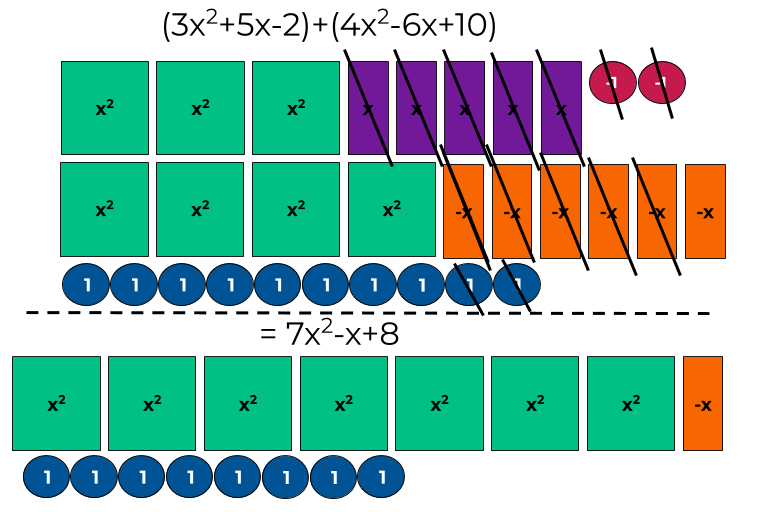
Now, let's look at a model:

model of 
(3x^2+5x-2)+(4x^2-6x+10) = 7x^2-x+8

Image source: by Zora Gilbert

We see a similar idea when we subtract polynomials.

Now, let's do some practice of adding polynomials:

What is the sum of (x3+5x−6)+(5x2+6x+10)(x^3+5x-6)+(5x^2+6x+10)?

Choose one answer

Video

(Video) Adding and Subtracting Polynomials

by PatrickJMT

This video by PatrickJMT shows how you add and subtract polynomials.

Summary\large{\text{Summary}}

First, we need to combine like terms. Let's look at an example to see this. Suppose we want to add: (x2+4x+5)+(6x+3)(x^2+4x+5)+(6x+3)

First, we distribute anything outside the parentheses inside. Since there's nothing, we can drop both sets of parentheses. (x2+4x+5)+(6x+3)=x2+4x+5+6x+3\begin{align} &(x^2+4x+5)+(6x+3)\\ &=x^2+4x+5+6x+3 \end{align}

Next, we want to group the like terms together. Recall, like terms have the same variable and same exponent. x2+4x+5+6x+3=x2+(4x+6x)+(5+3)\begin{align} &x^2+4x+5+6x+3\\ &=x^2+(4x+6x)+(5+3) \end{align}

Then, pull out the variables. In (4x+6x)(4x+6x), both have an xx so we can pull it out. x2+(4x+6x)+(5+3)=x2+(4+6)x+(5+3)\begin{align} &x^2+(4x+6x)+(5+3)\\ &=x^2+(4+6)x+(5+3) \end{align}

Finally, add the coefficients. x2+(4+6)x+(5+3)=x2+10x+8\begin{align} &x^2+(4+6)x+(5+3)\\ &=x^2+10x+8 \end{align}

Type a concept, like “slope” or “photosynthesis”.

↑ ↓ to choose · Enter to openSearch explanations and problems



