বহুপদীর বিয়োগ

Before this, knowএকপদীর যোগ ও বিয়োগ

Interactive · 1 question

Subtracting Polynomials

First, let's subtract the coefficients of terms with the same exponents.

Be careful when distributing the "-" sign through each polynomial in the equation. Recall the rules for multiplying negative numbers!

Let's look at an example:


(2x^2 + x - 4) - (2x^2 - 5x + 3) - (-4x^2 + 3x - 1)

(Step 1: Remove the parentheses and distribute the "-")
= 2x^2 + x - 4 - 2x^2 + 5x - 3 + 4x^2 - 3x + 1 

(Step 2: Rearrange the expression so like terms are together)
= 2x^2 - 2x^2 + 4x^2 + x + 5x - 3x - 4 - 3 + 1

(Step 3: Subtract)
= 4x^2 + 3x - 6

Image source: by Hannah Bonville

Let's practice. Subtract these polynomials:

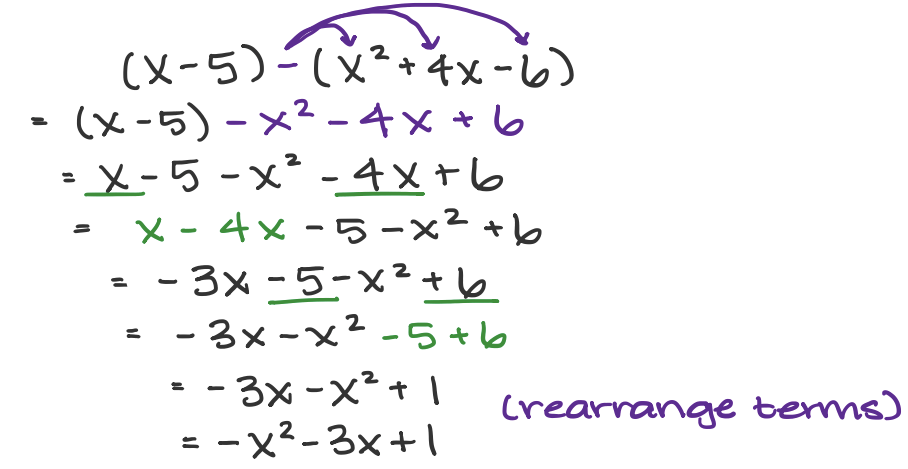
(x−5)−(x2+4x−6)\left(x-5\right)-\left(x^2+4x-6\right)

What is the result?

Choose one answer

Video

(Video) Adding and Subtracting Polynomials

by PatrickJMT

This video by PatrickJMT shows how you subtract and add polynomials.

Summary\large{\text{Summary}}

First, we need to combine like terms. Let's look at an example to see this. Suppose we want to subtract: 2(x4+5x)−6(x4+8x−3)2(x^4+5x)-6(x^4+8x-3)

First, we distribute anything outside the parentheses inside. It's important to note that when subtracting polynomials, we need to distribute the negative sign inside as well. In our example, we distribute the 22 inside, and then the −6-6 inside. Once this is done, we can drop the parentheses. 2(x4+5x)−6(x4+8x−3)=2x4+10x−6x4−48x+18\begin{align} &2(x^4+5x)-6(x^4+8x-3)\\ &=2x^4+10x{\color{#8925AE}{-}}6x^4{\color{#8925AE}{-}}48x{\color{#8925AE}{+}}18 \end{align}

Next, we want to group the like terms together. Recall, like terms have the same variable and same exponent. 2x4+10x−6x4−48x+18=(2x4−6x4)+(10x−48x)+18\begin{align} &2x^4+10x-6x^4-48x+18\\ &=(2x^4-6x^4)+(10x-48x)+18 \end{align}

Then, pull out the variables. For example, in (10x−48x)(10x-48x), both have an xx so we can pull it out. (2x4−6x4)+(10x−48x)+18=(2−6)x4+(10−48)x+18\begin{align} &(2x^4-6x^4)+(10x-48x)+18\\ &=(2-6)x^4+(10-48)x+18 \end{align}

Finally, subtract the coefficients. (2−6)x4+(10−48)x+18=−4x4−38x+18\begin{align} &(2-6)x^4+(10-48)x+18\\ &=-4x^4-38x+18 \end{align}

Now that you've learned how to subtract single-variable polynomials, you can learn to subtract multi-variable polynomials!


Illustrated · 1 min

While solving equations, it often comes in handy to be able to subtract polynomials. Let us begin with an example: 8x3+54x2−23x+4=4x3−6x2+19x−178x^3+54x^2-23x+4=4x^3-6x^2+19x-17 We first begin by moving all the terms to one side of the equation: 8x3+54x2−23x+4−4x3+6x2−19x+17=08x^3+54x^2-23x+4-4x^3+6x^2-19x+17=0 Now we put them into groups based on the exponent of xx. (8x3−4x3)+(54x2+6x2)+(−23x−19x)+(4+17)=0(8x^3-4x^3)+(54x^2+6x^2)+(-23x-19x)+(4+17)=0 By subtracting/adding, we get: 4x3+60x2+(−42x)+21=04x^3+60x^2+(-42x)+21=0 4x3+60x2−42x+21=04x^3+60x^2-42x+21=0 This is the final answer.

Modeling of 8x^3+54x^2-23x+4=4x^3-6x^2+19x-17 and then 8x^3+54x^2-23x+4-4x^3+6x^2-19x+17=0

Image source: by Zora Gilbert

Let's do another example: 3y2+x=−2x−83y^2+x=-2x-8 Looking at this, we see that there are no other y2y^2 terms in this equation besides 3y23y^2, so we can leave it alone. However, we notice that there are 22 xx terms, so we can combine them. We move the −2x-2x to the other side of the equation and combine: 3y2+x+2x+8=03y^2+x+2x+8=0 3y2+3x+8=03y^2+3x+8=0 Note that we also moved the −8-8 to the other side of the equation. It is always a good idea to set the whole equation equal to 00, as it will help when performing other operations on polynomials.

model of 3y^2+x=-2x-8 and then 3y^2+3x+8=0

Image source: by Zora Gilbert

Type a concept, like “slope” or “photosynthesis”.

↑ ↓ to choose · Enter to openSearch explanations and problems