
Illustrated · 1 min
Suppose two numbers and are each chosen such that and . What is the probability that ?
If we go about solving this problem using traditional counting methods, we would be in a dilemma. There would be infinitely many possibilities we would have to consider ... that would take way too long. Fortunately, there is a better method - geometric probability. This strategy is used to compute a probability when the outcome is continuous (that is, there are infinite possibilities). We consider our "successful" and "possible" regions as some geometric object. In this example, the possible region can be represented in the coordinate plane with and . This region is a square with corners and .
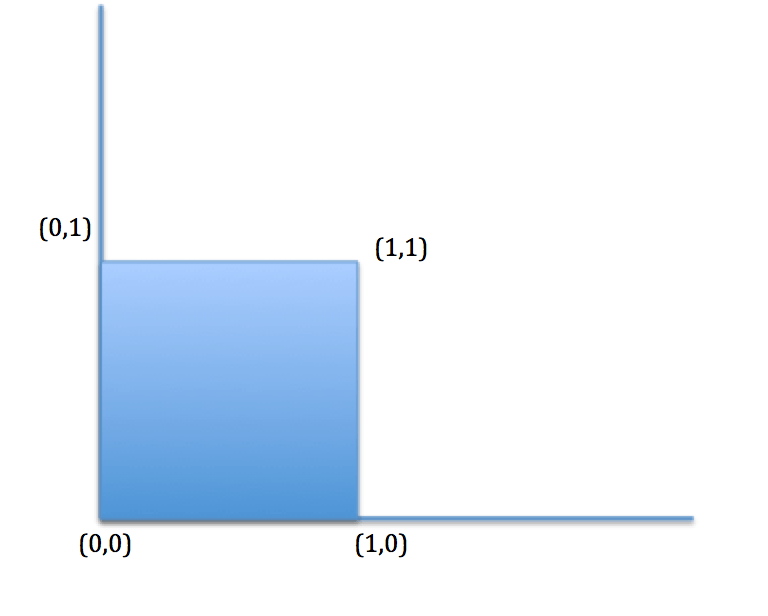
Total Outcomes Region
Now we need to draw the successful region. is a line, and the region inside the square and below this line is the successful region.
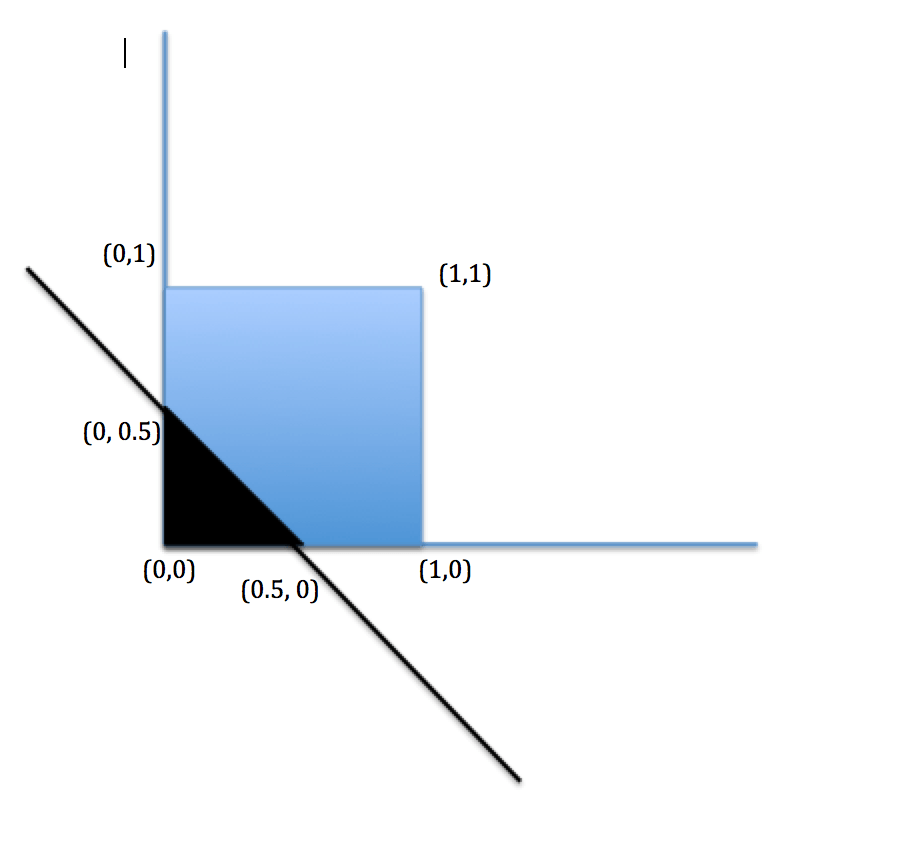
Possible and Successful Region
We now calculate the areas. The area of the square is 1, while the area of the triangle is . The probability is