পরম মান সমীকরণের সমাধানের কিছু স্ট্যাটেজি

Before this, knowপরম মান সমীকরণ(যোগ)পরম মান সমীকরণ(গুণ)

Illustrated · 1 min

A couple of things before we start this lesson. First, review the lesson on absolute values to make sure you've mastered that skill. Second, remember that absolute value can never be a negative number.

Solving Absolute Value Equations
Steps:
1) Isolate the absolute value.
2) Write two equations: one with a positive solution and one with a negative solution.
3) Solve for x in both equations so you have two solutions.

Image source: by Anusha Rahman

There are a few steps that you can consistently follow to solve equations that contain variables and absolute values:

1. Isolate the absolute value

2. Write two equations: one with a positive solution and one with a negative solution

3. Solve for xx in both equations

Let's take a look at an example of absolute value equations with sums to see these steps in action:

3∣2x−5∣+7=223|2x - 5| + 7 = 22

Step 1: Isolate the absolute value expression

We need to get the absolute value (∣2x−5∣|2x-5|) alone on one side of the equation.

3∣2x−5∣+7=223∣2x−5∣=15∣2x−5∣=5\begin{align} 3|2x - 5| + 7 &= 22\\ 3|2x - 5| &= 15\\ |2x - 5| &= 5\\ \end{align}

Step 2: Write two equations: one with a positive solution and one with a negative solution

Remove the absolute value sign and set up two equations:

2x−5=52x−5=−5\begin{align} 2x - 5 &= 5\\ 2x - 5 &= -5 \end{align}

Step 3: Solve for xx in both equations

What are the two possible values of xx?

2x−5=52x=10x=5 OR 2x−5=−52x=0x=0\begin{align} 2x - 5 &= 5\\ 2x &= 10\\ x &= 5\\\ \\ OR\\\ \\ 2x - 5 &= -5\\ 2x &= 0\\ x &= 0 \end{align}

Notice how both values for xx, when plugged into the original equation, produce the same result. This is a good way to check your answer.

We can also write the values of xx as a solution set that looks like this: {0,5}\{0, 5\}

Put ideas together

Contest problems often need this idea together with one or two others. That is where understanding goes deeper than memory. These are real problems from the AMC 8, AMC 10, AMC 12 and AIME, the national math competitions for middle and high school students, each with a worked solution on LIVE by Po-Shen Loh.

Illustrated · 2 min

Way 1: Two Cases

You can solve absolute value equations breaking them into two cases. For example, suppose you're given the equation:

∣x−5∣=4|x-5|=4.

Because of the way absolute values work, we can rewrite this as x−5=±4x-5=\pm4 and separate it into two equation. Both will produce a solution:

x−5=4x−5=−4\begin{align} x-5=4\\ x-5=-4 \end{align}

These result in x=9x=9 and x=1x=1, which both satisfy the equation.

This works because an absolute value turns the expression inside it to a positive value. For example, both of the following equations are true:

∣5∣=5∣−3∣=3\begin{align}|5|&=5\\ |-3|&=3\end{align}

(Surprisingly enough, you can use the two cases method to produce the general solution to the equation ∣x+a∣=b|x+a|=b, which is x=±b−ax=\pm b-a.)

Way 2: Number Lines and Definitions

You can also use a number line as well as the definition of absolute value to solve an absolute value equation. The definition, by the way, is that the absolute value of an expression is its distance from 00 on the number line. Note that this method is very similar to the Two Cases method, but it's still different in its own way.

If you have an equation that looks like ∣[expression]∣=[number]|\text{[expression]}|=\text{[number]}, you can plot points on the number line at [number]\text{[number]} and write [expression]\text{[expression]} over them. (Don't literally write the word "expression", though!) From there, plot more points on the number line following the steps of simplifying [expression]\text{[expression]} down to just your variable (for example, adding 22, dividing by 77, taking the square root, etc.), which will produce the solutions.

Way 2: Example

Let's say we have the absolute value equation

∣2x−5∣=3|2x - 5| = 3

Plot points on the number line at 33 and −3-3 and write the expression 2x−52x - 5 over each one. I'm calling one point AA and one point BB.

Number line with our points labeled.

Image source: by Jack Kiuttu

From there, plot two more points 55 spaces to the right of the previous two and write 2x2x over each of those.

We now have new points 5 units to the right of the originals.

Image source: by Jack Kiuttu

Finally, plot your last points: one at A2\frac{A}{2} and B2\frac{B}{2} and write xx over each one. This simulates the final step in the equation, dividing both sides by 22. Those are your solutions!

Dividing each number gives us our x values.

Image source: by Jack Kiuttu

When solving these types of equations, you may come across an equation with no solution.

Looking Further

Later in math, you will learn about absolute value functions, which are basically 2-dimensional versions of absolute value equations.

Video · + 1 min read

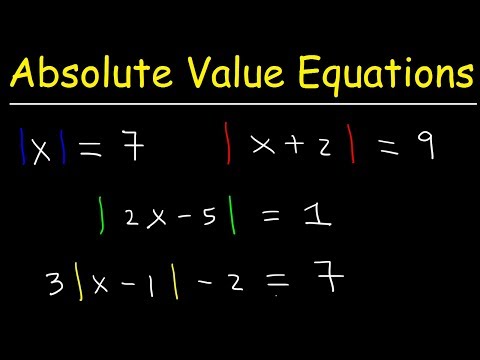
(Video) Solving Absolute Value Equations

by The Organic Chemistry Tutor

In this video, The Organic Chemistry Tutor goes over how to solve absolute value equations.

Summary

Absolute value is the distance from zero, so you cannot have a negative value. ∣5∣−5|5|-5 ∣−8∣=8|-8|=8

So, if we're told that: ∣x∣=7,|x|=7, what are the possible values of xx? Well, xx can equal 77 or −7-7.

So how can we use this concept when solving absolute value equations? Say we have the equation, ∣x+2∣=9|x+2|=9. That means that: x+2=9x+2=9 x+7x+7 OROR x+2=−9x+2=-9 x=−11x=-11 Both of these equations are true.

Let's look at another example. Say ∣2x−5∣=1|2x-5|=1. What are the possible values of xx? Well, ∣2x−5∣|2x-5| can equal +1+1 or −1-1. 2x−5=12x-5=1 2x=62x=6 x=3x=3 OROR 2x−5=−12x-5=-1 2x=42x=4 x=2x=2

What if we were given the equation: ∣5x−1∣=−2|5x-1|=-2 What are the values of xx? Well, there is no solution to this equation, because the absolute value can never be negative.

Let's look at another example that's a bit more complex. What are the values of xx that satisfy: 3∣x−1∣−2=73|x-1|-2=7?

The first thing we want to do is isolate the absolute value part on one side of the equation. 3∣x−1∣−2=73|x-1|-2=7 3∣x−1∣=93|x-1|=9 ∣x−1∣=3|x-1|=3 Then, we can solve it by setting up the absolute value part to equal 33 or −3-3. x−1=3x-1=3 x=4x=4 OROR x−1=−3x-1=-3 x=−2x=-2

Type a concept, like “slope” or “photosynthesis”.

↑ ↓ to choose · Enter to openSearch explanations and problems