Read · 3 min
We're beginning our exploration of thermodynamics. We started by examining internal energy. The more energy something has, the more change it can cause. In chemistry, we care about the breaking and reforming of chemical bonds. We've seen that energy gets transferred when atoms or molecules collide. If the collision has enough energy, they initiate a chemical reaction. If not, a reaction won't happen. But they can transfer kinetic energy.
We've also seen that energy can get transferred via physical processes. For example, changes in pressure or volume can lift a piston. The fancy term we use is pressure-volume work. A standard instance occurs when a reaction produces a gas. The evolved gas generates pressure. At the molecular level, the molecules collide with the piston. What's the result? It raises the piston. In this case, we call the reaction the system. It lifts the piston against gravity. So, the system did work on the surroundings.
Finally, we've examined heat and temperature. Temperature measures the average kinetic energy of the molecules. So, if they start moving faster, the temperature rises. Heat is the energy transfer caused by temperature differences. So, temperature is the state variable that indicates heat transfer. For example, we know that chemical reactions can be exothermic or endothermic. In an exothermic reaction, energy gets transferred from the system to the surroundings. So, the temperature increases. In endothermic reactions, it's the opposite. We have an intuitive feel for heat transfer. But what's the quantitative connection between heat and temperature?
Heat Capacity and Specific Heats
At this point, we understand heat and temperature from a molecular perspective. But that's not very practical. In thermodynamics, we care about whole systems. For example, let's say I have 100 grams of gold. I want to know how much energy is required to raise its temperature. Does that change if I have 1000 grams of gold? What happens if the metal is sodium or lithium?
To answer my questions, we need to consider the heat capacity. It's the energy required to raise an object's temperature by one Kelvin. It has units of joules per kelvin (). So, we see the correlation between energy and temperature. A certain amount of energy gets transferred (heat) into the system to raise the temperature.
The problem with heat capacity is that it's not specific. It's impossible to have a heat capacity for every object. But we can define a heat capacity for each element. We define it based on the element's mass. So, the specific heat is the energy (heat) required to raise one gram by one kelvin. So, to increase the temperature of 100 grams of gold by one kelvin needs . 1000 grams of gold is . How did I get those numbers? Let's take a look.
Calculating Specific Heats
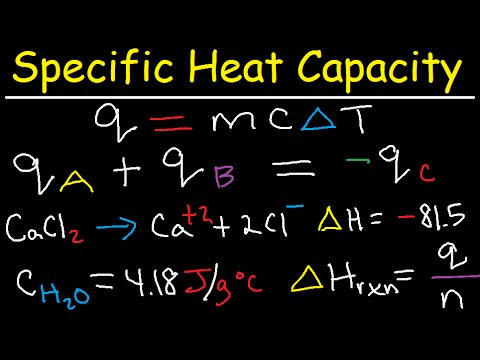
Thankfully, we have a formula for calculating transferred energy via heat. It's . is the heat in joules or kilojoules. is the substance's mass in grams. is the constant pressure heat capacity. Its units are . Sometimes we use kilojoules or kilograms based on the substance's mass. But that's simply a metric conversion. Finally, is the change in temperature. Remember, the temperature change is equivalent for Kelvin or Celsius.
How does this help us to calculate the specific heat capacity? We only have to rearrange the equation! . So, if we know the energy transferred, mass, and temperature change, we can calculate the specific heat capacity.
Let's look at an example. I'm a coffee snob. So every morning, I make myself a pour-over. I fill my kettle with 800.0 grams of water. I heat it from room temperature () to the boiling point (). I have a gas stove. So, it uses a combustion reaction to heat my kettle. We'll ignore that the metal kettle also gets heated. Let's say it requires 247,456.0 joules to boil my water. Calculate the specific heat capacity of water.
Let's list our known values.
Now we can plug the values into our equation.
The specific heat capacity of water is . We use it a lot! So, you should probably memorize it. For example, you've already seen it in our lessons on heating and cooling curves, phase change diagrams, and the phase change diagrams of water. In later thermodynamics lessons, we'll use it to examine calorimetry.