বৃত্ত, ব্যাসার্ধ অার চাপ কি?

Illustrated · 1 min

Circles are not polygons. A circle is defined by its center and radius. More specifically, a circle can be defined as the set of all points equidistant to a given point:

Note that a circle only consists of these points. Point B is on the circle, but point A is not. We say point A is in the circle. In this picture, A is the center of the circle. AB‾\overline{AB} is a radius of this circle. A radius is a line from the center to any point on the circle. A circle has an infinite number of radii. A chord is any line segment with endpoints on the circle. A diameter is a chord passing through the center. A secant is any line that intersects the circle twice. A tangent is a line that intersects the circle only once. A trenvent intersects the circle three times. Trenvents do not exist. If you see one, report it to the NSA immediately.

We say that a polygon is inscribed in a circle when all its corners are on the circle.

Put ideas together

Contest problems often need this idea together with one or two others. That is where understanding goes deeper than memory. These are real problems from the AMC 8, AMC 10, AMC 12 and AIME, the national math competitions for middle and high school students, each with a worked solution on LIVE by Po-Shen Loh.

Illustrated · 1 min

An arc is a closed segment of a circle. It is determined by a pair of points on the circle.

An arc is shown in green. (https://en.wikipedia.org/wiki/File:Circle_arc.svg by User:Cburnett)

θ\theta is the measurement of the angle between the two ends of the arc. L is the length of the arc. r is the radius of the circle

Illustrated · 1 min

It's a circle!

A circle is the set of all points that are an equal, constant distance from a central point. Circles are two-dimensional figures that are not polygons.

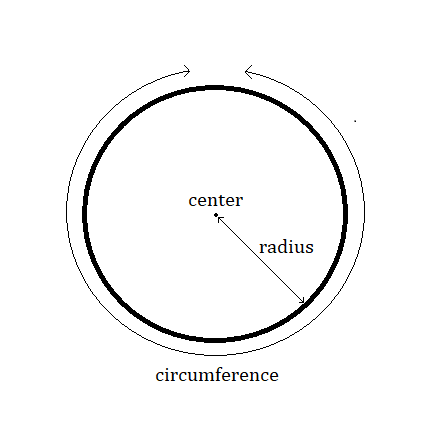
To construct a circle, two things are needed: a center and a radius. The center is the point from which all of the points on the center are the same distance; keep in mind, however, that the center is not a point on the circle. The radius is the exact distance from the center to any point on the circle.

Same circle, but with the center and radius labeled.

The circle is then constructed by connecting the points that are a radius length apart from the center.

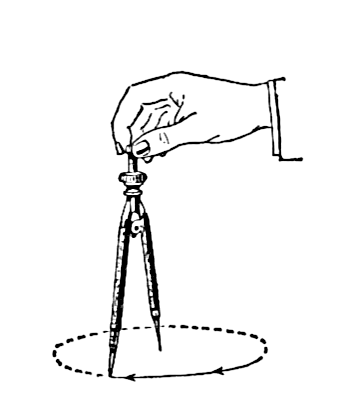
The device above is called a compass, which is used to draw a circle. Note how one leg stays still at the center of the circle while the other draws the circle itself. Here, the distance between the two legs of the compass is the radius. Source: goo.gl/tXoduq

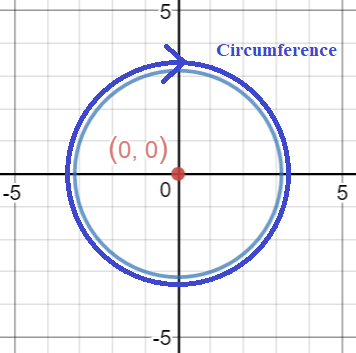
The perimeter of the circle, called the circumference of the circle, has a special property: it is directly proportional to the radius. In all circles - no matter their size - the circumference is equal to 2π\pi times the radius. To learn more about π\pi, check out the expii topic here.

And now the circle has a circumference!

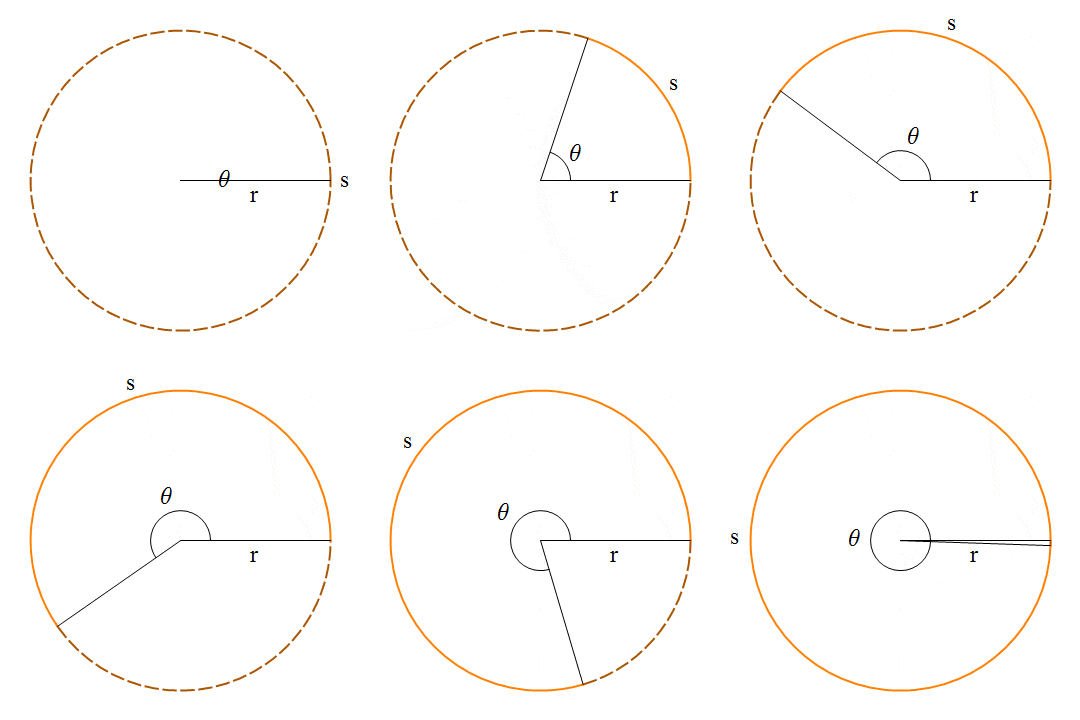
Finally, let's talk about arcs! An arc is a segment of the circle that is proportional to an angle; check out the animation below to see how the arc (s) is constructed from the radius (r) and angle (θ\theta).

To learn more about arcs and angles, check out the expii topic here.

Illustrated · 2 min

When studying Geometry it is important to know the properties of the different shapes and figures that you may be studying. In this case we will discuss the properties of a circle. Let's begin with the definition of a circle. A circle is a curved line that creates a closed loop. This line is made up of infinitely many points and each of these points are an equal distance to the middle.

Properties

A circle has many parts and properties which are listed below.

  • Center: The center of a circle is defined as the point in the middle of the circle. The points that make up the curve that is the circle are all equidistant from the center point.
All points on the circle are equidistant (the same distance) from the center.

All points on the circle are equidistant (the same distance) from the center.

  • Radius: The radius is the distance from the center point to the circle, this distance is always equal in a circle. It is half the diameter. When working with the radius in geometry it is often denoted by rr.
As you rotate in a circle, the radius (distance to the center) is constant.

As you rotate in a circle, the radius (distance to the center) is constant.

  • Diameter: The diameter is the distance from one side of the circle to the other side of the circle. This distance is twice the radius. When working with the radius in geometry it is often denoted by dd. It is important to remember that d=2rd=2r.
The diameter is sort of the "width" or "widest part" of the circle.

The diameter is sort of the "width" or "widest part" of the circle.

  • Circumference: The circumference of a circle is the distance of the line that makes up the circle. Circumference is denoted by CC and can be calculated using the following formula: C=2πrC=2\pi r.
As you rotate once in a circle, you cover every point of the circumference.

As you rotate once in a circle, you cover every point of the circumference.

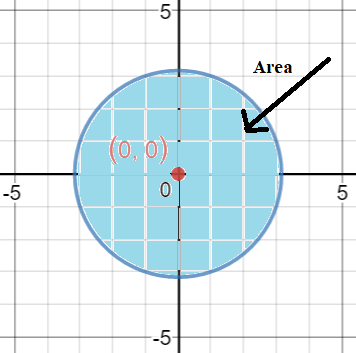
  • Area: The area of the space enclosed by the circle can be calculated with the following formula: Ac=πr2A_c=\pi r^2.
Remember that area is how much two-dimensional space a shape contains.

Remember that area is how much two-dimensional space a shape contains.

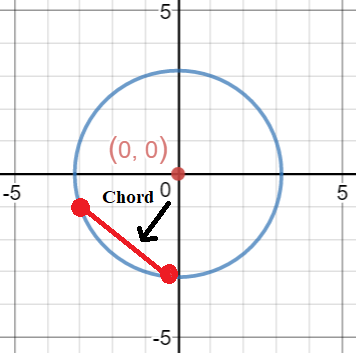
  • Chord: A chord is a line segment that links any two points on a circle.
The two endpoints of a chord always lie on the circumference.

The two endpoints of a chord always lie on the circumference.

  • Tangent: A tangent line is a line that touches a circle at one point.
A tangent line "just barely" intersects a circle, at a single point (unlike a chord).

A tangent line "just barely" intersects a circle, at a single point (unlike a chord).

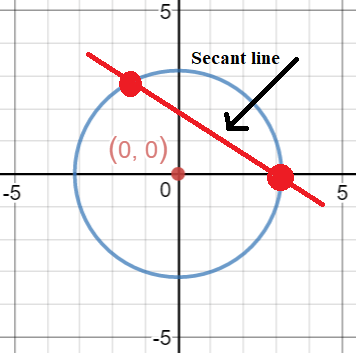
  • Secant: A secant line is a line that goes through a circle and intersects the circle at two points.
A secant is technically not a chord, but it contains a chord (the segment between the two red intersection points).

A secant is technically not a chord, but it contains a chord (the segment between the two red intersection points).

Similar to a quadratic equation, a specific type of equation will create a circle when graphed. Unlike quadratic equations, the xx and yy terms are always squared. The equation of a circle is as follows: (x−h)2+(y−k)2=r2,(x-h)^2+(y-k)^2=r^2, where hh and kk are the xx and yy coordinates of the center point of the circle.

Illustrated · 1 min

A circle is the set of all points in a plane equidistant to a given point in that plane.

Consider the figure below. We can clearly see that all points in this particular circle are exactly one unit away from the origin (0, 0).

All circles have a center and a radius. Looking at the figure below, we see the center is shown by the blue point, while the radii are shown by the green lines.

Note that all radii of a circle are congruent.

Now that we know what the center and the radius of circles is, we can define what a diameter is.

The diameter is two radii. All diameters of the same circle must have the same length.

Looking at the figure we've been dealing with, we see that our diameter is 22. This is because we simply added the radii together →\rightarrow 1+1=21+1=2

Now let's consider arcs. An arc is some section of a circle. Arcs are measured in degrees. In the figure below, our arc ACAC is equal to ∠ABC\angle{ABC} that is 90∘90^\circ

Putting these terms together, we have a fully labeled circle.

Illustrated · 1 min

This is a circle (see diagram below)

A circle is always round.

The portion between the magenta points is an arc.

This is an angle. It is made up of two rays with the same starting point.(pretend that there are arrows at the end:) )

Was that hard?

Read · 1 min

A circle is nothing but a round closed shape consisting of various points on it's circumference, which are equidistant from a fixed point that is its centre point.

Video

(Video) Introduction to Circles

by Art of Problem Solving

Here's a great introductory video to circles from Art of Problem Solving!

Type a concept, like “slope” or “photosynthesis”.

↑ ↓ to choose · Enter to openSearch explanations and problems