Illustrated · 1 min

Similarity is a quality of scaling: two shapes are similar if you can scale one to be like the other, like these triangles ABC and DEF.

Since all circles are of the same shape (they only vary by size), any circle can be scaled to form any other circle. Thus, all circles are similar!

Illustrated · 1 min

If two shapes are similar to each other, they have the same shape, but not necessarily the same size.

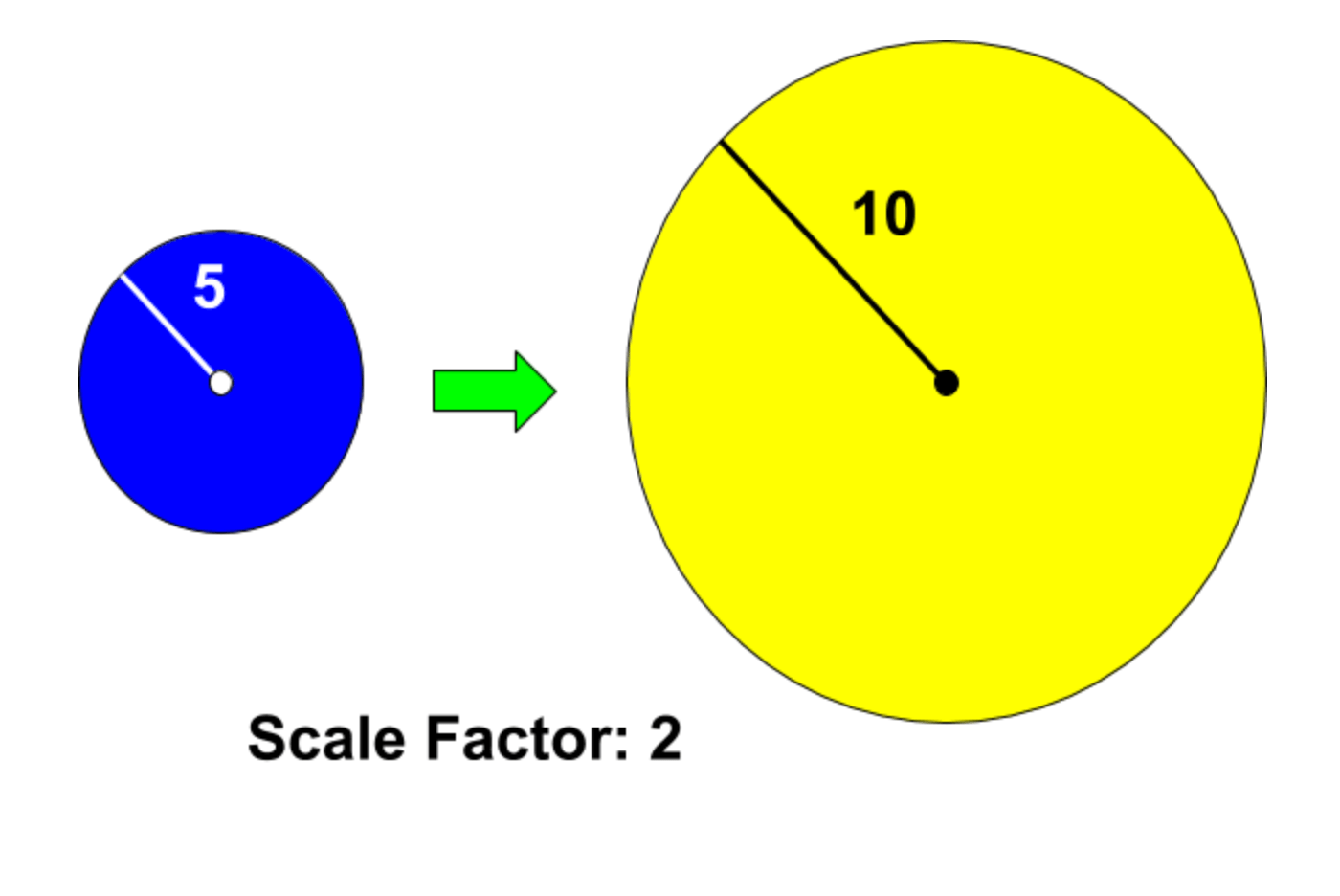
Consider the two circles below. While they have different colors and different radii, they are still similar.

All circles are similar to each other. All points on the circumference of any circle are equi-distant from its center.

Because the size of any circle is defined by its radius, we use the radii to determine its scale factor.

In the previous figure, we were given tow circles with a scale factor of 22. We can also represent this with an equation.

Plugging this in to the formula, we get →\rightarrow 5⋅2=105\cdot{2}=10

Read · 1 min

In geometry, similarity is a property of at least two shapes relative to each other. If two shapes are similar, then they maintain the same properties in proportion to one another. Proportionality here simply means that all the values in question are multiples of each other.

We've seen before that a circle is defined by two properties: its center and radius. Since similarity is independent of position (and circles remain the same regardless of rotation or reflection), the similarity of circles depends only on the circle radii.

But wait! Since a radius is a constant (an unchanging number), and any constant is proportional to another constant, then all circles must be similar.

A related geometric property is congruence. Congruent shapes are identical in every possible way: proportion, angles, size. Like similarity, congruence is unaffected by position, rotation, or reflection.

All congruent shapes are similar by definition; however, not all similar shapes are congruent.

Video

Here's a great video detailing a proof that all circles are similar!

Type a concept, like “slope” or “photosynthesis”.

↑ ↓ to choose · Enter to openSearch explanations and problems