Video

(Video) What is the definition of a hyperbola

by Brian McLogan

Check out this video by Brian McLogan to learn about the definition of hyperbolas!

We have already learned about ellipses and their centers, axes, vertices, and foci. Our knowledge of ellipses and their graphs can help us understand hyperbolas!

Like Brian says, an ellipse is like 2 parabolas facing inwards. A hyperbola is like 2 parabolas facing outwards.

The definition of a hyperbola is that for any point on a hyperbola, the distance/difference between two points is constant, as is said in the video.

In an ellipse the sum of two points is constant, but in a hyperbola the difference is constant.

Find your level

The problems run from approachable to very hard, and each is rated by how often real students solve it, so you can pick your next step. These are real problems from the AMC 12 and AIME, the national math competitions for middle and high school students, each with a worked solution on LIVE by Po-Shen Loh.

Illustrated · 1 min

Hyperbola

A hyperbola is another type of conic section. Like circles, parabolas, and ellipses, hyperbolas are created by slicing a cone with a plane.

A hyperbola has two curved branches that open away from each other. Unlike a circle or ellipse, a hyperbola is not one connected curve.

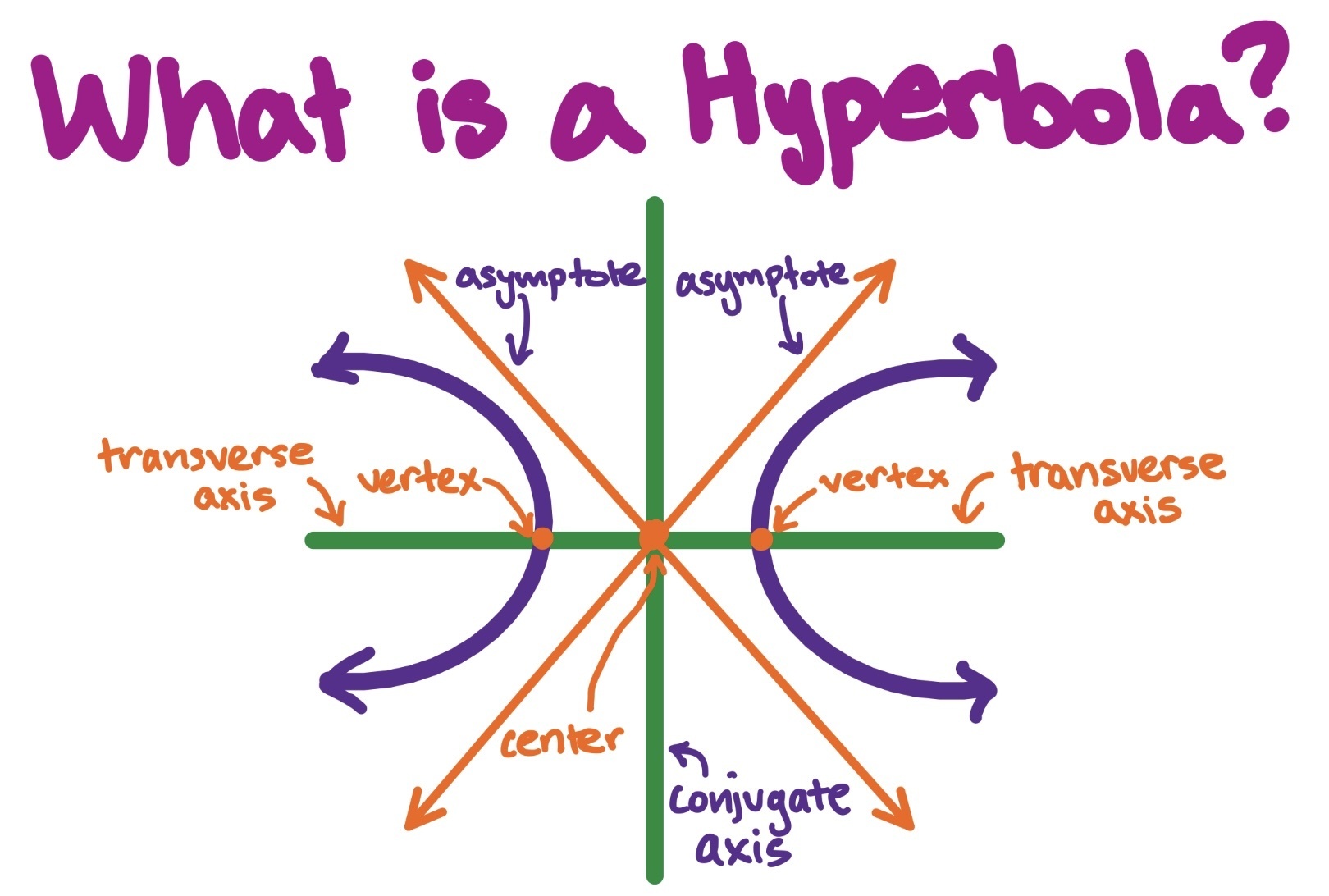
What is a hyperbola?

Coordinate plane with hyperbola drawn. Center, conjugate axis, transverse axis, vertexes, and asymptotes labeled.

Image source: by Trisha

A hyperbola can open left and right OR up and down. The graph has two separate parts called branches. In general, one branch will move in one direction. The other branch will move in the opposite direction.

As the branches continue, they get closer and closer to their asymptote.

A hyperbola is a set of all points where the difference of the distances to two fixed points (the foci) is constant. The main idea is that:

  • Ellipses are based on a sum of distances
  • Hyperbolas are based on a difference of distances

Key Parts

  • Center: the center is the midpoint between the two branches
  • Vertices: the vertices are the points where the branches begin
  • Asymptotes: asymptotes are invisible/dashed guide lines that the graph approaches but never touches
  • Foci: the foci are special points used to define the hyperbola's shape

Comparing to the Other Conics

  • Circle: perfectly round
  • Ellipse: stretched circle
  • Parabola: one curved branch
  • Hyperbola: two separate branches

Illustrated · 1 min

Hyperbola

In our next lesson on conic sections, we have the hyperbola!

The hyperbola occurs when a plane intersects with a cone, creating two semicircular sections. There are two branches to these open curves.

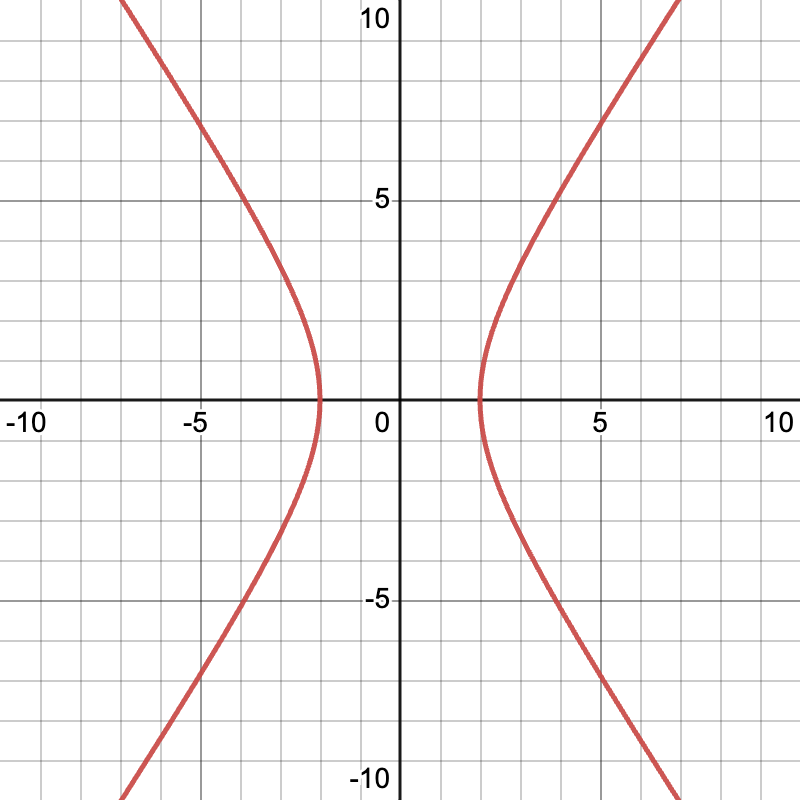
The following is a graph of the most simple hyperbola, so you are better able to understand what this unique function is. This hyperbola is centered over the origin, so it's symmetrical with the xx-axis and yy-axis.

The general form of a hyperbola is:

(x2a2) − (y2b2) = 1\left(\frac{x^{2}}{a^{2}}\right)\ -\ \left(\frac{y^{2}}{b^{2}}\right)\ =\ 1

You can complete the square to convert a hyperbola from general form to standard form.

Graph of hyperbola

Created by Desmos

The equation of this hyperbola is:

(x222) − (y232) = 1\left(\frac{x^{2}}{2^{2}}\right)\ -\ \left(\frac{y^{2}}{3^{2}}\right)\ =\ 1

Key Features

There are a few key features of a hyperbola that make it unique.

Two Asymptotes

There are two asymptotes in a hyperbolic graph. The asymptotes' general forms are:

y=baxy = \frac{b}{a} x y=−baxy = -\frac{b}{a} x

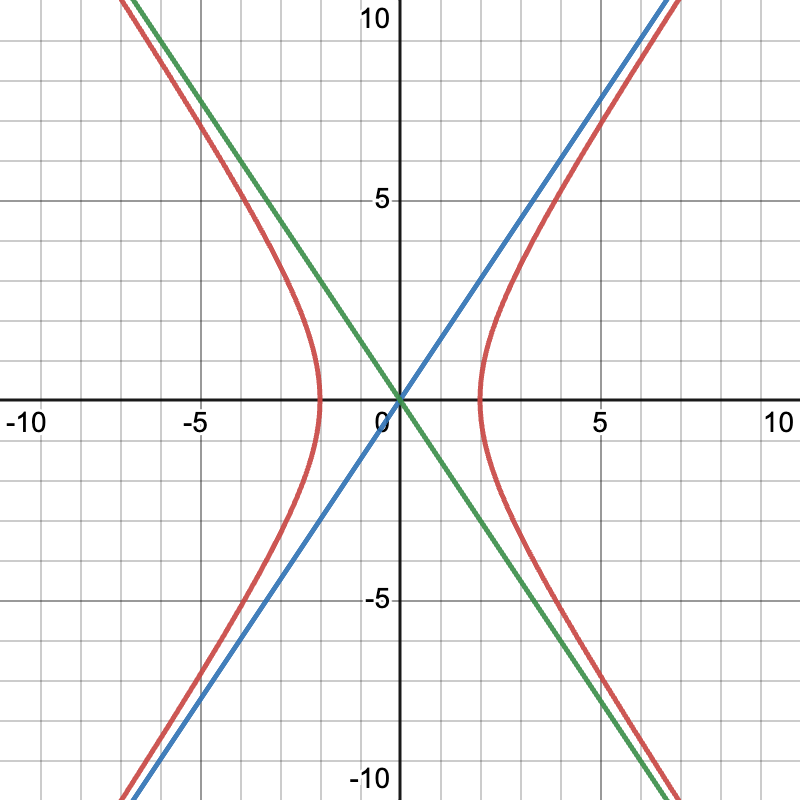
If we think back to our example red graph, we will note that the asymptotes are: y=32xy = \frac{3}{2} x and y=−32xy = -\frac{3}{2} x. Here is a graph with the asymptotes labeled in blue and green, respectively.

Hyperbola with asymptotes

Created by Desmos

Eccentricity

You may remember learning about the [focus and directrix] of a parabola. Those concepts apply to hyperbolas, too! In hyperbolas, the distance from the focus (the fixed point) and the directrix (the fixed straight line) is always in the same ratio. This ratio is what we call eccentricity. The eccentricity, or the ratio, is always greater than 11.

Latus Rectum

The last concept we will talk about is the latus rectum. Sounds a little funny, but it's a very simple concept. Keep the focus and directrix in your mind - we'll also be using it here! The Latus Rectum is the line the passed through the focus and is parallel to the directrix. In the hyperbola, the length of the Latus Rectum is: 2b2/a2b^2/a.

Type a concept, like “slope” or “photosynthesis”.

↑ ↓ to choose · Enter to openSearch explanations and problems