Read · 1 min
+1 contributors

The distance from a number to is call the absolute value, modulus, or magnitude of the number. Note that this definition is simply a generalization of the definition of absolute value of a real number. The previously described angle is called the argument of a number. For example, if , we would write and .
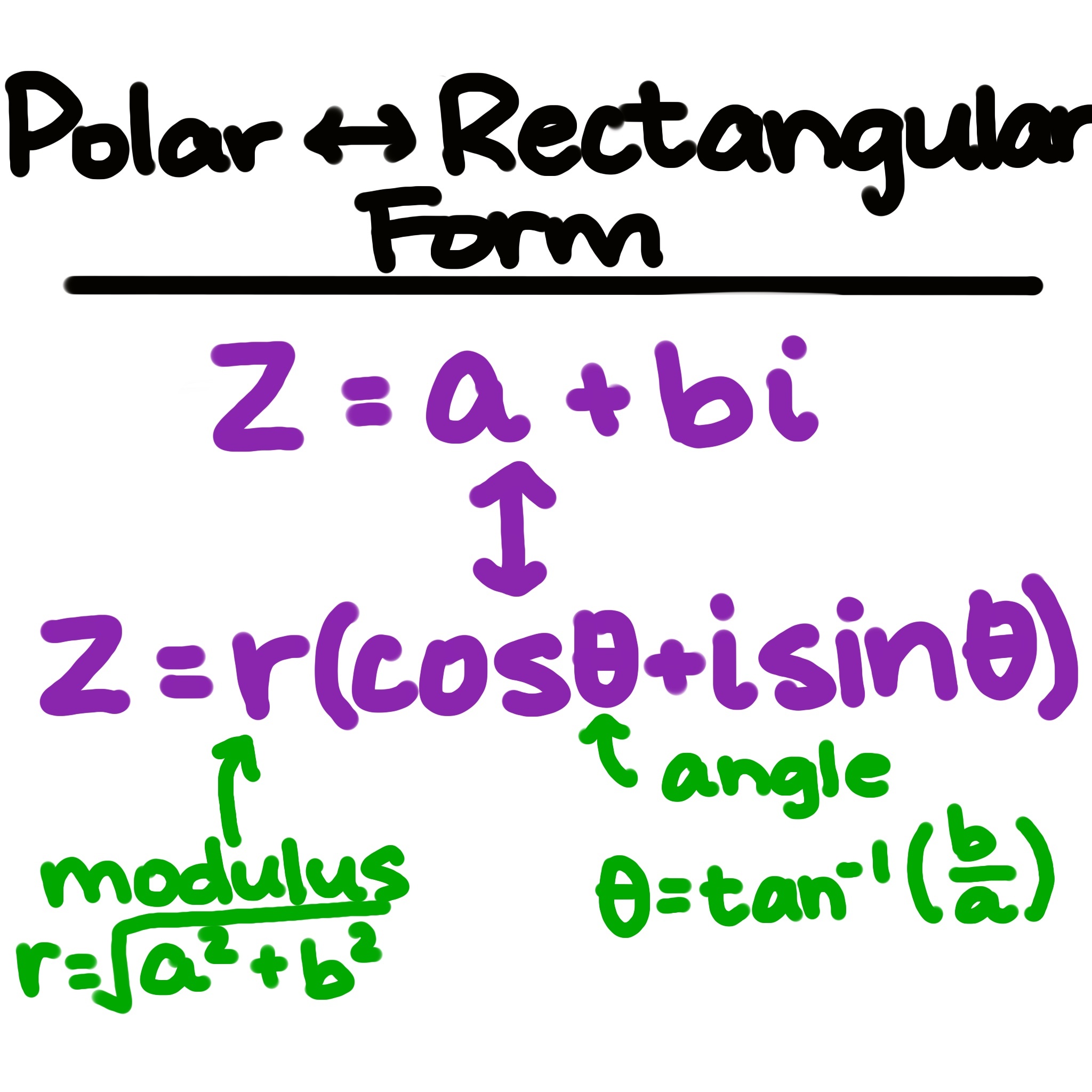
It should be relatively easy to see that, if a complex number has magnitude and argument , then: This is called the polar form of a complex number.
Thus, if you want to convert from polar form to rectangular form, remember that and .
If you want to convert a complex number from rectangular from to polar form, then use the following conversions, which are also quite easy to show:
There are two things of which to be cautious when calculating :
First, if , then is undefined. In this case, if , then , and if , then . If , then the complex number is simply , which does not have a well-defined argument. In this case, you are free to choose any argument you want, since anyway.
Second, can lie anywhere in the range , but is periodic with period . Thus, when you compute , there will be possible values of ; in order to determine which is which, check the signs of and to determine which quadrant contains the complex number.