Interactive · 2 questions
+3 contributors


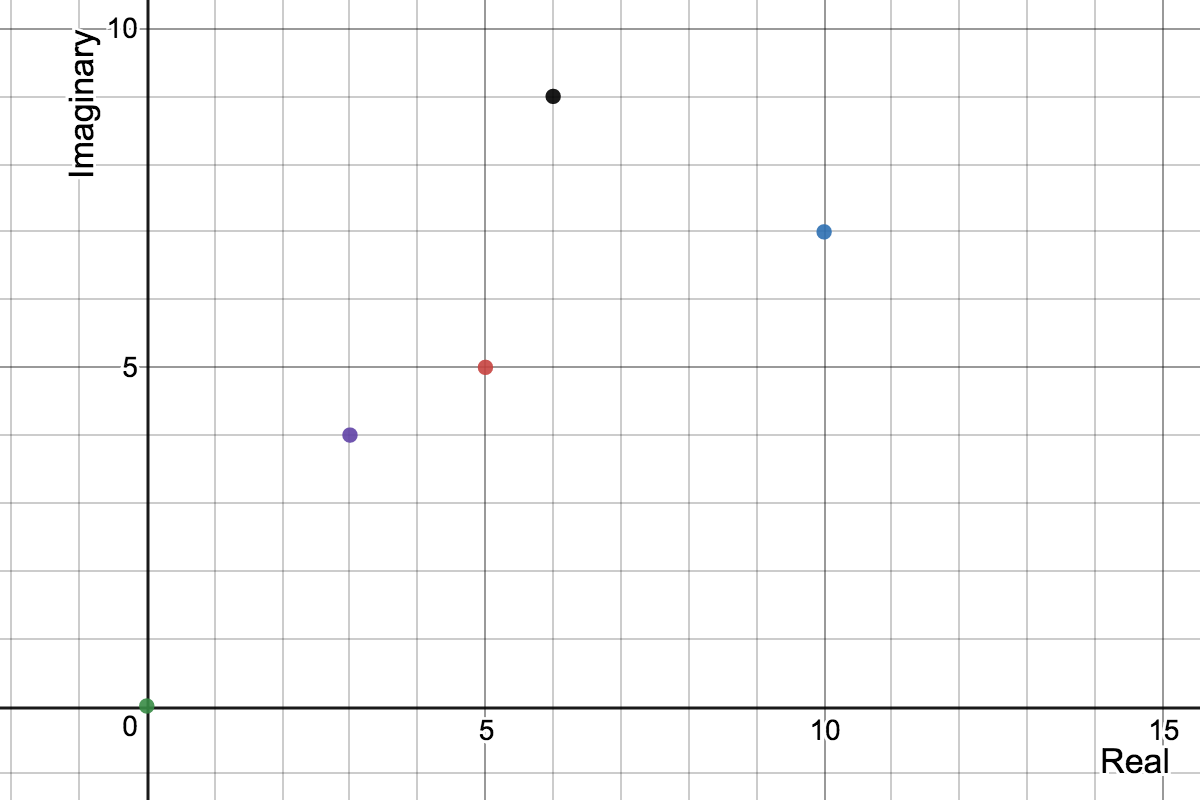
The most typical way to express a complex number would be to decompose it into its real and imaginary components, i.e. . This is called the rectangular form of a complex number, and it's easy to see why. We can imagine plotting all complex numbers on a plane parametrized by rectangular coordinates, with the real and imaginary components serving as the x- and y-coordinates, respectively.
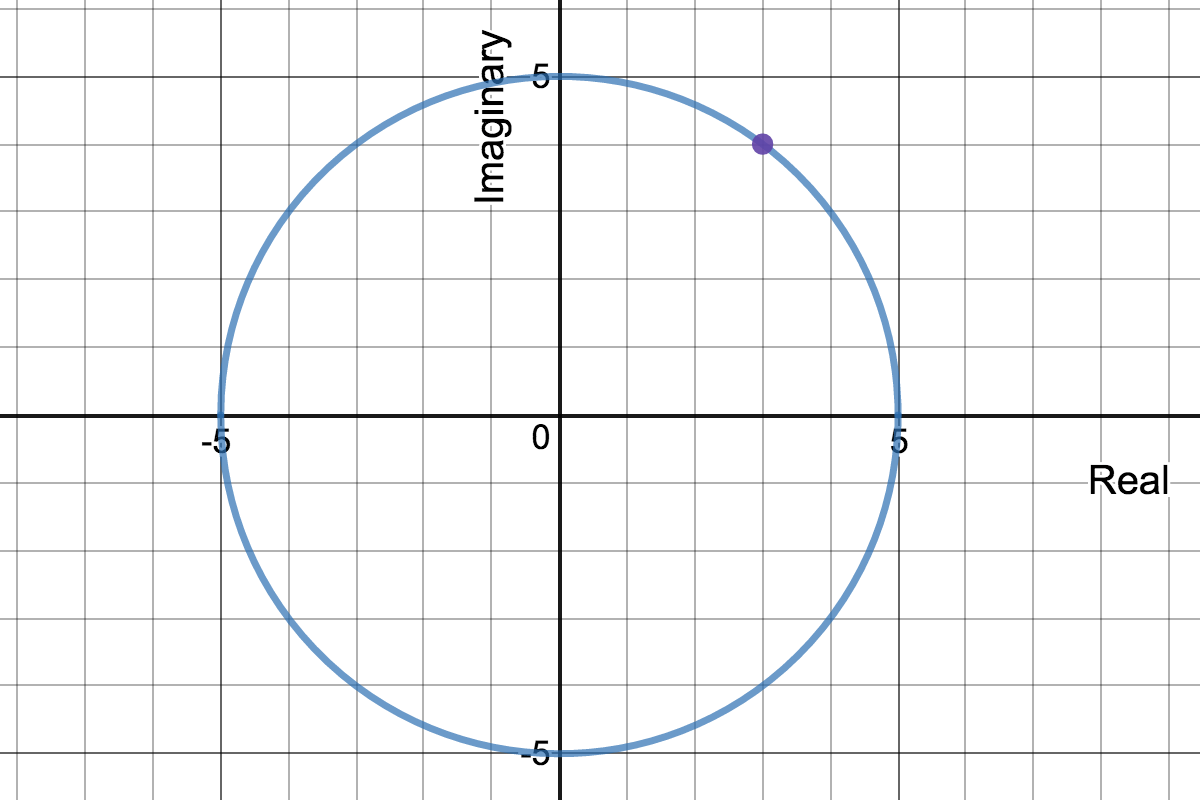
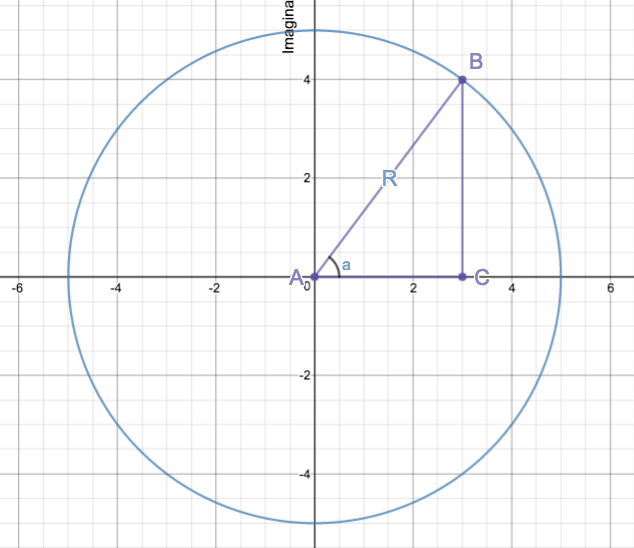
However, if we visualize complex numbers as points on a plane, then switching from rectangular to polar coordinates gives us another way to think of complex numbers. We can express a complex number in terms of its distance from , , and the angle that the ray from to the number makes with the positive real axis. This angle is measured counterclockwise, as it is in polar coordinates.
The distance from a number to is call the absolute value or magnitude of the number. Note that this definition is simply a generalization of the definition of absolute value of a real number. The previously described angle is called the argument of a number. For example, if , we would write and .
It should be relatively easy to see that, if a complex number has magnitude and argument , then: This is called the polar form of a complex number.
Thus, if you want to convert from polar form to rectangular form, remember that and .
If you want to convert a complex number from rectangular from to polar form, then use the following conversions, which are also quite easy to show:
For convenience, we sometimes write . This shorthand is used because "cis" has the first letter of cosine, the letter i, and the first letter of sine.
Clearly, adding numbers would be a disaster, unless we convert to rectangular form and then convert back, which negates the whole point of using a different form.
Polar form is incredibly useful for multiplication. Prepare yourselves for one of the most important and mind-blowing fact about complex numbers. Let's see what happens when we multiply two complex numbers, and :
The two terms in parentheses should look very familiar.
What is ?
Now, what is ?
These above results are just the angle addition identities.
Now, we conclude with our amazing result:
This is absolutely incredible. When we multiply two complex numbers, we multiply their magnitudes and add their arguments. This fact is not at all obvious, but it is very useful. As you will see in the future, this will often make multiplying using polar form much easier than multiplying using rectangular form. It will also allow for us to make many interesting and useful connections between complex numbers and seemingly unrelated areas of mathematics.