"Parallel" in Two-Dimensional Euclidean Geometry
In Euclidean geometry, any two lines which do not intersect in the two-dimensional euclidean plane (a plane is a flat surface in space such as the x-y plane a.k.a. cartesian plane) are called parallel.
In other words, two lines which are equidistant from each other are parallel. This can also be expressed as any two lines which create a common angle α along with a common complementary angle β when intersected by another line (called a transversal) are called parallel.
So how do we know if two lines are parallel or not? To give an example, let's use two lines in the x-y plane.
We know that in the x-y plane, a line has the form y=ax+b where a is the slope of the line (commonly referred to as runrise ) and b is the y intercept. Let's say that we have two lines y1=a1x+b1 and y2=a2x+b2. There are two conditions that have to be satisfied in order to consider these two lines to be parallel.
Condition 1.) The two lines must have two different y intercepts (b1=b2).
Condition 2.) The two lines must have the same slope (a1=a2).
Note: There is a third condition regarding the consistency with respect to the distance between the two lines, but generally the above two conditions are sufficient for two-dimensional Euclidean planes. There is also a fourth condition which we can check that involves the definition of parallel lines using angles and transversals which was mentioned before, but again generally the above two conditions are sufficient.
Let's look at an example. Suppose we have two lines y1=3x−2 and y2=3x+2. We know these two lines are parallel since −2=2⇒b1=b2 and 3=3⇒a1=a2.
On the other hand, the lines y1=3x−2 and y2=31+2 are not parallel (we call these lines intersecting) as 2=2⇒b1=b2 and 3=31⇒a1=a2 which means that these lines do not satisfy either of our conditions.
Let's try and test your understanding of this concept!
Answer: The x-y plane displays two lines f(x)=21x+2 and g(x)=2x−2. In these two lines, the first condition was satisfied as 2=−2, however the second condition was not as 21=2. Thus these two lines intersect and are not parallel.
Answer: The x-y plane displays two lines f(x)=2x+1 and g(x)=21x+1. The first condition is not fulfilled as 1=1, and to assure ourselves even further that these two lines are not parallel, the second condition is also not fulfilled as 2=21.
Answer: The x-y plane displays two lines f(x)=21x−3 and g(x)=21x+5. The first condition was satisfied as 3=5, and so was the second condition as 21=21. Therefore, these two lines are parallel.
This concludes our exploration of parallel lines in two-dimensional Euclidean geometry. However, what if we go beyond...into three-dimensional Euclidean geometry? Let's explore!
"Parallel" in Three-Dimensional Euclidean Geometry
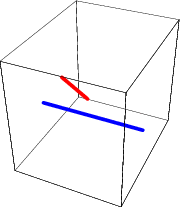
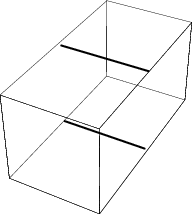
Our definition of when two lines are parallel are different in three-dimensional Euclidean geometry. It is true that the two lines can not intersect, but we have to be careful because in a three-dimensional Euclidean space there can exist skew lines a.k.a. agonic lines which do not intersect but are not parallel.
The key difference between a skew line and a parallel line in a three-dimensional Euclidean space is that a parallel line will maintain a constant distance apart from each other. Hence a general definition for two parallel lines in a three-dimensional Euclidean space would be as follows.
Definition: *A set of lines are parallel if and only if the lines coexist in a single plane and are always equidistant from each other. *