গোলকের সমীকরণ

Before this, knowপুনরা‌লোচনা: বৃ‌ত্তের সমীকরণDistance Formula in Space

Video · + 1 min read

Equation of a Sphere, Plus Center and Radius

by Krista King

Sphere's are the 3D representations of circles. The equation of a sphere is similar to that of a circle, but with an extra variable for the extra dimension. (x−h)2+(y−k)2+(z−l)2=r2(x-h)^2+(y-k)^2+\color{Red}{(z-l)^2}=r^2 In this equation, r=radiusr=\text{radius}. The coordinate (h,k,l)(h,k,l) tells us where the center of the sphere is.

In this video, Krista goes over two types of problems you might encounter when dealing with equations of spheres.

Find Equation Given Point and Center

Suppose you have a sphere whose center is C(3,8,1)C(3,8,1) and it passes through the point (4,3,−1)(4,3,-1). What is its equation?

First, we are given the center of the sphere: (3,8,1)(3,8,1). Let's plug this point into our sphere equation. (x−h)2+(y−k)2+(z−l)2=r2(x−3)2+(y−8)2+(z−1)2=r2\begin{align} (x-h)^2+(y-k)^2+(z-l)^2&=r^2\\ (x-\color{Red}{3})^2+(y-\color{Red}{8})^2+(z-\color{Red}{1})^2&=r^2 \end{align}

We're actually almost done! We also know the sphere passes through the point (4,3,−1)(4,3,-1). We can plug this in for (x,y,z)(x,y,z) and solve for r2r^2. (x−3)2+(y−8)2+(z−1)2=r2(4−3)2+(3−8)2+(−1−1)2=r2(1)2+(−5)2+(−2)2=r21+25+4=r230=r2\begin{align} (x-3)^2+(y-8)^2+(z-1)^2&=r^2\\ (\color{Blue}{4}-3)^2+(\color{Blue}{3}-8)^2+(\color{Blue}{-1}-1)^2&=r^2\\ (1)^2+(-5)^2+(-2)^2&=r^2\\ 1+25+4&=r^2\\ 30&=r^2 \end{align}

Now that we know r2r^2 and the center, we know the equation of the sphere. (x−3)2+(y−8)2+(z−1)2=30\boxed{(x-3)^2+(y-8)^2+(z-1)^2=30}

Find Center and Radius Given an Equation

Suppose you have a sphere with the equation x2+y2+z2−2x−4y+8z=15x^2+y^2+z^2-2x-4y+8z=15. What is the radius and center of this sphere? To solve these problems, we want to start by grouping our variables together. x2+y2+z2−2x−4y+8z=15(x2−2x)+(y2−4y)+(z2+8z)=15\begin{align} x^2+y^2+z^2-2x-4y+8z&=15\\ (x^2-2x)+(y^2-4y)+(z^2+8z)&=15 \end{align}

Next, we want to complete the square for each grouping. When completing the square, we want to take the coefficient in front of the variable and halve it, square it, and add it on to both ends. For example, in our equation above, to complete the square for the xx variable, we take the −2-2 and halve it, −22=−1\frac{-2}{2}=-1, square it, (−1)2=1(-1)^2=1, and add it to both sides. (x2−2x)+(y2−4y)+(z2+8z)=15(x2−2x+(−22)2)+(y2−4y)+(z2+8z)=15+(−22)2(x2−2x+1)+(y2−4y)+(z2+8z)=15+1(x2−2x+1)+(y2−4y+(−42)2)+(z2+8z)=15+1+(−42)2(x2−2x+1)+(y2−4y+4)+(z2+8z)=15+1+4(x2−2x+1)+(y2−4y+4)+(z2+8z+(82)2)=15+1+4+(82)2(x2−2x+1)+(y2−4y+4)+(z2+8z+16)=15+1+4+16(x2−2x+1)+(y2−4y+4)+(z2+8z+16)=36\begin{align} (x^2-2x)+(y^2-4y)+(z^2+8z)&=15\\ \left(x^2-2x+\color{Green}{\left(\frac{-2}{2}\right)^2}\right)+(y^2-4y)+(z^2+8z)&=15+\color{Green}{\left(\frac{-2}{2}\right)^2}\\ (x^2-2x+1)+(y^2-4y)+(z^2+8z)&=15+1\\ (x^2-2x+1)+\left(y^2-4y+\color{Green}{\left(\frac{-4}{2}\right)^2}\right)+(z^2+8z)&=15+1+\color{Green}{\left(\frac{-4}{2}\right)^2}\\ (x^2-2x+1)+(y^2-4y+4)+(z^2+8z)&=15+1+4\\ (x^2-2x+1)+(y^2-4y+4)+\left(z^2+8z+\color{Green}{\left(\frac{8}{2}\right)^2}\right)&=15+1+4+\color{Green}{\left(\frac{8}{2}\right)^2}\\ (x^2-2x+1)+(y^2-4y+4)+(z^2+8z+16)&=15+1+4+16\\ (x^2-2x+1)+(y^2-4y+4)+(z^2+8z+16)&=36\\ \end{align}

Once we've completed the square, we can factor each grouping. (x2−2x+1)+(y2−4y+4)+(z2+8z+16)=36(x−1)(x−1)+(y−2)(y−2)+(z+4)(z+4)=36(x−1)2+(y−2)2+(z+4)2=36\begin{align} (x^2-2x+1)+(y^2-4y+4)+(z^2+8z+16)&=36\\ (x-1)(x-1)+(y-2)(y-2)+(z+4)(z+4)&=36\\ (x-1)^2+(y-2)^2+(z+4)^2&=36 \end{align}

We now have our equation in a form we can understand. The center of the sphere are number being subtracted. (x−1)2+(y−2)2+(z−(−4))2=36(x-\color{Red}{1})^2+(y-\color{Red}{2})^2+(z-\color{Red}{(-4)})^2=36 The center is at (1,2,−4)(1,2,-4).

The radius is the square root of the number at the end. r=36=6r=\sqrt{36}=6 The sphere has a radius of 6.

Video · + 2 min read

Let's think about a sphere for a bit. For a concrete example, we could consider, say, a beach ball or a marble or a tennis ball or any such spherical object of your liking.

If your preferred ball-shaped item is perfectly round, then every single point on its surface would be equally distanced from its center. This distance can be referred to as the radius (just like in a circle!). Moreover, since this radius is always the same for all points on the sphere, we can create an equation to mathematically represent this sphere.

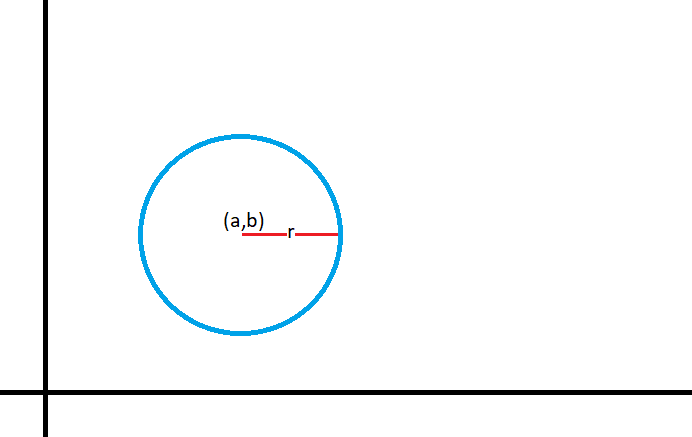
If we think back to working with circles, remember that a circle with center (a,b)(a,b) and radius rr is represented by the equation (x−a)2+(y−b)2=r2.(x-a)^2 + (y-b)^2 = r^2. A circle lives in two dimensions and a sphere in three. The two shapes both represent the set of all points equidistant from a single center, so the equation can easily be generalized to three dimensions!

But, what is this equation?

It turns out that the equation of a sphere with center (a,b,c)(a,b,c) and radius rr has the equation (x−a)2+(y−b)2+(z−c)2=r2.(x-a)^2 + (y-b)^2 + (z-c)^2 = r^2. This formula has its origins in the general distance formula, which lets you calculate the distance between any two specific points, even in 3D space.

For some practice, consider the sphere denoted by the equation (x−4)2+(y−1)2+(z−9)2=16.(x-4)^2 + (y-1)^2 + (z-9)^2 = 16.

What point is the center of this sphere?

Choose one answer

Interactive · 5 questions

Sphere Intersection

So we know how to graph a sphere. But how can we tell if two spheres intersect?

Let's start out with some smaller dimensions.

Note: Not everyone agrees on the definition of a sphere, but throughout this explanation, a sphere will include everything inside. (Sometimes that would be called a ball instead.) When we write an equation like x2+y2+z2=1x^2+y^2+z^2 = 1, that will refer to the points on the surface of the sphere; the inequality x2+y2+z2≤1x^2+y^2+z^2 \leq 1 refers to everything within or on the sphere.

Zero-Dimensional Spheres???

We've gone too small! But let's try reasoning out what happens anyway for the sake of being good mathematicians.

A "zero-dimensional sphere" is really just a point; we know two points "intersect" when they are exactly the same point!

One-Dimensional Spheres

A "one-dimensional sphere" is a line (or, to be more specific, a line segment); two segments will intersect at at most one point, unless they are part of the same extended line (like two intervals on a number line). You can read more about intersecting lines here.

One cool way to think about lines as one-dimensional spheres is to consider equations such as (x−a)2=r2(x-a)^2=r^2 for a "sphere" centered at a point aa with radius rr on a line. Then we can visualize a sphere on a line like so:

Here, the black line is any line.  The blue line is actually our sphere!  As you can see, every point in the sphere is at most distance r away from its center point a!

Here, the black line is any line. The blue line is actually our sphere! As you can see, every point in the sphere is at most distance r away from its center point a!

Then how do we check if two if these segments intersect? Well, we can look at the center points and radii of two such segments.

Suppose we have two segments: segment AA with radius rr centered at point aa and segment BB with radius qq centered at point bb. If any part of a segment AA overlaps with segment BB, then they intersect. Symbolically, if the intervals [a−r,a+r][a-r, a+r] and [b−q,b+q][b-q, b+q] overlap, then we know our one-dimensional spheres intersect.

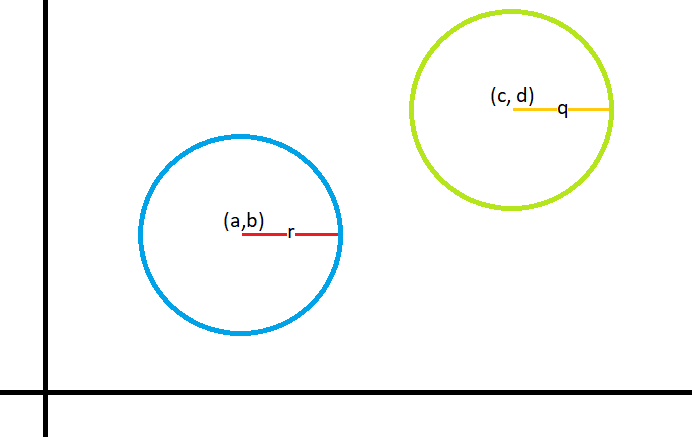
Now we have two spheres!

Now we have two spheres!

Which of the following one-dimensional spheres intersect?

Choose all correct answers

Interactive · 1 question

A sphere is the set of all points a given distance (its "radius") from a given point (the "center" of the sphere). As the sphere is a generalization of the circle, it stands to reason their equations would look similar.

Indeed, recall that for a circle with center (a,b)(a,b) and radius rr, the equation is:

(x−a)2+(y−b)2=r2(x-a)^2+(y-b)^2=r^2

We can derive a similar result for three dimensions using the distance formula. The sphere of radius rr centered at (a,b,c)(a,b,c) is simply the set of all points (x,y,z)(x,y,z) such that the distance between (x,y,z)(x,y,z) and (a,b,c)(a,b,c) is rr. By the aforementioned distance formula, this is:

(x−a)2+(y−b)2+(z−c)2=r\sqrt{(x-a)^2+(y-b)^2+(z-c)^2}=r

so the equation for the sphere is just:

(x−a)2+(y−b)2+(z−c)2=r2\boxed{(x-a)^2+(y-b)^2+(z-c)^2=r^2}

Note the similarity with the circle's equation! Can you figure out how this would generalize to higher dimensional "spheres"?

Try extending the equation of a sphere to 4-dimensional space.

Choose one answer

Type a concept, like “slope” or “photosynthesis”.

↑ ↓ to choose · Enter to openSearch explanations and problems