
Interactive · 6 questions
+5 contributors



Throughout our math lives, the goal has been to find answers: the value of , the area of a circle, the length of a line. It seems logical, right? Every problem should have a solution that we can write down and circle and feel good about.
Let's remind ourselves of what one of these math problems looks like (and get in a little practice at solving equations while we're at it):
Solve for in the following equation:
And we're done!
The truth is, though, that not all problems work like this. Sometimes, there are equations with no solutions. This means that there is no possible value we could use for to make the equation true.
Let's take a look at the next equation to start exploring this "no solution" idea.
Which of these is an accurately simplified version of our equation?
Take a second to see if any part of that equation looks a little fishy to you. (It's okay if it doesn't—we'll keep explaining below!)
When we try to solve the equation for , we end up with:
Solve the equation using the same approach as always—get alone on one side of the equation.
When we actually do that, here's what we're left with:
This statement (that equals ) is FALSE.
This is what we mean when we say that an equation "has no solution." The answer we get is something that is not and cannot be true. What happens when an equation is put on a balancing scale, but it has no solutions?
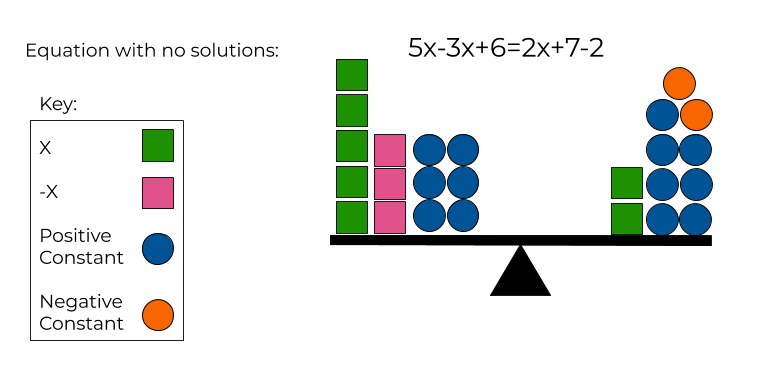
Image source: by Hannah Bonville
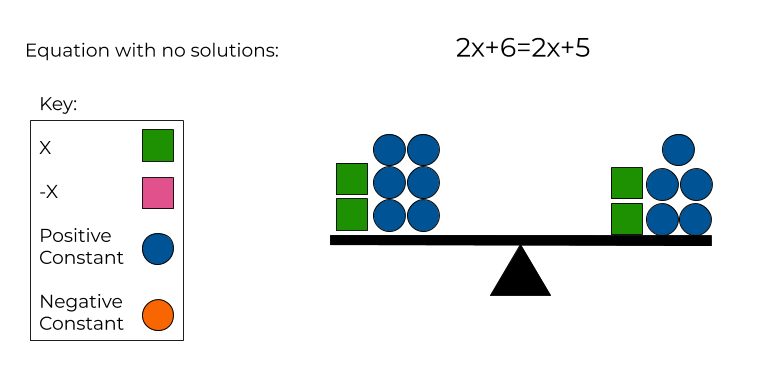
Image source: by Hannah Bonville
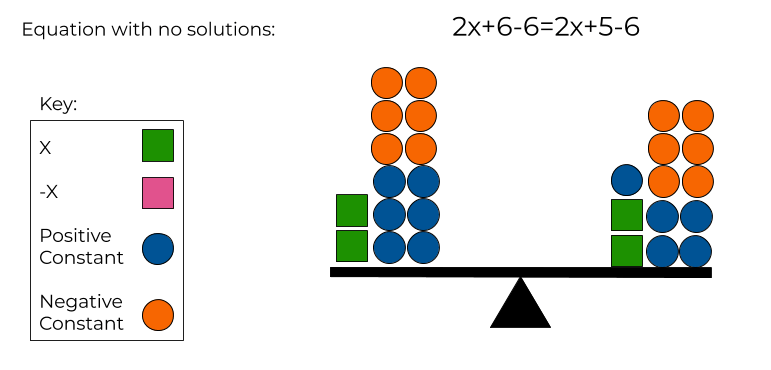
Image source: by Hannah Bonville
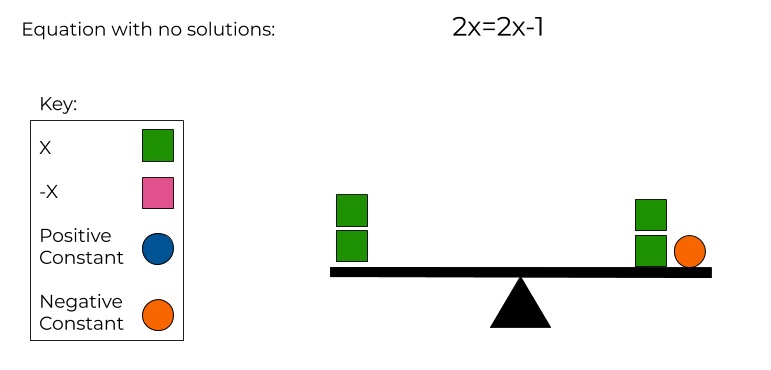
Image source: by Hannah Bonville
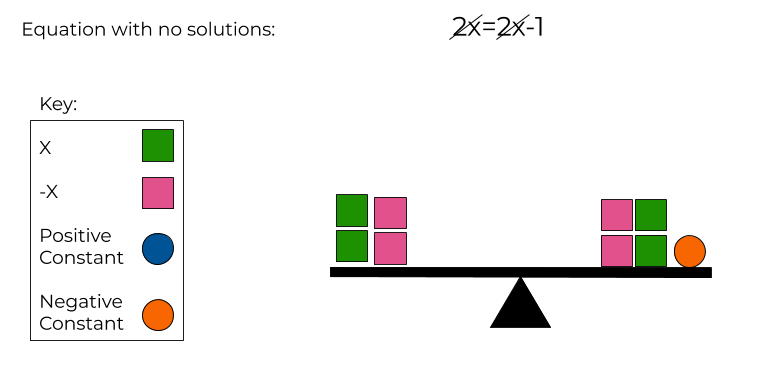
Image source: by Hannah Bonville
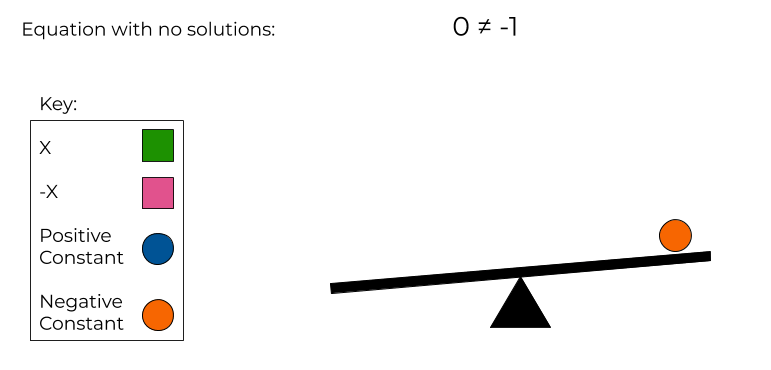
Image source: by Hannah Bonville
There are two things to be careful about with equations with no solutions:
- Make sure you didn't make a mistake when solving for . Always check your work!
- There is a difference between no solution and an equation where the solution is zero. (For instance, for the equation ).
Let's practice a little!
Solve for :
Once we simplify this equation completely and try to solve for , we get .
That's one of those statements that just can't be true. This means that there is no solution.
Let's try another problem:
Which of these equations has no solution?
Try solving each of those equations. You'll find:
- First choice:
- Second choice:
- Third choice:
The only statement that is false is the second choice. Whenever we end up with a false statement (something that just can't be true), we can say that there is no solution.
Now, let's take a look at the equation
How many solutions do you think this equation has?
To figure out how many solutions the equation has, we just have to simplify and solve for . Let's do that! We get the answer . This is a true statement always. This means there are infinitely many solutions. Let's look at how we would model that.
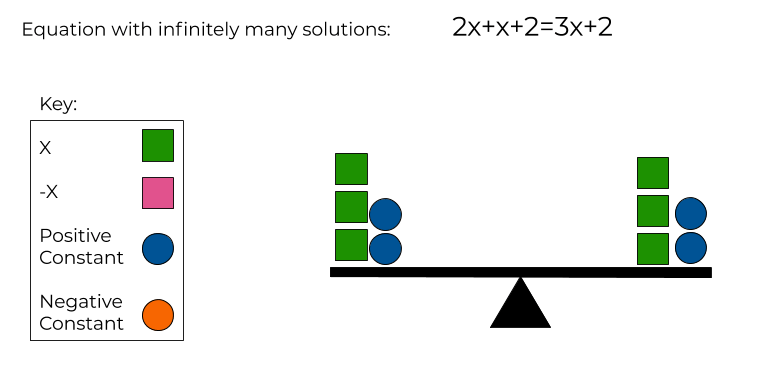
Image source: by Hannah Bonville
We can see there are the same exact things on each side of the scale so it will always be balanced!
We can take this a step further by look at systems of equations, which can also have no solution or infinitely many solutions.

