অটল সমীকরণ: নির্দিষ্ট চলক এর সমাধান

Before this, know$ax+b = c$অটল সমীকরণ

Illustrated · 1 min

Solve Formulas for a Given Variable

Solving equations in terms of other variables is very similar to solving any other equation. You need to manipulate the equation to isolate the variable you are trying to solve for. You won't get a constant answer such as x=3x=3 or y=12y=\frac12. Instead, you'll get one variable defined by another variable, such as x=2yx=2y.

Example:

Solve 2x+3y=62x+3y=6 for yy.

Since we're solving for yy, we want to get the yy variable alone on one side of the equation. Let's look at it step-by-step. 2x+3y=62x − 2x+3y=6 − 2x3y=6−2x\begin{align} 2x+3y&=6\\ 2x\,{\color{#8925AE}{-\,2x}}+3y&=6\,\color{#8925AE}{-\,2x}\\ 3y&=6-2x \end{align}

Now that the yy variable is alone on one side, all we have to do is isolate it completely. 3y=6−2x3y3=6−2x3y=2−23x\begin{align} 3y&=6-2x\\ \frac{3y}{\color{#8925AE}{3}}&=\frac{6-2x}{\color{#8925AE}{3}}\\ y&=2-\frac23x \end{align}

We can see that this new equation is actually equivalent to our original equation, which we can do because of the properties of equality, the multiplication & division property of equality and the addition & subtraction property of equality!

Let's look at one more example with some images to walk us through. Remember, when looking at models, the grey line represents the equal sign.

Solve 5x−y=105x-y=10 for yy.

5x-y=10

Image source: by Zora Gilbert

We can add y to both sides.
5x-y+y=10+y

Image source: by Zora Gilbert

5x=10+y

Image source: by Zora Gilbert

Subtracting 10 from both sides will isolate y on the right side.
5x-10=10+y-10

Image source: by Zora Gilbert

y=5x-10

Image source: by Zora Gilbert

If you solve for your variable, xx, you can check your solution by substituting the solved xx value into both equations. You can learn more about that in a later lesson!

Interactive · 5 questions

Most literal equations have more than one variable, so you'll be asked to solve the equation in terms of one of the variables. For instance, if the literal equation contains variables xx and yy, you might just be asked to solve for xx in terms of yy.

This explanation includes:

  • Solving for a given variable xx in terms of other variable(s)
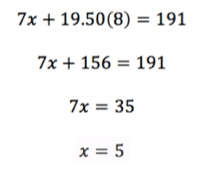
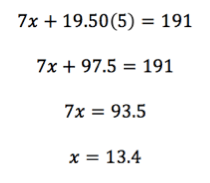
  • Solving for a given variable xx (and getting a numerical answer)

Solving for a given variable xx in terms of other variable(s)

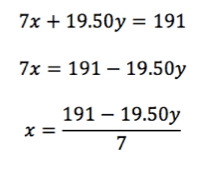
Let's start with a pretty basic literal equation problem. First, we'll create a literal equation from this word problem:

Darryl is on his way to buy chicken and ribs for his family's cookout. He is going to spend exactly 191191 dollars (he has a big family!). Darryl knows that each chicken costs 77 dollars and each pack of ribs costs $19.50\text{\textdollar}19.50. Come up with an equation that models this information.

Grill tools.

Image source: By Clker-Free-Vector-Images CC0 via pixabay.com

Unless the problem instructs you otherwise, you can choose whatever letters you want as your variables. We're just going to stick with the standard xx and yy here, but you could certainly choose something like cc (for chicken) and rr (for ribs).

Which term below represents the cost of the chickens that Darryl buys?

Choose one answer

Video · + 1 min read

(Video) Solving Literal Equations

by YourMathGal

This video YourMathGirl explains what literal equations. We can use this video to help us solve literal equations in terms of one of the variables.

Summary\large{\text{Summary}}

A literal equation is an equation with more than one variable.

The equation for the volume of a box, V=lwhV=lwh, is a literal equation because it has four variables that are unknown. If you wanted to solve for a certain variable, like ll, you would divide both sides by ww and hh. This would give l=Vwhl=\frac{V}{wh}.

The trick is to pretend the other variables are numbers and apply any operation that you would normally apply in order to move the variables around in the equation. Just always remember: whatever you do to one side of the equation, you have to do to the other!

Test Yourself:

The surface area of a sphere is given by the equation S=4πr2S=4\pi r^2. Solve for the radius rr.

Choose one answer

Type a concept, like “slope” or “photosynthesis”.

↑ ↓ to choose · Enter to openSearch explanations and problems