Telescoping sums (or telescoping series) are series whose partial sums eventually cancel each other out to leave certain initial and final terms. The name arises from older telescopes, which often had multiple components that could be "squished" to a smaller size. In this regard, telescoping sums can be viewed as an example of a huge class of math problems using the "top-down" approach; breaking a problem into simpler components often reveals important patterns.
Evaluating a telescoping sum often requires the knowledge of how to decompose fractions into partial fractions. The technique of partial fraction decomposition also arises in the integration of rational functions, since breaking up a rational function into smaller (linear) components leads to more tractable sub-integrals.
Example 1: Evaluate the sum n=1∑50n2+n1.
Solution: Decomposing the fraction, we get:
n=1∑50n(n+1)1=n=1∑50(n1−n+11).
Summing, we get:
1−21+21−31+31−41+...+501−511.
Now, with cancellation, we obtain:
1−511=n=1∑50n2+n1=5150
You may be wondering how to find such a decomposition in general. See Partial Fraction Decomposition for more details on this.
Example 2: Evaluate the sum k=1∑nk2(k−1)!.
Solution: Note that
k2(k−1)!=kk!=(k+1)k!−k!.
Therefore, our desired sum is:
k=1∑nk2(k−1)!=k=1∑n(k+1)!−k=1∑nk!.
Most of the terms are common between the two sums, and therefore cancel out. The last term of the first sum and the first term of the second sum are the only surviving terms. Our answer is (n+1)!−1.
There are analogous problems for products as well. We'll present a trigonometric example that the reader is encouraged to generalize.
Example 3: Find cos(7π)cos(72π)cos(74π).
Solution: First notice that the problem involves powers of 2, which seems especially interesting since 7=23−1. That suggests that a simplification technique such as double angle may succeed.
In order to apply the sine double angle relation sin(2θ)=2sin(θ)cos(θ), we need both sines and cosines. The problem seems to conveniently leave out any sines, but let's try to introduce them on both sides. Let the desired product be P, and consider Psin(7π). Those who have played 2048 may recognize the idea. We have that
Contest problems rarely look like the examples you studied. Solving one means finding your own way in. These are real problems from the AMC 8, AMC 12 and AIME, the national math competitions for middle and high school students, each with a worked solution on LIVE by Po-Shen Loh.
Telescoping sums are series whose terms will stack together and cancel themselves out. Just like the telescopes that some pirates used, the telescopes that these sums were named after those telescopes you could stack together and stuff into your pocket very easily. In the same way, it's way easier to find the value of what's left of a telescoping sum after you collapse it than the entire telescope.
The best way to explain how to telescope a series and what series are telescopic is to show some examples.
Question:
How would you telescope the sum 1+2−2+3−3+4−4+⋯+10−10+11?
This becomes 1+(2−2)+(3−3)+(4−4)+⋯+(10−10)+11, or 1+0+0+⋯+0+11=12!
The ⋯+n−n+⋯ terms all cancel out, just leaving a 1+11.
Let's try a harder one! This is a very well-known telescoping series: 1⋅21+2⋅31+...+5⋅61
Telescoping sums are sums wherein terms cancel out each other, leaving only a few terms. There are various techniques used to simplify telescoping sums. Let's look at some examples
Easy Examples
Evaluate (1−2)+(2−3)+...+(2013−2014)
Clearly one would realize that this is equivalent to (−1)∗2013=−2013. However, if we think about this using telescoping sums, we realize that the -2 and 2 cancel out, then -3 and 3, and so on until the -2013 and 2013. The ones that we are left with are 1 and -2014, so the sum is 1−2014=−2013.
Let's go to a bit more "challenging" one.
Evaluate (1+2−3−4)+(2+3−4−5)+...+(97+98−99−100).
If one wants to compute out each parenthesis (each is equal to k+(k+1)−(k+2)−(k+3)=−4, and note that there are 97 parentheses, the sum would be −4∗97=−388.
However, we could think about this with telescoping sums!
It is easy to notice that there are 97 parentheses. Consider the 1st, 3rd, ..., 97th parenthesis. The 3 and the 4 in the first parenthesis cancels out with the 3 and the 4 in the second parenthesis. The 5 and the 6 in the second parenthesis cancels out with the 5 and 6 in the third parenthesis. We could continue doing this, until we are left with 1+2-99-100.
With regards to the "even-ordered" parentheses, we are left with 2+3-98-99.
Adding up, we get (1+2−99−100)+(2+3−98−99)=−196+(−192)=−388.
Sum of Reciprocals (or something close to it)
Evaluate (1)(2)1+(2)(3)1+...+(9)(10)1.
Since we are trying to make this a telescoping sum, we try to express each as the difference of two fractions.
We know that k1−k+11=(k)(k+1)1, so the sum is equal to (11−21)+(21−31)+...+(91−101)=11−101=109.
With this, we could generalize this to (1)(2)1+...+(k)(k+1)1=k(k+1)k(k+1)−1.
Of course, the difference between the terms is not necessarily equal to 1.
For example, the following is true: k1−k+n1=k(k+n)n. If the common differences are all equal, then we could still represent the sum as a telescoping sum, and then the terms will cancel out.
Clearly this method could be extended to products, with the numerators and denominators cancelling out.
2. Evaluate (3)(5)1+(5)(7)1+...+(97)(99)1.
We could write the sum as 2(31−51)+(51−71)+...+(971−991)=231−991=(3)(99)(2)96=9916.
Trigonometric Applications
Trigonometric identities (usually the angle addition identity) would make telescoping sums easy. The double-angle identity would also help.
Simplify 8cos(32π)sin(32π)sin(16π)sin(8π)
Using the identity sin2a=2sinacosa repeatedly, this is equal to
Now we would want to see how is sin1∘ relevant to cosk∘ and cos(k+1)∘. We could use the difference identity, which is sin(a−b)∘=sina∘cosb∘−cosa∘sinb∘. Hence sin1∘=sin(k+1)∘cosk∘−sink∘cos(k+1)∘.
Thus we can write each term as cosk∘cos(k+1)∘sin(k+1)∘cosk∘−cos(k+1)∘sink∘=cos(k+1)∘sin(k+1)∘−cosk∘sink∘.
Summing up all of these from k=0 to k=88 gives that the sum is cos89∘sin89∘−cos0∘sin0∘=sin1∘cos1∘, which is exactly what we want to show!
Inequalities
Show that 121+221+...k21<2 for whatever k.
Find the greatest integer less than 11+21+...+100001
Exercises
Roughly arranged in increasing order of difficulty.
Simplify (1)(4)1+(4)(7)1+...+(2011)(2014)1.
(AHSME 1986) Simplify the product (1−221)(1−321)...(1−1021).
Prove that the infinite product (1−221)(1−321)... equals to 21.
(Putnam 1977) Evaluate the infinite product: (23+123−1)(33+133−1)....
(HMMT) Compute the infinite sum 32+11+42+11+52+31+....
Evaluate the sum ∑k=1n(k+1)k−kk+11.
Simplify sin1∘+sin2∘+...+sinn∘ in terms of cos21, cos(n+21), and 2sin21.
(Leningrad Mathematical Olympiad) Prove that for all positive integers n, n−1<1+21+2+53+...+(n−1)2+1+n2+12n−1<n.
(IMO 2012)* Let a2, a3, ..., an be positive real numbers that satisfy a2⋅a3⋅...⋅an=1. Prove that (a2+1)2⋅(a3+1)3⋅...⋅(an+1)n≥nn.
(IMO 2013)* Prove that for any pair of positive integers k and n, there exist k positive integers m1, m2, ..., mk (not necessarily different) such that 1+n2k−1=(1+m11)(1+m21)...(1+mk1).
Starred problem uses ideas other than telescoping sums, but the concept is the same.
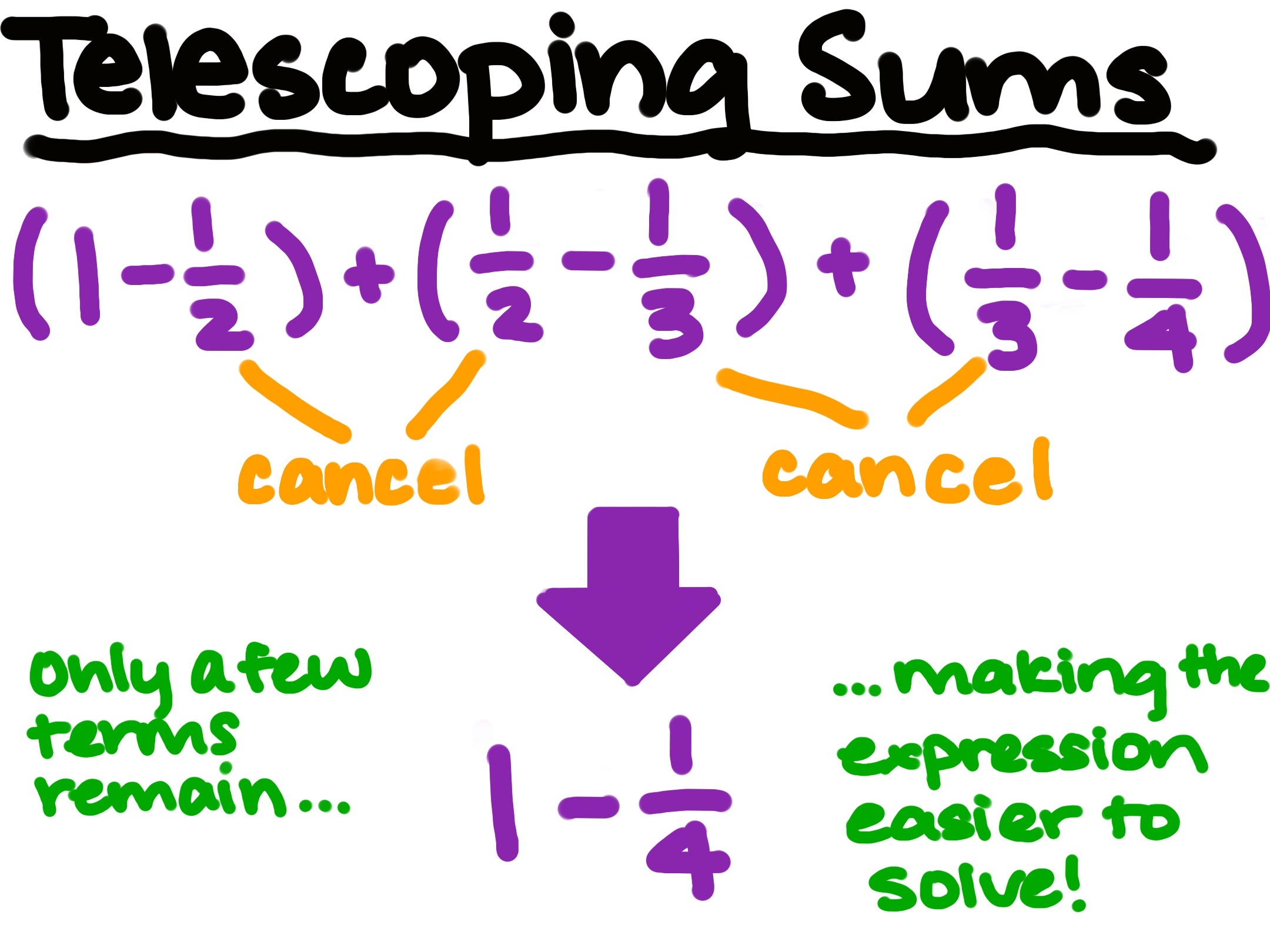
A telescoping sum is a sum in which many of the terms cancel each other out. Instead of adding every term separately, you look for terms that appear with opposite signs. As the matching terms cancel, the expression becomes much shorter.
Usually, only the first and last few terms remain. This makes telescoping sums much easier to evaluate than they first appear.
Image source: by Anusha Rahman
For example,
(1−21)+(21−31)+(31−41)
The 21 and −21 cancel each other out. Similarly, the 31 and −31 also cancel each other out. After the cancelations, you're left with:
1−41
Instead of adding six fractions, you only need to subtract the remaining term from the first.
####Telescoping Products
A telescoping product works similarly, but it uses multiplication instead of addition. Matching factors in the numerators and denominators cancel each other.
For example,
12⋅23⋅34⋅45
The 2s, 3s, and 4s will cancel each other out, leaving you with 15, which equals 5.
Learning to recognize telescoping sums and products can save a great deal of work. Instead of performing many calculations, you can focus on the few terms that do not cancel. This makes telescoping expressions a useful tool for simplifying finite sums and products.
Like telescoping sums, Infinite Geometric Series as Rational Functions provide a way to rewrite an infinite sum as a simple closed-form expression. Both techniques transform a long series into a much simpler result.