প্রয়োগ: চক্রবৃদ্ধি সুদ

Before this, knowসমান্তর ধারাসসীম গুণোত্তর ধারা

Video · + 4 min read

(Videos) Superannuation

by Eddie Woo

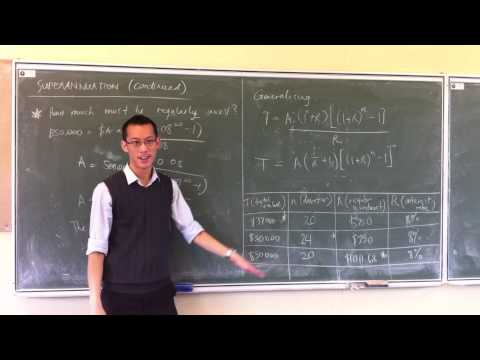
Here's a video by Eddie Woo where he discusses superannuation and how you solve for it.

Recall the two different types of interest. The first is called simple interest. It's an easy way to teach interest but it doesn't show up in the real world. I=PrnI=Prn If you put in $1000\$1000 at a rate of 0.080.08 for 2020 years, this equation gives you: I=PrnI=1000⋅0.08⋅20I=1600\begin{align} I&=Prn\\ I&=1000\cdot0.08\cdot20\\ I&=1600 \end{align}

The second, and more useful, interest is compound interest. This is where the interest starts earning interest, hence why it's called compound. A=P(1+r)nA=P(1+r)^n If we use the same information from before, we get: A=P(1+r)nA=1000(1+0.08)20A=4660.96\begin{align} A&=P(1+r)^n\\ A&=1000(1+0.08)^{20}\\ A&=4660.96 \end{align}

Superannuation Investment

A superannuation is a type of investment where your employer, or the government, takes a set amount of money out of your paycheck each year and adds it to an account to earn interest.

Suppose there's a man who invests $750\$750 every year (p.a.) which is earning interest at 8% p.a. For the sake of simplicity assume it's being compounded annually. How much will he have after 20 years?

Before we begin, let's look at a key idea. Suppose you have two separate accounts of $750\$750. $750$750\begin{array}{ccc} \$750&\quad\quad\quad&\$750 \end{array} Each of these accounts earns interest at 8%. $750$7508%8%\begin{array}{ccc} \$750&\quad\quad\quad&\$750\\ 8\%&\quad\quad\quad&8\% \end{array} The key idea is that there is no difference between this and if they were in the same account earning 8% interest. $750$7508%8%$15008%\begin{array}{ccc} \$750&\quad\quad\quad&\$750\\ 8\%&\quad\quad\quad&8\%\\\\ &\quad\$1500\quad&\\ &\quad8\%\quad& \end{array} It might seem that more money would mean you'd end up earning more but that's not true. These two scenarios are equal.

So when doing the superannuation we're going to look at a bunch of separate instances of $750\$750. We begin by looking at the first time he puts $750\$750 in. Using the compound interest formula, we're able to figure out how much that $750\$750 is worth after 20 years. A=P(1+r)n=750⋅1.0820\begin{align} A&=P(1+r)^n\\ &=750\cdot1.08^{20} \end{align} The next year rolls around and another $750\$750 is put in. Since a year has passed, there's only 19 years left until we reach our end 2 years. So it's interest will be: A=750⋅1.0819A=750\cdot1.08^{19} We do this until we reach the final year. $750\$750 is put in and it sits for a year. A=750⋅1.08A=750\cdot1.08

If we want to find the total amount after 20 years, you might notice that this is a series! 750(1.0820+1.0819+⋅⋅⋅+1.08)750(1.08^{20}+1.08^{19}+\cdot\cdot\cdot+1.08) Because it's same no matter which we add these terms we're going to rewrite it so it's in ascending order. You don't have to but it's what we're used to. 750(1.08+1.082+⋅⋅⋅+1.0820)750(1.08+1.08^{2}+\cdot\cdot\cdot+1.08^{20}) This part in parentheses is our geometric progression. To solve this we need to figure out the starting value aa, the common ratio rr, and how long nn. a=1.08r=1.08n=20\begin{align} a&=1.08\\ r&=1.08\\ n&=20 \end{align} Be careful when calculating nn. You might be tempted to say we have 20−120-1 years, but this is incorrect.

So we can write the total amount of this superannuation as: TA=750[a(rn−1)r−1]TA=750[1.08(1.0820−1)1.08−1]TA=$37067\begin{align} TA&=750\bigg[\frac{a(r^n-1)}{r-1}\bigg]\\ TA&=750\bigg[\frac{1.08(1.08^{20}-1)}{1.08-1}\bigg]\\ TA&=\$37067 \end{align}

Want to Find nn

Suppose now we're given the end amount for a superannuation and we want to find how long it'll take to reach that. This man wants to now find how long it'll take for him to reach $50000\$50000. Now our series becomes: 50000=750(1.08+1.082+⋅⋅⋅1.08n)50000=750[a(rn−1)r−1]50000=750[1.08(1.08n−1)0.08]4.938271604=1.08n−15.938271604=1.08nln⁡(5.938271604)=nln⁡(1.08)n=ln⁡(5.938271604)ln⁡(1.08)n=23.15\begin{align} 50000&=750(1.08+1.08^2+\cdot\cdot\cdot1.08^n)\\ 50000&=750\bigg[\frac{a(r^n-1)}{r-1}\bigg]\\ 50000&=750\bigg[\frac{1.08(1.08^{n}-1)}{0.08}\bigg]\\ 4.938271604&=1.08^n-1\\ 5.938271604&=1.08^n\\ \ln(5.938271604)&=n\ln(1.08)\\ n&=\frac{\ln(5.938271604)}{\ln(1.08)}\\ n&=23.15 \end{align} Be careful though. This superannuation is annual. So we want a whole number year. You might think to round down to 23 years, but let's take a look at what happens when we plug this in. If n=23, T=$49,323If n=24, T=$54,079\begin{align} &\text{If }n=23,\ T=\$49,323\\ &\text{If }n=24,\ T=\$54,079 \end{align} So if we choose 23 years, our man won't have his $50000\$50000. We want to choose the closest year where he has this, and that's when n=24n=24.

Want to Find Starting Value

Suppose now the man is dying and needs to make the $50000\$50000 within his original 20 years. How much would he need to put in every year to achieve that. 50000=A(1.08+1.082+⋅⋅⋅1.0820)50000=A[1.08(1.0820−1)0.08]A=50000[0.081.08(1.0820−1)]A=1011.68\begin{align} 50000&=A(1.08+1.08^2+\cdot\cdot\cdot1.08^{20})\\ 50000&=A\bigg[ \frac{1.08(1.08^{20}-1)}{0.08} \bigg]\\ A&=50000\bigg[ \frac{0.08}{1.08(1.08^{20}-1)} \bigg]\\ A&=1011.68 \end{align} He would need to invest $1011.68\$1011.68 p.a.

Generalizing

We can write a general formula for this application. T=A(1+r)[(1+r)n−1]rT=A(1r+1)[(1+r)n−1]T=\frac{A(1+r)[(1+r)^n-1]}{r}\\ \boxed{T=A\bigg(\frac1r+1\bigg)[(1+r)^n-1]}

This is a nice generalized formula where we can clearly see all its parts: T,n,A,rT,n,A,r.

There are some flaws with this generalized formula though.

  1. It masks the fact that this is a geometric progression. This is a problem because we don't know where it came from. Suppose something happens in the middle of the 20 years and the man can only put in $250\$250 now. There's nowhere in this formula to do this. You can't adjust it.
  2. If you make an error, it's hard to figure out where the error is.

Finding Interest

Suppose now the man wants to find the interest it would take to superannuate $750\$750 to $50000\$50000 in 20 years. Let's plug our numbers into our generalized equation. T=A(1r+1)[(1+r)n−1]50000=750(1r+1)[(1+r)20−1]\begin{align} T&=A\bigg(\frac1r+1\bigg)[(1+r)^n-1]\\ 50000&=750\bigg(\frac1r+1\bigg)[(1+r)^{20}-1] \end{align}

But there's a problem. Before, when solving for T,A,nT,A,n, we only had one in the equation. So how do we isolate the rr? Normally, you'd expand out the factors but we have (1+r)20(1+r)^{20} and I don't know about you but I don't want to expand that out.

There's only 2 ways to solve this kind of equation.

  1. Guess and Check
  2. Newton's Method: this is a sort of "guided" guess and check method that finds the roots of polynomials. This isn't learned until calculus though.

So as of right now, there's no way to solve this version of the equation.

But if you're curious, plugging this into Wolfram Alpha, we get that the interest needs to be: r=10.5%r=10.5\%.

Video · + 5 min read

(Videos) Time Payments

by Eddie Woo

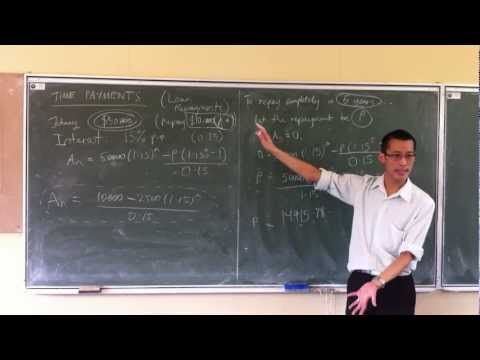
Here's a series of videos by Eddie Woo where he talks about time payments or loan repayments and how they involve geometric progressions.

Time payments are just payments you make over time. You borrow some money and pay it back over a length of time.

Time Payments

Suppose Johnny needs to borrow $50000\$50000. He works out that he can repay $10000\$10000 a year (p.a.). Because he's borrowing money, the bank will charge him interest. When you borrow money, the interest rate is much higher than when you're saving money. So his interest rate is 15%15\%.

How much will he repay after the first 5 years? If there was no interest rate, he would be able to pay off the loan within 5 years (10000∗5=5000010000*5=50000). So by asking this question we can see by how much this interest rate delays him. We start from the beginning and we want to look for a geometric progression.

We want to let the amount owed after nn years be $An\$A_n. In sequences, we usually use TnT_n to denote the nthn^{\text{th}} amount. This is the same thing.

Let's begin by figuring out what A1A_1 would be. We start with the $50000\$50000. At the end of the first year he's going to make his payment of $10000\$10000. But before that, the bank is going to charge him interest on the $50000\$50000. A1=50000(1.15)−10000A_1=50000(1.15)-10000

Now the next year rolls around. He's about to make his second repayment but before that he's charged interest on the amount he has left to pay, A1A_1. A2=A1(1.15)−10000A2=[50000(1.15)−10000](1.15)−10000A2=50000(1.15)2−10000(1.15)−10000\begin{align} A_2&=A_1(1.15)-10000\\ A_2&=[50000(1.15)-10000](1.15)-10000\\ A_2&=50000(1.15)^2-10000(1.15)-10000 \end{align}

You do the same for the third year. A3=A2(1.15)−10000A3=[50000(1.15)2−10000(1.15)−10000](1.15)−10000A3=50000(1.15)3−10000(1.15)2−10000(1.15)−10000\begin{align} A_3&=A_2(1.15)-10000\\ A_3&=[50000(1.15)^2-10000(1.15)-10000](1.15)-10000\\ A_3&=50000(1.15)^3-10000(1.15)^2-10000(1.15)-10000 \end{align}

By now you can probably either see, or smell, a geometric progression somewhere in here. The first term, 50000(1.15)350000(1.15)^3, doesn't really fit with the rest. A −10000-10000 can be factored from the remaining terms. A3=50000(1.15)3−10000(1.152+1.15+1)A_3=50000(1.15)^3-10000(1.15^2+1.15+1) We can then rearrange the terms inside the parentheses so that their exponents are in ascending order. A3=50000(1.15)3−10000(1+1.15+1.152)A_3=50000(1.15)^3-10000(1+1.15+1.15^2)

From here, we can build a generalized equation for the nthn^{\text{th}} term. An=50000(1.15)n−10000(1+1.5+⋅⋅⋅+1.15n−1)A_n=50000(1.15)^n-10000(\color{#8925AE}{1+1.5+\cdot\cdot\cdot+1.15^{n-1}}) Here, the 5000050000 is our original amount owed, the 0.150.15 is the interest, the 1000010000 is the payments made each year, and nn is the number of years.

Furthermore, the purple part in parentheses is a geometric progression so we can work out what it's equal to. Since it's a geometric progression we need to define our three components: a,r,na,r,n. The first term in the series is 11 so that's our aa. It increases by 1.151.15 each term, so that's our rr. Now you might be tempted to say there's n−1n-1 terms, but there's actually nn terms. This is because the first term 11 can be rewritten as 1.1501.15^0. So if you count from 0 to n−1n-1 you get nn. If this doesn't make sense you can check for your self by counting the terms in A3A_3. a=1r=1.15n=n\begin{align} a&=1\\ r&=1.15\\ n&=n \end{align} So AnA_n can be rewritten as: An=50000(1.15)n−10000⋅1(1.15n−1)0.15An=50000(1.15)n−10000(1.15n−1)0.15An=0.15(50000)(1.15)n0.15−10000(1.15n−1)0.15An=7500(1.15)n−10000(1.15)n+100000.15An=10000−2500(1.15)n0.15\begin{align} A_n&=50000(1.15)^n-\frac{10000\cdot1(1.15^n-1)}{0.15}\\ A_n&=50000(1.15)^n-\frac{10000(1.15^n-1)}{0.15}\\ A_n&=\frac{0.15(50000)(1.15)^n}{0.15}-\frac{10000(1.15^n-1)}{0.15}\\ A_n&=\frac{7500(1.15)^n-10000(1.15)^n+10000}{0.15}\\ A_n&=\frac{10000-2500(1.15)^n}{0.15} \end{align}

Now that we built the general term, we can use it to find the 5th5^{\text{th}}. A5=10000−2500(1.15)50.15A5=33144.05\begin{align} A_5&=\frac{10000-2500(1.15)^{\color{#8925AE}{5}}}{0.15}\\ A_5&=33144.05 \end{align}

This is the amount owed from the original $50000\$50000. As you can see, after 5 years he hasn't even reached half-way to repaying it.

(Videos) Time Payments

by Eddie Woo

How Long

We just found out that Johnny hasn't even paid half his loan within 5 years. The next logical question to ask is, "how many years will it take?"

We know that the equation for this is: An=10000−2500(1.15)n0.15\boxed{A_n=\frac{10000-2500(1.15)^n}{0.15}} Because we're looking for when his loan is paid, that's equivalent to asking when he has no more loan, or when An=0A_n=0. Plug this in and then solve for nn.

An=10000−2500(1.15)n0.150=10000−2500(1.15)n0.150=10000−2500(1.15)n2500(1.15)n=100001.15n=4nln⁡1.15=ln⁡4n=ln⁡4ln⁡1.15n=9.919\begin{align} A_n&=\frac{10000-2500(1.15)^n}{0.15}\\ 0&=\frac{10000-2500(1.15)^n}{0.15}\\ 0&=10000-2500(1.15)^n\\ 2500(1.15)^n&=10000\\ 1.15^n&=4\\ n\ln1.15&=\ln4\\ n&=\frac{\ln4}{\ln1.15}\\ n&=9.919 \end{align}

So Johnny would fully repay his loan after the 10th10^{\text{th}} year.

(Videos) Time Payments

by Eddie Woo

Find Repay Amount

Suppose 10 years is too long for Johnny. He instead decides to alter how much he repays at the end of the year in order to finish within 5 years. Well we can just plug in PP for our payment. But where do we plug it in? An=10000−2500(1.15)n0.15A_n=\frac{10000-2500(1.15)^n}{0.15}

You might think we can just exchange it for the 1000010000 but, if you recall, we used the 1000010000 to help us get 25002500. So this equation doesn't actually help us. We need to go farther back in the equation to a point where PP was still preserved. An=50000(1.15)n−10000(1.15n−1)0.15A_n=50000(1.15)^n-\frac{10000(1.15^n-1)}{0.15}\\

Here we can safely substitute out 1000010000 for PP. An=50000(1.15)n−P(1.15n−1)0.15A_n=50000(1.15)^n-\frac{P(1.15^n-1)}{0.15} Since we want it the loan to be repaid within 5 years we set A5=0A_5=0 and solve. An=50000(1.15)n−P(1.15n−1)0.150=50000(1.15)5−P(1.155−1)0.15P(1.155−1)0.15=50000(1.15)5P(1.155−1)=15085.17891.011357P=15085.1789P=14915.78\begin{align} A_n&=50000(1.15)^n-\frac{P(1.15^n-1)}{0.15}\\ 0&=50000(1.15)^5-\frac{P(1.15^5-1)}{0.15}\\ \frac{P(1.15^5-1)}{0.15}&=50000(1.15)^5\\ P(1.15^5-1)&=15085.1789\\ 1.011357P&=15085.1789\\ P&=14915.78 \end{align}

So in order to pay off the loan within 5 years, Johnny would have to pay back $14915.78\$14915.78 each year.

(Videos) Time Payments

by Eddie Woo

Monthly Installments

Suppose now that the bank has Johnny pay in monthly installments instead. Everything else stays the same: he borrows $50000\$50000, the interest is 15%15\%, and it's 5 years. Only now, everything is represented monthly.

How much will he save (over the life of the loan) by paying monthly (not annually)?

So 5 years in terms on months is 60 months. The interest is 15%15\% per year. If we divide by 12 months we get the interest for each month. 15%÷12=1.25%15\%\div12=1.25\%.

The only piece of information we don't know is how much he's repaying each month. Let's figure this out by setting A60=0A_{60}=0 and solving. An=50000(1.0125)n−P(1.025n−1)0.01250=50000(1.0125)60−P(1.02560−1)0.0125P(1.012560−1)0.0125=50000(1.0125)60P=0.0125(50000)(1.0125)601.012560−1P=1189.50\begin{align} A_n&=50000(1.0125)^n-\frac{P(1.025^n-1)}{0.0125}\\ 0&=50000(1.0125)^{60}-\frac{P(1.025^{60}-1)}{0.0125}\\ \frac{P(1.0125^{60}-1)}{0.0125}&=50000(1.0125)^{60}\\ P&=\frac{0.0125(50000)(1.0125)^{60}}{1.0125^{60}-1}\\ P&=1189.50 \end{align}

To figure out how much he pays over the life of the loan we multiply his monthly payment by how many months he's paying it. 1189.50⋅60=713701189.50\cdot60=71370

If you look back to the previous section, in order to pay off the loan in 5 years with annual payments, he'd need to pay 14915.7814915.78 each year. So the amount over the life of the loan is: 14915.78⋅5=74578.9014915.78\cdot5=74578.90

So Johnny would be saving, 74578.90−71370=3208.9074578.90-71370=3208.90 just by switching from yearly to monthly.

(Videos) Time Payments

by Eddie Woo

How Much can You Borrow

Suppose Johnny only have 5 years, he can only pay 1000010000 p.a., there's 15%15\% interest, it's compounded annually, and he wants it all paid by the end of the year.

How much can Johnny really borrow? Let the borrowed amount be $B\$B.

An=B(1.15)n−10000(1.15n−1)0.150=B(1.15)5−10000(1.155−1)0.15B(1.15)5=10000(1.155−1)0.15B=10000(1.155−1)0.15(1.15)5B=33521.55\begin{align} A_n&=B(1.15)^n-\frac{10000(1.15^n-1)}{0.15}\\ 0&=B(1.15)^5-\frac{10000(1.15^5-1)}{0.15}\\ B(1.15)^5&=\frac{10000(1.15^5-1)}{0.15}\\ B&=\frac{10000(1.15^5-1)}{0.15(1.15)^5}\\ B&=33521.55 \end{align}

He can borrow $33521.55\$33521.55.

This is interesting because in the very first section we say that after 5 years he only paid 50000−33144.05=16855.9550000-33144.05=16855.95 but in this example he was almost able to borrow double and be able to repay it.

The reason is because he borrows a larger amount in the first section. Just by borrowing a larger amount at the beginning that's what makes him pay off so little by the end. So if you can help it, don't borrow large amounts of money.

Read · 2 min

Finite Series Word Problems

Understanding finite series and their applications in solving word problems is essential in many fields, such as math, finance, and science. Recognizing patterns and applying math concepts will help you to effectively solve real-world problems involving finite geometric and finite arithmetic series.

####Let's Recap

Finite series are sequences of numbers with a finite number of terms. They are typically encountered in real-world scenarios where values are accumulated or added over a period of time. When dealing with word problems, we need to identify the pattern of accumulation and use it to find the total or final value.

Before moving forward in the lesson, it would be helpful to fully understand how to evaluate a series by adding and using summation and product notation. Remember that arithmetic progressions have a constant difference between terms, and geometric progressions have a constant ratio between terms.

####Solving Word Problems

We can use these types of word problems involving finite series in various contexts, like finance, population growth, or inventory management. There are three main steps that we will use to tackle these problems: break down the problem, identify the pattern, and set up equations to find the solution.

Use diagrams, tables, and charts! Organize the information presented to you to help you in solving the problems.

Let's take a look at an example problem in the finance industry.

Example Problem

An investor deposits $500\$500 into a savings account on the first of every month for 1212 months. If the account earns an annual interest of 4%4\%, find the total amount in the account after 1212 months.

To solve this problem, we will use the concepts of finite arithmetic series to find the total amount in the account after 1212 months.

We know that the monthly deposit amount is $500\$500, the number of months is 1212, and the annual interest rate is 4%4\% (0.040.04).

First, we want to calculate the total amount deposited over 1212 months.

total deposit=monthly deposit/cdotnumber of months=500⋅12=6000\begin{align} \text{total deposit} &= \text{monthly deposit} /cdot \text{number of months} \\ &= 500 \cdot 12 \\ &= 6000 \\ \end{align}

So, the investor deposited $6000\$6000 over one year.

Second, we want to calculate the interest earned on each deposit. Since the account earns 4%4\% annual interest, we need to find the monthly interest rate.

monthly interest rate=annual interest rate/12=0.04/12=0.00333\begin{align} \text{monthly interest rate} &= \text{annual interest rate} / 12 \\ &= 0.04 / 12 \\ &= 0.00333 \\ \end{align}

We will now use these two calculate values to find the total interest over 1212 months. total interest=total deposit⋅monthly interest rate⋅number of months=6000⋅0.00333⋅12=239.76\begin{align} \text{total interest} &= \text{total deposit} \cdot \text{monthly interest rate} \cdot \text{number of months} \\ &= 6000 \cdot 0.00333 \cdot 12 \\ &= 239.76 \\ \end{align}

Finally, we will calculate the final amount in the account! final amount=total deposit+total interest=6000+239.76=6239.76\begin{align} \text{final amount} &= \text{total deposit} + \text{total interest} \\ &= 6000 + 239.76 \\ &= 6239.76 \\ \end{align}

The investor has $6239.76\$6239.76 in the savings account after 1212 months.

Looking Further

To close out this set of lessons, we will learn about triangular numbers in the next lesson.

Illustrated · 1 min

Word Problems with Finite Series

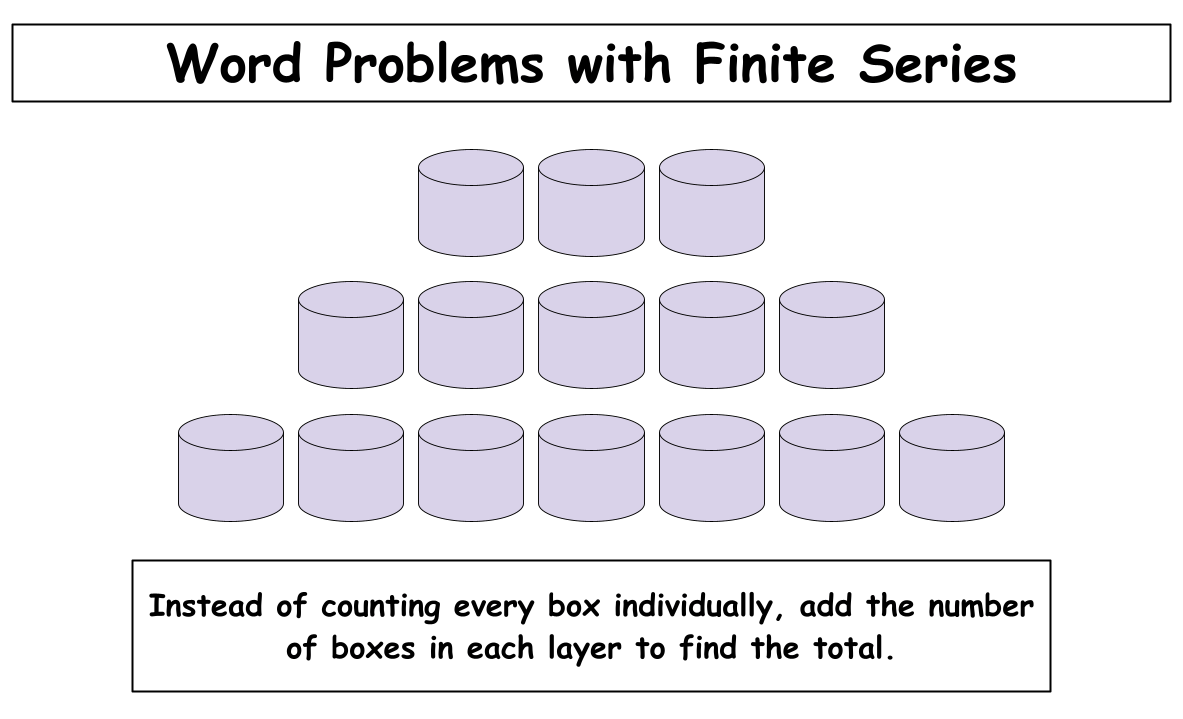
Instead of counting every box individually, add the number of boxes in each layer to find the total.

Image source: by Anusha Rahman

Stacks like this are a great example of a finite series. Each layer contains a certain number of boxes, and the total number of boxes is found by adding all of the layers together.

If the number of boxes increases by the same amount from one layer to the next, the layers form an arithmetic sequence. Adding all of those terms creates an arithmetic series.

For a small stack, you could simply count or add the boxes one layer at a time. However, this becomes difficult when there are many layers.

You can instead use the arithmetic series formula to find the total number much more quickly. Before you use the formula, identify the first layer, the last layer, and the total number of layers. These values will tell you everything you need to calculate the sum. The answer represents the total number of boxes in the entire stack.

This same idea works for many real-world situations where the values increase or decrease by a constant amount. For example, you could use it to find the total number of seats in a stadium or the total number of plants arranged in rows.

The key is recognizing that the numbers follow an arithmetic sequence. Once you identify the pattern, the arithmetic series formula lets you find the total without adding every term one by one.

Looking Further

The final lesson in section on finite series is on triangular numbers.

Once you master finite series, we'll make things a little more complicated with infinite series.

Type a concept, like “slope” or “photosynthesis”.

↑ ↓ to choose · Enter to openSearch explanations and problems