Finding the Center and Radius of a Circle
There are two ways you can find the center and radius of a circle: by graphing or reading an equation. We will start with reading an equation.
Reading an Equation
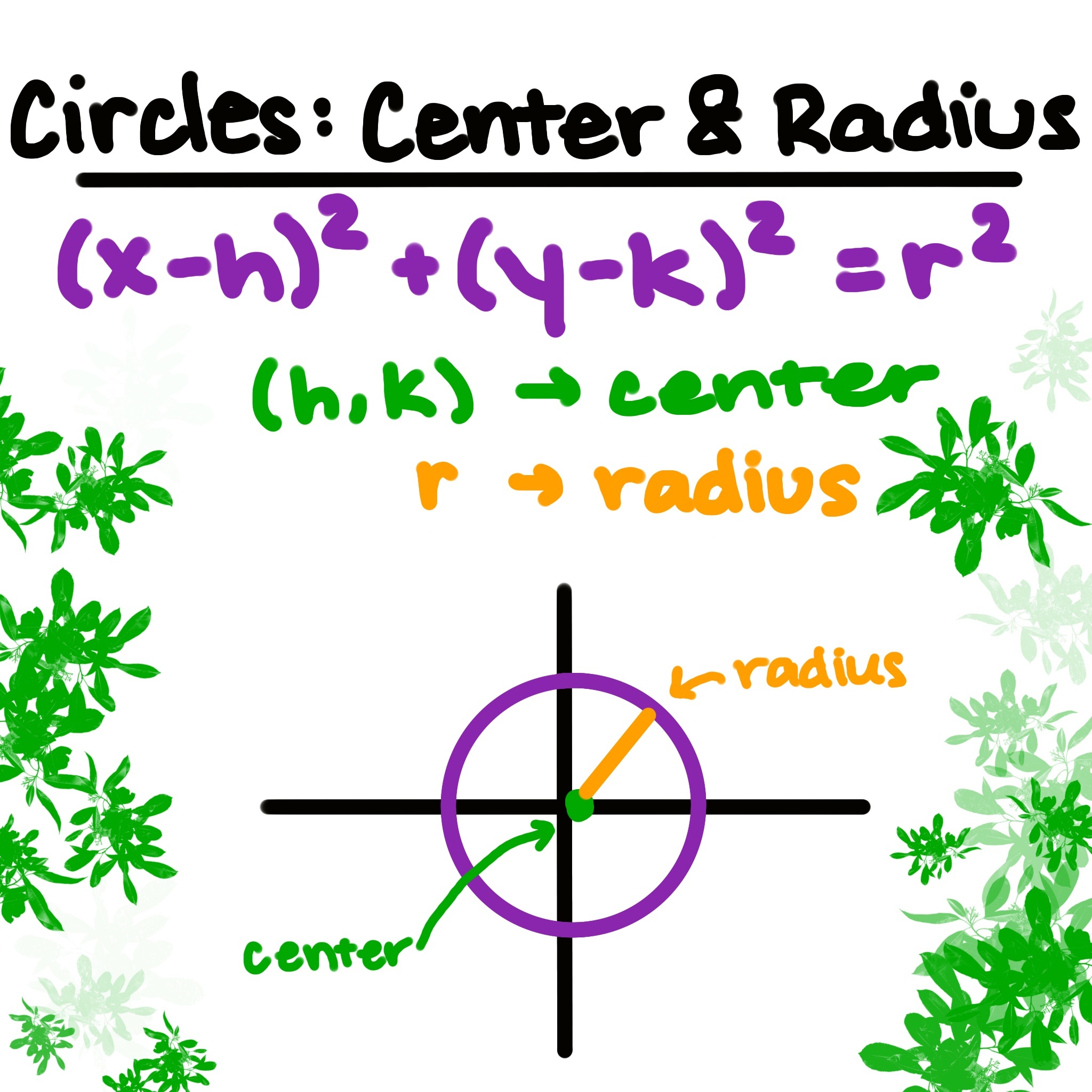
As we saw in the previous lesson, circles often follow a standard form. We also learned how to convert from different forms. This lesson will help you to find the equation of a circle using the radius and center. The following equation is the standard form of a circle:
(x−h)2+(y−k)2=r2
You already have the tools to find the center and radius using the standard form! Radius, r, is the simplest. Just take the square root of the right-hand side (r2) of the equation in standard form.
The center is a tad bit more complicated, but nothing you can't handle. To find the center of a circle using standard form, know that the circle's center is found at (h,k). Beware of the signs!
Reading a Graph
To find the center and radius of a circle that is graphed requires a little deduction. Let's start with the radius. We know that the radius is one-half of the diameter of a circle. We also know that the diameter is the distance from one point of the circle to the absolute other side of the circle.
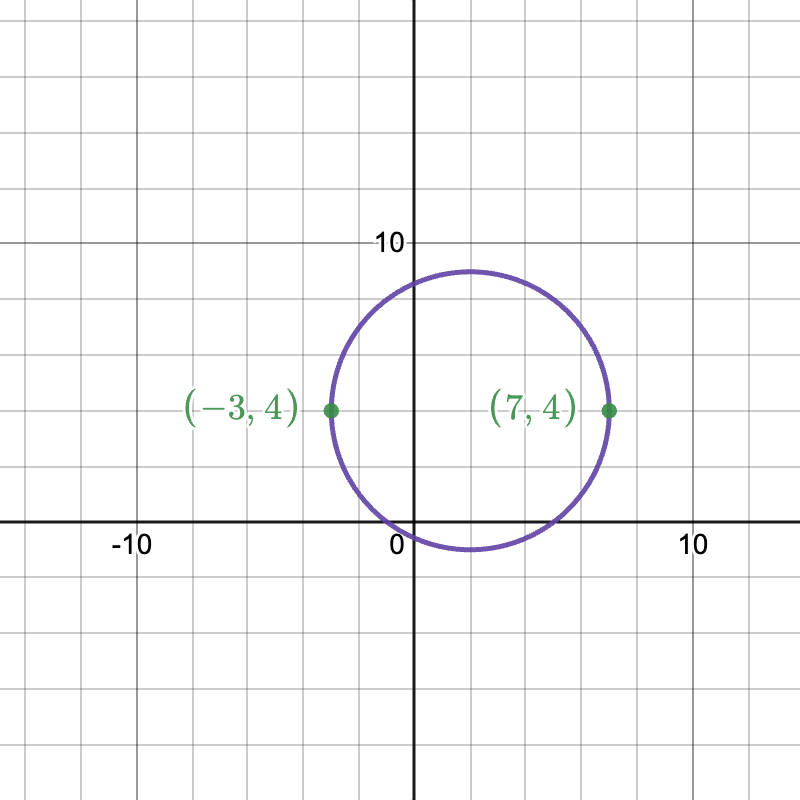
In the above graph, we can see two points on the circle labeled, one at (−3,4) and one at (7,4). Now, we need to calculate the distance between the two points in order to find the diameter. Since the y values of both points are the same, we need only to consider the x values. The distance between the two points is 10.
Therefore, the radius of the circle is 5.
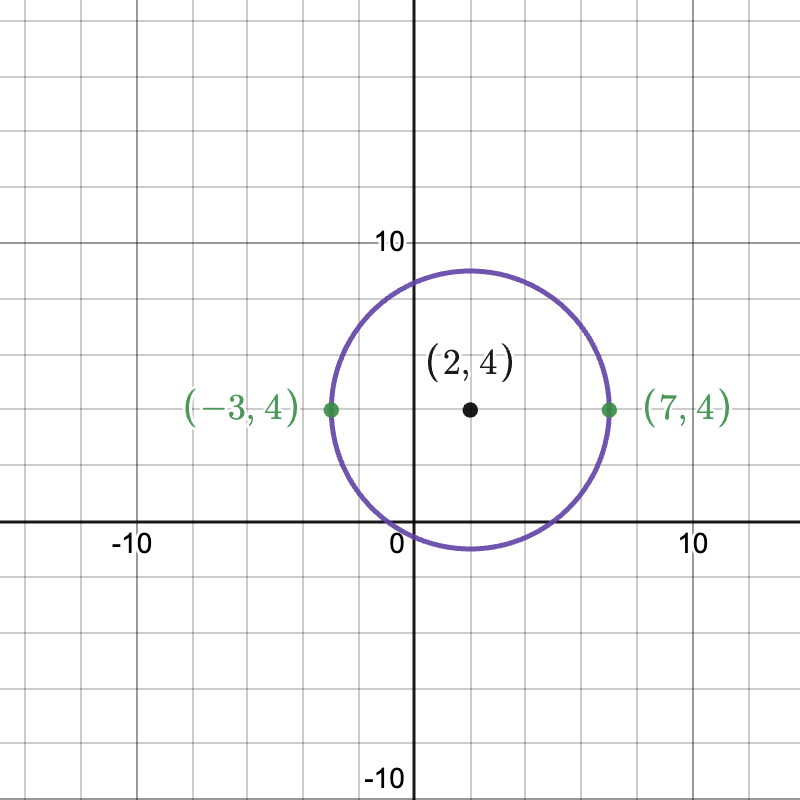
Next, we will find the center of the circle. If we go back to the definition of a circle, we know that the center of a circle is a point equidistance from any point on the circle. Another way to think of the center of a circle is to look at the halfway point on a diameter of the circle. We can continue to consider the above graph.
The halfway point between both points can be found at (2,4).