Illustrated · 1 min

The Circle
By definition, a circle is a set of points on a curve that are a fixed distance, the radius, from a center point.

Image source: by Anusha Rahman
Deriving The Equation of a Circle
To get the equation of a circle, we need to first go back to our basics -- the pythagorean theorem!

Image source: by Anusha Rahman
Imagine the above triangle on a cartesian plane. The horizontal line is and the vertical line is . The hypotenuse goes from the origin to a point on the circle, designated by , the radius.
We can apply the pythagorean theorem to the above triangle.
Say we want to graph a circle with a radius of . The equation is:

Made using Desmos
Applying the Equation of a Circle
So far, we've figured out the equation of a circle that is centered at the origin, . Let's think about what happens if the circle is not centered at the origin.
Think back to our function transformations!
If the function is not centered at the origin, it will have a different center at .
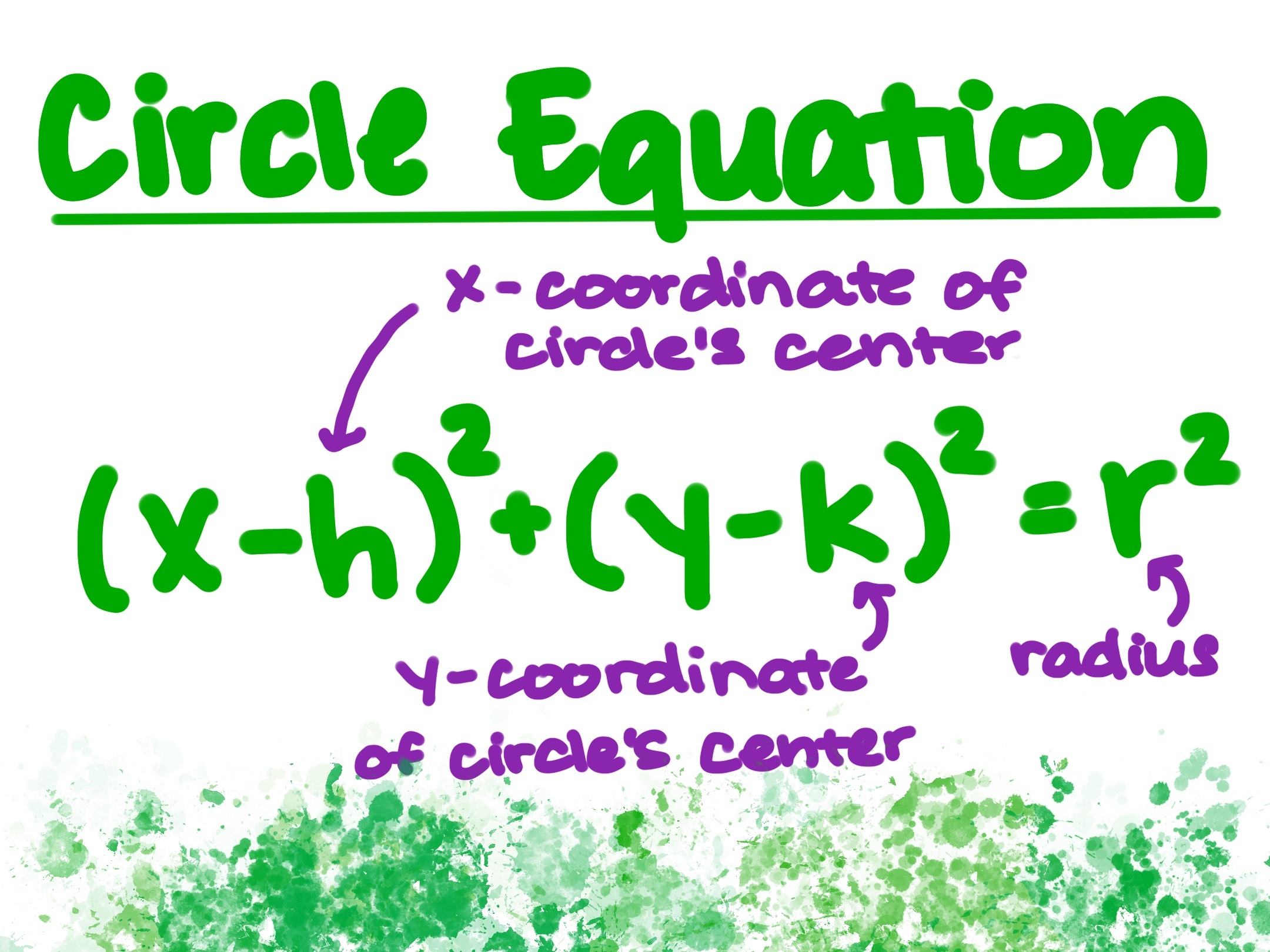
So, that means that our new equation for a circle is:
Always be careful to watch your signs inside the parentheses! This is your standard form.
For a circle with a center at and radius of , our equation is

Made using Desmos