বিপরীতযোগ্য ম্যাট্রিক্স উপপাদ্য

Before this, know$2\times 2$ ম্যাট্রিক্সের ইনভার্স

Read · 1 min

The invertible matrix theorem is a theorem in linear algebra which offers a list of equivalent conditions for an n×n square matrix A to have an inverse.

Matrix A is invertible if and only if any (and hence, all) of the following hold:

  1. A is row-equivalent to the n×n identity matrix I_n.

  2. A has n pivot positions.

  3. The equation Ax=0 has only the trivial solution x=0.

  4. The columns of A form a linearly independent set.

  5. The linear transformation x|->Ax is one-to-one.

  6. For each column vector b in R^n, the equation Ax=b has a unique solution.

  7. The columns of A span R^n.

  8. The linear transformation x|->Ax is a surjection.

  9. There is an n×n matrix C such that CA=I_n.

  10. There is an n×n matrix D such that AD=I_n.

  11. The transpose matrix A^(T) is invertible.

  12. The columns of A form a basis for R^n.

  13. The column space of A is equal to R^n.

  14. The dimension of the column space of A is n.

  15. The rank of A is n.

  16. The null space of A is {0}.

  17. The dimension of the null space of A is 0.

  18. 0 fails to be an eigenvalue of A.

  19. The determinant of A is not zero.

  20. The orthogonal complement of the column space of A is {0}.

  21. The orthogonal complement of the null space of A is R^n.

  22. The row space of A is R^n.

  23. The matrix A has n non-zero singular values.

Video · + 1 min read

The Invertible Matrix Theorem

by James Hamblin

This video by James Hamblin walks you through the 1212 statements that make up the Invertible Matrix Theorem.

Summary

The Invertible Matrix Theorem characterizes all of the conditions that must be met in order for a matrix to be considered invertible. All of the following statements must be true, or all of the following statements must be false.

The theorem says that: Let AA be a square nxnnxn matrix. The following are equivalent:

(a) The matrix AA is invertible

(b) The matrix AA is row-equivalent to InI_n

(c) The matrix AA has nn pivot positions

(d) The equation Ax=0Ax=0 has only the trivial solution

(e) The columns of AA are linearly independent

(f) The linear transformation T(x)=AxT(x)=Ax is one-to-one

(g) The equation Ax=bAx=b is consistent for all bϵRnb \epsilon R^n

(h) The columns of AA span RnR^n

(i) The linear transformation T(x)=AxT(x) = Ax is onto

(j) There is an nxnnxn matrix CC such that CA=InCA=I_n

(k) There is an nxnnxn matrix DD such that AD=InAD = I_n

(l) The matrix ATA^T is invertible

To prove that several statements are equivalent, we have to prove that if any one of them is true, then all of the others are true. We do this by creating implication chains, which are a series of "if and only if" statements. Watch the video to see how to use these implication chains!

The previous example looked at square matrices to see if they are invertible matrices. This theorem only applies to square matrices, not any other type of matrix.

Illustrated · 1 min

Invertible Matrix Theorem

The Invertible Matrix Theorem comes in handy for very large matrices. You won't need to always compute the inverse directly - you can check any of these equivalent conditions.

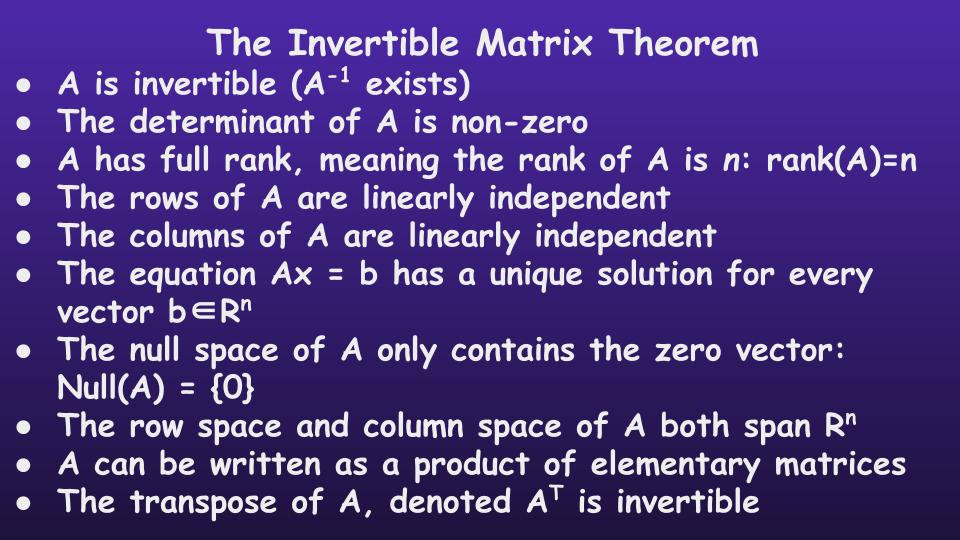
The Invertible Matrix Theorem
A is invertible (A-1 exists)
The determinant of A is non-zero
A has full rank, meaning the rank of A is n: rank(A)=n
The rows of A are linearly independent
The columns of A are linearly independent
The equation Ax = b has a unique solution for every vector b∈Rn
The null space of A only contains the zero vector: Null(A) = {0}
The row space and column space of A both span Rn
A can be written as a product of elementary matrices
The transpose of A, denoted AT is invertible

Image source: by Anusha Rahman

Some key terms to know:

  • Invertibility: A matrix is invertible if there is another matrix A−1A^{-1} such that A⋅A−1=A−1A \cdot A^-1 = A^-1. A=IA=I, where II is the identity matrix.
  • Determinant: the determinant is a scalar value. If det(A)/neq0det(A) /neq 0, then the matrix is invertible.
  • Rank: the maximum number of linearly independent rows or columns. Invertible matrices must have full rank, meaning its rows and columns and linearly independent.
  • Linear independence: no row or column can be written as a linear combination of the others.
  • Unique solutions: If AA is invertible, the system Ax=bAx=b always has a unique solution, no matter what vector bb is.
  • Null space: the set of all vectors xx that satisfy Ax=0Ax=0. If the null space only contains the zero vector, the columns of AA are linearly independent, and AA is invertible.
  • Spanning: The row space and column space of an invertible matrix span all of RnR^n, meaning they fill up the entire space without any gaps.

Type a concept, like “slope” or “photosynthesis”.

↑ ↓ to choose · Enter to openSearch explanations and problems