Interactive · 2 questions

+3 contributors




By NASA, Public Domain, Wikimedia Commons
You may have heard that people are weightless in outer space before and wondered how that could be possible. In daily life on Earth, we tend to think of mass and weight as synonyms. However, weight is actually a description of the pull of gravity on an object, while mass is the actual value of how much "stuff" it contains, which doesn't change in different locations.
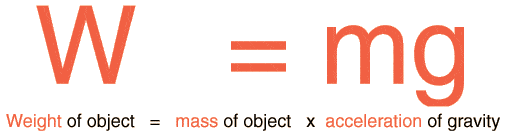
Specifically, weight is defined as the product of mass and gravitational acceleration, or W = m*g, with g representing the gravitational acceleration, or force of gravity pulling on the object. On Earth, g = 9.81 m/s.
Since the moon is less massive than the Earth, it has a smaller gravitational acceleration. Because of this, your weight on the moon would be 1/6th of your weight on Earth!
In chemistry, we use mass to determine the amount of substance (which is a fancy word for "chemical") present. Grams, abbreviated as g, are the units used in the International System of Measurements to measure mass.
Because Jupiter is so much more massive than Earth, the gravitational acceleration there is 2.5 times stronger than the gravity on Earth. If you weigh 100 pounds on Earth, what number would you expect to see if you stepped on a scale on Jupiter?
You bring a 500g water bottle with you on your trip to Jupiter in order to stay hydrated (incredibly important in the dryness and cold of space!). What mass would your water have on Jupiter? As a reminder, the gravitational acceleration there is 2.5x that on Earth.