শতকরা পরিবর্তনের সুত্র

Before this, knowশতকরা পরিবর্তন

Interactive · 9 questions

Calculating Percent Change

You're probably more familiar with the idea of percent change than you realize. Every time you see a TV commercial, a billboard, or a storefront sign advertising a sale, you're actually looking at a calculation of it!

Instead of saying, "Our TVs are now 347.78347.78 instead of 869.43869.43," it's a lot easier (and a lot catchier) to say "Our TVs are now 40%40\% off." Whenever you see a "%\% off" or "save ____%\%" sign, someone's done the calculation for you!

5% off

Image by Maklay62 via Pixabay (CC0)

So, let's look at a few examples to learn how to do these calculations ourselves. But first, let's take a look at a pretty simple formula to follow.

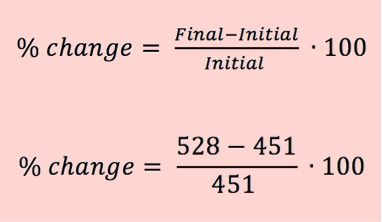
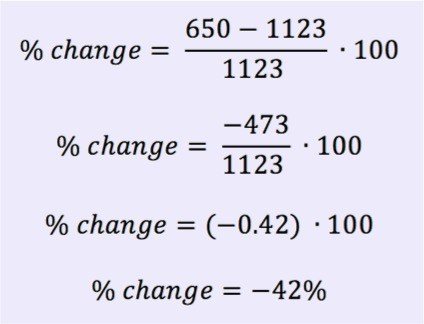
Percent change = [(Final value - Initial value)/Initial value] * 100

Image source: by Caroline Kulczycky

To use this formula, there are two values you need to know to calculate the percentage change: the initial (starting) value and the final value.

There are a few things to keep in mind:

  • It's okay to have values over 100%100\%
  • A Positive number means that the overall value increased (% increase)
  • A Negative number means that the overall value decreased (% decrease)

Your percent change can either increase or decrease.

The formula is multiplied by 100100 in order to convert the decimal into a percent.

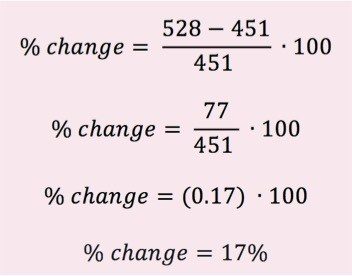
Main Street School had 451 students enrolled last year. They have 528 students enrolled this year. What is the percent change in student enrollment?

Image by Clker-Free-Vector-Images via Pixabay (CC0)

First, just by looking at the final and initial values, will our percent change be positive or negative?

Choose one answer

No recipe to follow

These problems have no steps to copy. You have to understand the idea well enough to bend it to a new purpose. These are real problems from the AMC 8, AMC 10, AMC 12 and AIME, the national math competitions for middle and high school students, each with a worked solution on LIVE by Po-Shen Loh.

Video

(Video) Percent Change Formula

by The Organic Chemistry Tutor

This video by The Organic Chemistry Tutor demonstrates the percent change formula with an example.

Summary\large{\text{Summary}}

The formula: % change=new - originaloriginal×100%\%\text{ change} = \frac{\text{new - original}}{\text{original}} \times 100 \%

Interpreting the result:

If your % change is...

  • Positive, that means there is an increase from the original.

  • Negative, that means there is a decrease from the original.

Example

Suppose we have something that changes from 3030 to 4242. What is the percent change?

The new value will be 4242 and the old value is 3030. Plugging these in and solving, we get: % change=new - originaloriginal×100%=42−3030×100%=1230×100%=25×100%=40%\begin{align} \%\text{ change} &= \frac{\text{new - original}}{\text{original}} \times 100 \%\\ &=\frac{42-30}{30}\times100\%\\ &=\frac{12}{30}\times100\%\\ &=\frac{2}{5}\times100\%\\ &=40\% \end{align}

Try it Yourself!

Lillie went to a restaurant for dinner. She spent 1616 dollars on her meal and decides to tip the waitress 18%18\%. How much did she end up spending on the meal?

Choose one answer

Illustrated · 2 min

Example: Increase in club member

In percent change problems, we are always comparing the change to the original. This makes sense, because we are interested in how we have progressed from the past. The formula is: (total - start)start×100=changestart×100\frac{\text{(total - start)}}{\text{start}}\times 100=\frac{\text{change}}{\text{start}}\times 100

Don't forget to multiply by 100100! Why? Because we are looking at a percentage, not a decimal.

We can use this concept when calculating lots of different things in the real world, like calculating a tip at a restaurant, looking at changes in populations, and calculating a change in your math test score! There are a lot of real world applications, so this is a fundamentally important concept to learn.

Let's take a look at a real world example.

Last year, the rowing team started with 1818 people. The team successfully recruited 88 new members. At the end of the year, 66 people graduated. This year, the team recruited 1414 people. Compare the amount of people on the team prior to recruitment this year and after. What is the percent change?

Last Year
18 +8 -6

This Year
? +14

How many does the team have beginning of this year?

Image source: by Christine

We want to compare the team before and after this year's recruitment. At the beginning of this year there are: 18+8−6=2018+8-6=20 We can see this because 88 people joined last year, but 66 people graduated.

The start in this case is 2020. In the question, we are not given the current total. However, we are given the change.

It is tricky when assigning a sign to change—is it negative or positive? In this case, since the team gained people, the change is positive, it is +14+14.

The calculation:

There is a 70%70\% increase in club member after recruitment! The population increased by a lot! Let's hope the team retains all the new members!

Keep in mind: you can have negative numbers when doing these problems, so just make sure you watch out for your rules for subtracting negative numbers!

If we want to take this concept a step further, we can explore percent error, which is a really important concept in science. This would be another real-world application!

Type a concept, like “slope” or “photosynthesis”.

↑ ↓ to choose · Enter to openSearch explanations and problems