শতকরা পরিবর্তন

Before this, knowঅনুপাতের সাহায্যে শতকরা নির্ণয়ডাকের অঙ্কে শতকরা

Interactive · 1 question

Relative Difference

Say you have a number (let's call it your reference number), and you want to compare it with a new number. One way we can represent this comparison is with a ratio called relative difference. Here's how to calculate relative difference:

Relative difference: (new-reference)/(reference)

Image source: by Caroline Kulczycky

Let's do an example.

You have 99 flowers in the vase on your kitchen table. Later, your mother adds 33 flowers to the vase. What is the relative difference in the amount of flowers you started with and the amount of flowers you ended with?

Choose one answer

Video · + 1 min read

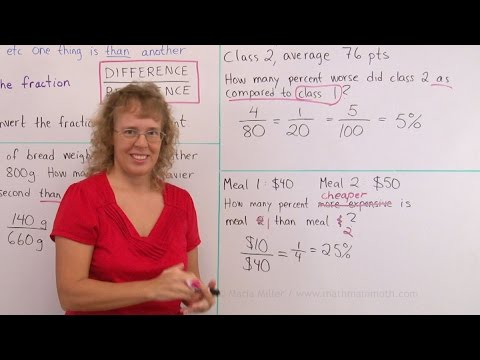
(Video) Relative Difference or Percentage Difference

by Math Mammoth

This video by Math Mammoth explains how to compare values using percents.

Summary\large{\text{Summary}}

The style of problems you will encounter will be along the lines:

How many percent more, less, taller, smaller, bigger, etc. is one thing than another?

The formula we use is: difference between the two thingsreference\frac{\text{difference between the two things}}{\text{reference}} Then, we convert this to a percent.

If this seems confusing, don't worry. A few examples will make it clearer.

A line break.

Example 1

A loaf of bread weighs 660 g660\text{ g}. Another weighs 800 g800\text{ g}. How many percent heavier is the second than the first?

First, we want to calculate the difference between the two weights. 800−660=140800-660=140

Next, we pick the reference weight. Notice the problem says "than the first". This tells us we want to know difference compared to the first weight. So the first weight is our reference. We can find the percent to be: 140660=21.21‾%\frac{140}{660}=21.\overline{21}\%

So we can say that the second loaf weighs about 21%21\% more than the first loaf.

A line break.

Example 2

Class 11 has an average of 8080 points. Class 22 has an average of 7676 points. How many percent worse did class 22 do compared to class 11?

Again, start by finding the difference. 80−76=480-76=4

What should be the reference in this problem?

Choose one answer

Interactive · 1 question

Calculating Relative Difference \\

Relative difference compares one value to another. It is helpful in determining the percentage increase or decrease from one value to another. This concept is similar to calculating percent change and percent error, which you'll learn about later. First, let's dive into relative difference.

The formula for relative difference is: DifferenceReference Value\frac{\text{Difference}}{\text{Reference Value}} Remember to convert the value into a percentage!

Examples

Example 1 \\ The lacrosse team had 1717 members last year. This year, they gained some new members and currently have 2424 members. What is the relative difference?

We are comparing the change in members with the original (last year's) team members. 24−1717=717≈0.412=41.2%\frac{24-17}{17}=\frac{7}{17}\approx 0.412 = 41.2 \%

There has been a 41.2%41.2\% increase in team members.

Example 2 \\ It has been a turbulent February—probably thanks to the impact of climate change. It was 6060 degrees Fahrenheit two days ago and today it is 4141 degrees Fahrenheit. What is the relative difference in temperature? 60−4160=2160=0.35=35\frac{60-41}{60} =\frac{21}{60} = 0.35=35%

There is a 35%35\% decrease in temperature in the past 22 days.

Try the problem below!

Rachel bought a bag of orange with 88 oranges in it. A week later, there are 22 oranges left. What is the relative difference?

Choose one answer

Interactive · 1 question

Relative Difference: Images and Examples

To find the relative difference between two values, divide the difference by the original value: differenceoriginal value\frac{\text{difference}}{\text{original value}} Convert this number to a percentage. If the value increased, we say there is a xx percentage increase. If the value decreased, we say there is a xx percentage decrease. xx is the number we calculated.

Now, let's look an example.

At Millie's Donuts, 66 donuts are sold at the price of $3.50\$3.50.

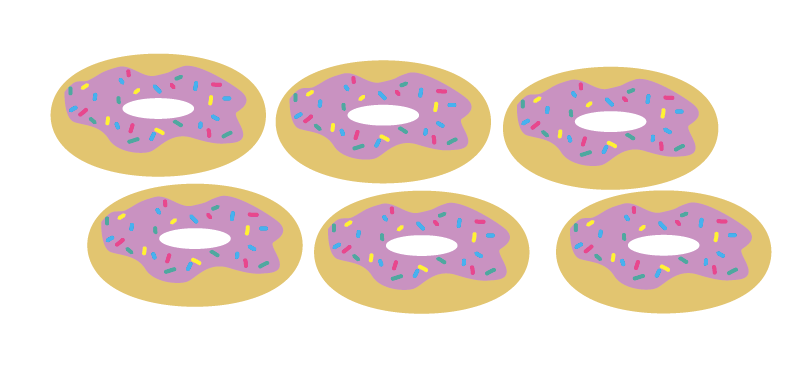
6 donuts.

Image source: by Christine

For their 55 year anniversary promotion, the store is selling 88 donuts at the same price.

8 donuts.

Image source: by Christine

Question 1

What is the relative difference in the amount of donuts you can buy with $3.50\$3.50?

We are comparing the relative difference from 66 to 88 donuts. differenceoriginal value=8−66≈0.333=33.3%\frac{\text{difference}}{\text{original value}}=\frac{8-6}{6}\approx 0.333 = 33.3\%

There is a 33.3%33.3\% increase in the amount of donuts you can buy with $3.50\$3.50.

If you got a funky number, it might be good to double check your conversion from a decimal to a percent!

Question 2

What is the relative difference in the unit price (price per donut)?

Let's calculate the original and sales unit prices.

  • Original unit price: 3.506\frac{3.50}{6}
  • Sales unit price: 3.508\frac{3.50}{8}

Now, we can calculate the relative difference: differenceoriginal value=3.506−3.5083.506=8×3.5−6×3.548×63.5=2×3.548×63.5=28=25%\begin{align} &\frac{\text{difference}}{\text{original value}}\\ &=\frac{\frac{3.50}{6}-\frac{3.50}{8}}{\frac{3.50}{6}} \\ &=\frac{8\times 3.5 -6\times 3.5}{48}\times \frac{6}{3.5}\\ &=\frac{2\times 3.5}{48}\times \frac{6}{3.5}\\ &=\frac{2}{8}\\ &=25\% \end{align} There is a 25%25\% decrease in unit price!

If you don't want to do all the math with fractions, you can also find the approximate values of the unit prices and calculate with those!

Now, try the problem below!

Millie's pushed out their new item—lemon lavender donut. For the first week, this donut is sold at $1.50\$1.50 per donut. Hoping to promote this new item, the price went down to $1.00\$1.00 for the second week. \\ What is the relative difference?

Choose one answer

Type a concept, like “slope” or “photosynthesis”.

↑ ↓ to choose · Enter to openSearch explanations and problems