Interactive · 9 questions
+2 contributors


What are the odds?
We often hear the words "odds," "probability," and "chance," used interchangeably. The truth is, though, that while probability and chance are similar in meaning, odds is its own concept. It is not quite the same as the other two words.
Probability and odds both describe the likeliness of an event. However, they look at likeliness through a different lens.
So, what exactly are odds?
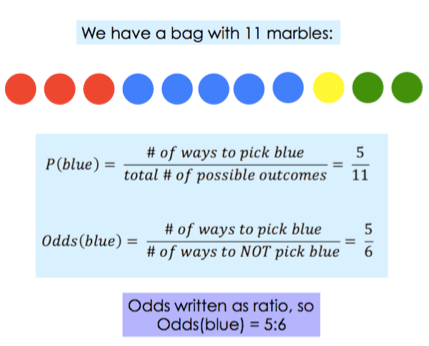
Note how the probability, and odds, give quite different values. Mixing these terms up could give pretty misleading information.
Our numerators are the same for calculating probability and odds; it's the denominators that differ. For odds, the denominator is no longer a total of all of the outcomes.
As you can see from our example, odds are written as a ratio of the number of ways the desired event could occur to the number of ways it could not occur.
As a result, the denominators for the formulas for odds and probability will be different.
Let's try another example, this time just calculating odds.
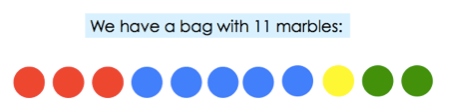
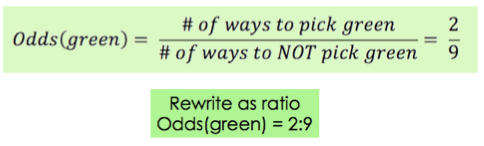
What are the odds of picking a green marble?
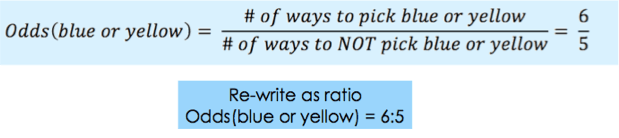
What are the odds of picking a blue OR yellow marble?
Odds in favor vs. odds against
In the previous examples, when we ask, "What are the odds of picking green," we are asking what the odds are in favor of green.
Outside betting, finding odds in favor is basically the default. It's usually what you're being asked.
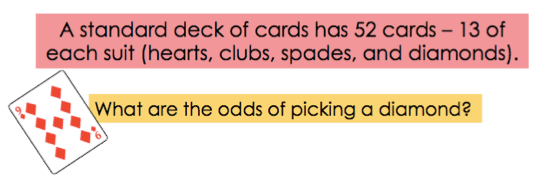
What kind of odds is the this question asking you to determine?
So, what are the odds of picking a diamond?
In gambling, however, you're more likely to be presented with odds against a particular outcome.

What are the odds against picking a diamond?
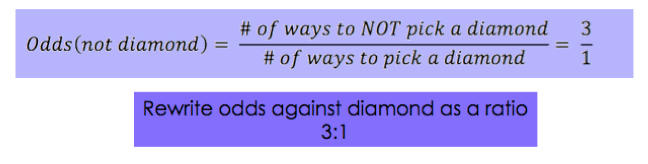
Notice how the odds against picking a diamond is the inverse (flipped over) version of the odds in favor of picking a diamond.
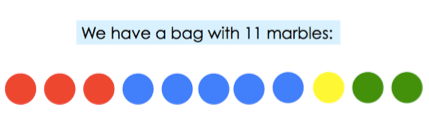
What are the odds in favor of picking a yellow marble?
What are the odds in favor of picking a red or blue marble?
What are the odds against picking a green marble?
What are the odds against picking a blue or yellow marble?
