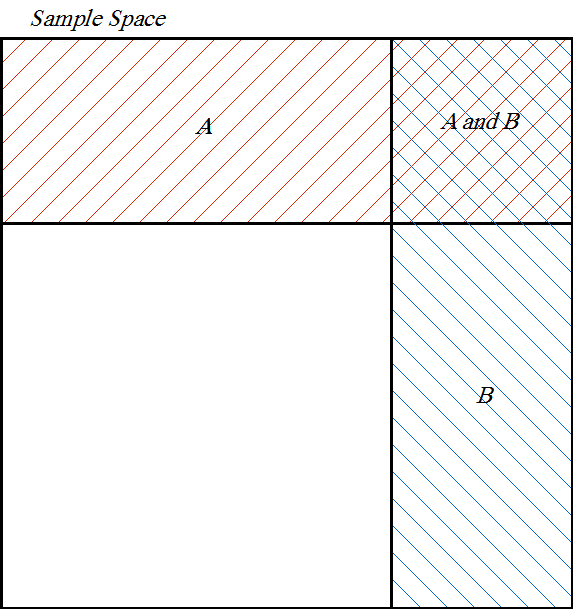
A অথবা B ঘটার সম্ভাবনা যেভাবে বের করবে

Interactive · 4 questions

Finding the Probability of AA or BB

Finding the probability of either event AA or event BB occurring is simpler than you might think.

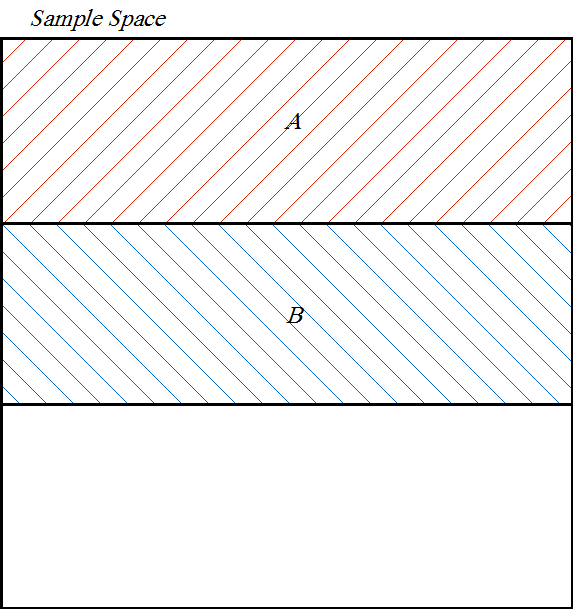
When doing problems like these, the 2 events we're interested in should be mutually exclusive. This means that it is not possible for the 2 events to occur at the same time.
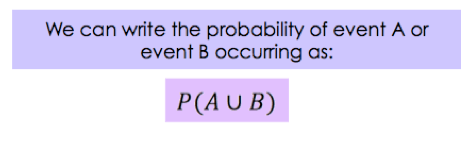
We can write the probability of event A or event B occurring as:
P(A union B)

This basically means that the probability that either AA or BB occur is the probability of the union of AA and BB. Think of the ∪\cup as "or."

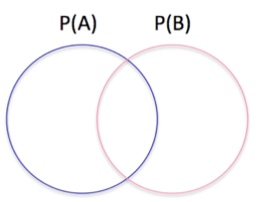
If you're more of a visuospatial learner, consider the Venn diagram below. When we are trying to find P(A∪B)P(A \cup B), we are trying to find the probability of landing in any of circle AA or any of circle BB.

A Venn Diagram with one circle P(A) and another circle P(B)

So, if we're trying to find the probability of landing in any of circle AA or any of circle B, we can re-write P(A∪B)P(A \cup B) as P(A)+P(B)P(A) + P(B).

P(A union B) = P(A) + P(B)

Let's try an example to see how this works.
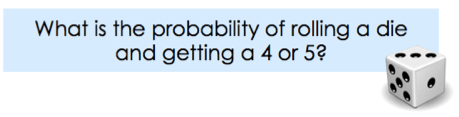
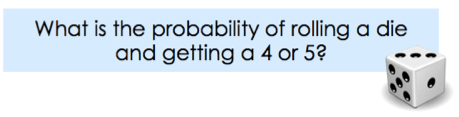
What is the probability of rolling a die and getting a 4 or 5?

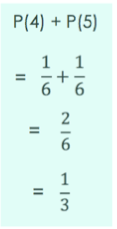
The question asks us about P(4∪5)P(4 \cup 5).

How can we re-write this?

Choose one answer

Interactive · 1 question

Often times, instead of being focused on only one possibility, we want to know the probability of several possibilities at the same time. This is where we want to use the "And" and "Or" rules of probability. Specifically in this section, we will focus on the "Or" rules

"Or" is used when you don't care which of the two happens, as long as at least one of them does happen. If, for example, you would win a card game if you drew either an ace or a king, that's a situation in which you would use the "Or" rule. Most of the time, if you would use the word "or" in a description of the problem, you're going to use the "Or" rule.

Usually we denote "Probability of either AA or BB" with the symbol P(A∪B)P(A \cup B)

The probability for two disjoint events (which cannot happen together) is

P(A∪B)=P(A)+P(B)P(A \cup B) = P(A) + P(B)

What is the probability of rolling a 55 or a 66 on one six sided die? (assume the die is fair)

Choose one answer

Video

(Video) Probability and Odds with Shaq

by Tyler Stubenhofer

Tyler Stubenhofer has a great video explaining the relationship between probability and odds.

Summary\large{\text{Summary}}

Probablity is successessuccesses + failures\frac{\text{successes}}{\text{successes + failures}}, or successestotal\frac{\text{successes}}{\text{total}}

Odds is represented by the ratio successes:failures\text{successes}:\text{failures}

In these two formulas, the numerators are the same, but the denominators are different.

If the probability and the odds in favor of the same event are both calculated, which quantity will be bigger?

Choose one answer

Type a concept, like “slope” or “photosynthesis”.

↑ ↓ to choose · Enter to openSearch explanations and problems