প্রয়োগ: হার-সময়-দুরত্ব সমস্যা

Before this, knowহার কী?

Video · + 2 min read

(Video) Distance, Rate, and Time Word Problem

by PatrickJMT

This video by PatrickJMT works through a word problem involving distance, rate, and time.

Summary\large{\text{Summary}}

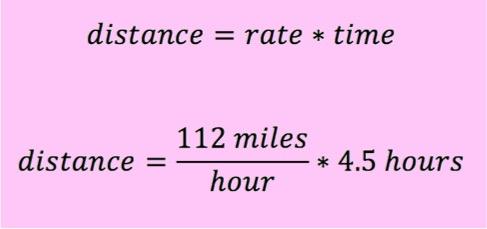
Distance, rate, and time are connected to one another by the equation: distance=rate×timed=rt\text{distance}=\text{rate}\times\text{time}\\ d=rt For example, if your rate is 60 mph60\text{ mph} and you drive for 3 hours3\text{ hours}, you will have driven 60×3=180 miles60\times3=180\text{ miles}.


Example

The speed of a boat in still water is 10 mph10\text{ mph}. It travels 24 miles24\text{ miles} upstream and 24 miles24\text{ miles} downstream in 5 hours5\text{ hours}. What is the speed of the current?

These can be tricky to solve but take it one step at a time and set up equations. First, let's define the speed of the current as cc. c=speed of currentc=\text{speed of current} Next, we'll find the distance, rate, and time for when the boat goes upstream and downstream.

Upstream

When the boat travels upstream, it's fighting against the current, so its speed (or rate) is reduced: rup=10−cr_{\text{up}}=10-c The distance it travels upstream is 24 miles24\text{ miles}. dup=24d_{\text{up}}=24 We know both trips combined take 5 hours5\text{ hours} but we don't know how long the upstream trip takes. Let's just call it tupt_{\text{up}} for now.

Downstream

Next, when going downstream, the boat works with the current so its speed is 10+c10+c. rdown=10+cr_{\text{down}}=10+c Again, it travels 24 miles24\text{ miles}. ddown=24d_{\text{down}}=24 And we don't know the time, so we'll call it tdownt_{\text{down}}.

Time

We aren't given the time for each trip, but we are given the total trip's time. It takes 5 hours5\text{ hours} to travel upstream and downstream. We can write this as: tup+tdown=5t_{\text{up}}+t_{\text{down}}=5 Using the distance equation, d=rtd=rt, we can solve for tt and get: t=drt=\frac dr Plugging this into our time equation, we get: duprup+ddownrdown=5\frac{d_{\text{up}}}{r_{\text{up}}}+\frac{d_{\text{down}}}{r_{\text{down}}}=5

Current

Finally, we plug in the information we have and solve for cc (find the rate). duprup+ddownrdown=52410−c+2410+c=5(10−c)(10+c)(2410−c+2410+c)=(10−c)(10+c)(5)24(10+c)+24(10−c)=5(100−c2)240+24c+240−24c=500−5c2480=500−5c25c2=20c2=4c=2\begin{align} \frac{d_{\text{up}}}{r_{\text{up}}}+\frac{d_{\text{down}}}{r_{\text{down}}}&=5\\ \frac{24}{10-c}+\frac{24}{10+c}&=5\\ {\color{#8925AE}{(10-c)(10+c)}}\left(\frac{24}{10-c}+\frac{24}{10+c}\right)&={\color{#8925AE}{(10-c)(10+c)}}(5)\\ 24(10+c)+24(10-c)&=5(100-c^2)\\ 240+24c+240-24c&=500-5c^2\\ 480&=500-5c^2\\ 5c^2&=20\\ c^2&=4\\ c&=2 \end{align} The current is 2 mph2\text{ mph}.

Spot the idea in disguise

In a contest problem, this idea hides inside a situation you have not seen before. Learning to spot it is the real skill. These are real problems from the AMC 8, AMC 12 and AIME, the national math competitions for middle and high school students, each with a worked solution on LIVE by Po-Shen Loh.

Video · + 2 min read

(Video) Linear Distance, Rate, and Time Word Problem

by PatrickJMT

In this video, Patricks works through a word problem involving distance, rate, and time.

Summary\large{\text{Summary}}

Distance, rate, and time are connected to one another by the literal equation: distance=rate×timed=rt\text{distance}=\text{rate}\times\text{time}\\ d=rt For example, if your rate is 60 mph60\text{ mph} and you drive for 3 hours3\text{ hours}, you will have driven 60×3=180 miles60\times3=180\text{ miles}.


Example

Marjorie was getting blackberries along a path from her back door to the rear of her garden. On the way to the rear of the garden, she walked at an average speed of 8 feet per minute8\text{ feet per minute}, and on the way back to her back door, she walked at an average speed of 16 feet per minute16\text{ feet per minute}. If the round trip took 21 minutes21\text{ minutes}, how far in feet is it from her back door to the rear of her garden.

In this problem we want to find the distance between her door and her garden. To do this, we want to look at her trip to the garden, and her trip back.

To the Garden

Going to the garden, she walks 8 feet per minute8\text{ feet per minute}. rgarden=8r_{\text{garden}}=8 We don't know the time it took to walk to the garden, only the time it took to walk there and back. So, we'll use tgardent_{\text{garden}}.

To the House

Going back to the house, she walks 16 feet per minute16\text{ feet per minute}. rhouse=16r_{\text{house}}=16 Again, we don't know the time, so we'll call it thouset_{\text{house}}.

Time

We're given the time for the entire trip, 21 minutes21\text{ minutes}. Wecan write this equation as: tgarden+thouse=21t_{\text{garden}}+t_{\text{house}}=21

Using the distance equation, d=rtd=rt, we can solve the equation for tt. t=drt=\frac dr

Plugging this into our time equation, we get: drgarden+drhouse=21\frac{d}{r_{\text{garden}}}+\frac{d}{r_{\text{house}}}=21

Solve for Distance

Finally, to find the distance, we plug in our known values and solve this equation. d8+d16=212d16+d16=213d16=213d=336d=112\begin{align} \frac{d}{8}+\frac{d}{16}&=21\\ \frac{2d}{16}+\frac{d}{16}&=21\\ \frac{3d}{16}&=21\\ 3d&=336\\ d&=112 \end{align} The distance between her house and garden is 112 feet112\text{ feet}.

Illustrated · 1 min

Rate-time-distance is pretty easy to understand, the formula to use for rate-time-distance is: Distance=Rate×Time\text{Distance} = \text{Rate} \times \text{Time} Rate=DistanceTime\text{Rate} = \frac{\text{Distance}}{\text{Time}} Time=DistanceRate\text{Time} = \frac{\text{Distance}}{\text{Rate}}

Let's try a problem that uses the third equation, finding the time.

Two cars are traveling from the same point, at 55 A.M., traveling in opposite directions at 4040 and 50 mph50\text{ mph} respectively. At what time will they be 450 miles450\text{ miles} apart? Assume neither car changes time zones.

After tt hours the distances D1D_1 and D2,D_2, in miles per hour, traveled by the two cars are given by D1=40tD2=50t\begin{align} D_1 &= 40t\\ D_2 &= 50t \end{align}

After tt hours, the distance DD separating the two cars is given by D=D1+D2=40t+50t=90t\begin{align} D &= D_1 + D_2\\ &= 40t + 50t\\ &= 90t \end{align}

Distance DD will be equal to 450450 miles when: D=90t=450 milesD = 90 t = 450 \text{ miles}

To find the time tt for DD to be 450450 miles, solve the above equation for tt to obtain t=5 hourst = 5\text{ hours}

After five hours pass, it will be 1010 A.M., as it was 55 A.M. when we started.

Let's try another problem, this time involving a train instead of cars.

A train drove 28882888 miles starting at its station, always going at 8080 mph. What is the amount of time since it left the station?

We know, that the train in 28882888 miles away from its station, we also know that the rate it is going at is 8080 miles per hour. We use the formula:

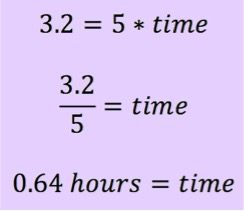
Time=DistanceRate.\text{Time} = \frac{\text{Distance}}{\text{Rate}}. 288880=36.1\frac{2888}{80}= 36.1

hours since the train left from its station.

We could also use the formula, Distance=rate×time.\text{Distance} = \text{rate} \times \text{time}. Let's try a problem using this one!

The biker is going to a parade at a speed of 2525 mph , she has biked for 22 hours. What is the distance she traveled from her house to the parade?

Lady on bicycle.

Image source: by Vinni Achanta

The rate is 2525 mph and the time is 22 hours so our equation becomes

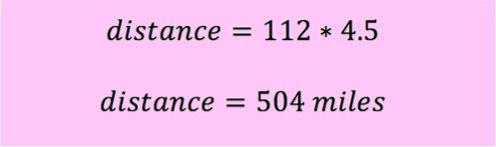
D=25 mph ×2 hours =50 miles.D = 25 \ \text{mph} \ \times 2 \ \text{hours} \ = \boxed{50} \ \text{miles}.

Interactive · 11 questions

How are Rate, Time, and Distance Related?

These 33 variables—rate, time, and distance—are all closely related to each other. They're like the Three Musketeers of math. If you know the values of two of them, you can easily find the third.

Below, we'll take a closer look at how to work with them.

3 musketeers as rate, time, and distance.

Image source: By The Clown CC0 via publicdomainpictures.net

The expression below equates the 33 variables. We'll manipulate this to solve a few example problems together.

Distance = rate * time

Image source: by Hannah Bonville

When working with this equation, make sure that the units of all three variables are consistent.

For example, if your distance is in meters and your time is in seconds, your rate should have meters per second as its units.

Let's work on some practice problems.

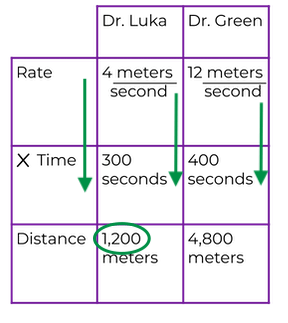
Dr. Luka is running to a patient at 4 meters per second4\text{ meters per second}. Dr. Green is flying in a helicopter at 12 meters per second12\text{ meters per second}. Dr. Luka beats Dr. Green to the patient by 100 seconds100\text{ seconds}. It took Dr. Green 400 seconds400\text{ seconds} to get there. How far did Dr. Luka run to the patient?

Choose one answer

Interactive · 1 question

If we want to find the relationship between distance, rate, and time, we use a simple formula.

Work and rate problems are common applications of rational expressions.

$d=rt$, where $d=distance, r=rate, t=time$.

Image source: by Anusha Rahman

We can use this formula to solve problems involving distance, rate, and time. To use the formula, you will plug in the values you know and solve for the values you don't know.

You may be wondering what happens when both coordinates depend on time. When both coordinates depend on time, the motion can be modeled using parametric equations. Don't worry, you'll learn about this concept later!

Evan Hansen is trying to figure out how fast he needs to walk to make it to the theatre on time for his performance. He needs to walk 33 miles, and he needs to be in the theatre in 22 hours. What is the speed at which he needs to walk?

Choose one answer

Type a concept, like “slope” or “photosynthesis”.

↑ ↓ to choose · Enter to openSearch explanations and problems