Read · 1 min

Compare honey to water. Water flows out easily but honey doesn't. You need a larger shearing stress to make it flow. Same is the case with toothpaste.

We say that honey and toothpaste are more viscous than water.

Viscosity is the property of a fluid by virtue of which it opposes relative motion between different layers of the fluid when it flows.

It is similar to solid friction in many ways.

The expression for viscous force is given by:

F=−ηAdvdxF = - \eta A \frac{dv}{dx}

Here, AA stands for the area of the layers of the fluid and dvdx\frac{dv}{dx} is the velocity gradient between layers of the fluid.

η\eta is a property of the fluid concerned. It is known as the coefficient of viscosity.
Illustrated · 1 min

Viscosity is defined as the state of being thick, sticky, and semifluid in consistency, due to internal friction. This might seem like a simple concept, but when calculating it, much more than the qualitative expression needs to be taken into account.

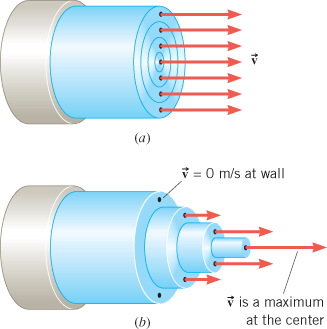
In the diagrams above, figure (a) represents the flow of an ideal fluid, which means no viscosity, while figure (b) represents the flow of a normal fluid that has some viscosity. When we think of viscous flow, we want to view the parts of the liquid as layers. This is also known as laminar flow.

Type a concept, like “slope” or “photosynthesis”.

↑ ↓ to choose · Enter to openSearch explanations and problems