
Illustrated · 1 min

Notice in Michael Busch's explanation that he talked about atmospheres. There are two other common units of pressure, most simply related to atmospheres, that I am going to describe here:

The millimeters of mercury (mmHg) was the first unit of pressure used. It was derived by using a barometer filled with mercury to measure pressure.
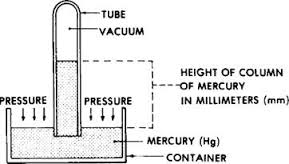
a barometer

The height of the column of mercury in millimeters is the pressure. 1 atm = 760 mmHg, so at STP the pressure is 760 mmHg.

In order to give justice to Evangelista Torricelli, inventor of the barometer, a unit of pressure, the torr, was named after him. 1 torr = 1 mmHg by definition, i.e. torr and mmHg can be used interchangeably. Torr is simply easier to say in everyday use than mmHg.

Anyways, have fun with your two new units of pressure!

Read · 1 min

The standard unit of pressure is the Pascal, defined as 1 Pa=1 Nm21 \, \text{Pa} = \frac{1 \, \text{N}}{\text{m}^2} (or equivalently, as 1 Pa=1 kgs2⋅m1 \, \text{Pa} =\frac{1 \, \text{kg}}{\text{s}^2 \cdot \text{m}}). This is a low pressure relative to our everyday experience - in Earth's gravity, it's about the pressure exerted on a surface by laying a single sheet of paper down on it.

Another common unit is the atmosphere or atm. This was originally defined as the mean absolute pressure of the Earth's atmosphere at sea level, but is now defined as 101,325 Pa101,325 \, \text{Pa} exactly. Another unit, the bar is exactly 100,000 Pa100,000 \, \text{Pa} and is therefore preferred.

Several other units of pressure are still used for historical reasons.

Type a concept, like “slope” or “photosynthesis”.

↑ ↓ to choose · Enter to openSearch explanations and problems