Interactive · 6 questions
+2 contributors

The product of all consecutive integers from to a non-negative integer is known as factorial, denoted .
This means that for any non-negative integer ,
Try this problem:
What is ?
Here's another one:
What is ?
As you can see, factorials get big pretty quickly!
Factorials are very useful in permutations and combinations.
A permutation is an arrangement of elements. For example, is a permutation of because it is an arrangement of the elements and . In permutations, the order of the elements does not matter. So if comes before , it will be a different permutation than if comes before .
Try this problem!
If there are five people in a race, how many different permutations are possible for the order in which the runners finish?
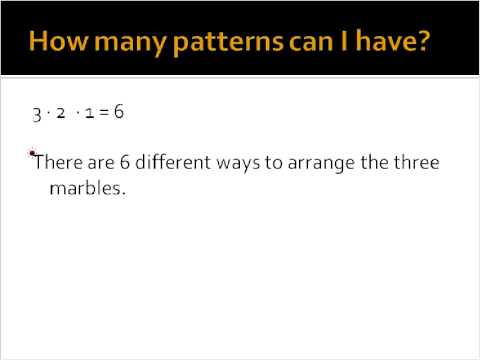
Since there are choices for 1st place, choices for 2nd place, choices for 3rd place, choices for 4th place, and choice for 5th place, we find that there are possible different finishing orders.
For a permutation where we are choosing things from total things, we find that the number of permutations is:
Try this problem using the formula.
How many ways are there to choose five animals from a total of eight animals?
Just plug in for and for to get which simplifies to .
A combination is similar to a permutation except in combinations, order does matter. would be considered the same combination as because you are not changing any of the elements, you are simply changing the order of the same elements.
If I have four different socks and I want to choose two to wear, how many different combinations of two socks can I choose?
A combination where you choose things from total things can be denoted with this formula:
Okay now that you know a lot about factorials and combinatorics, here's a tricky question for you.
What's ?
because, in a combinatorial sense, we have exactly one way to permute zero objects.