COMBINATIONS
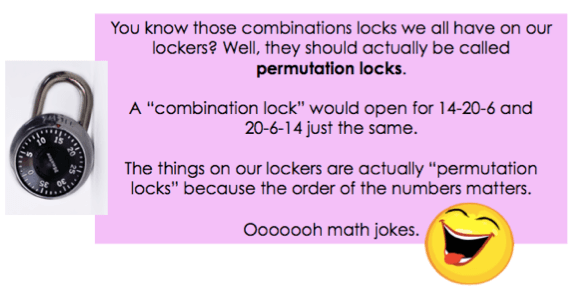
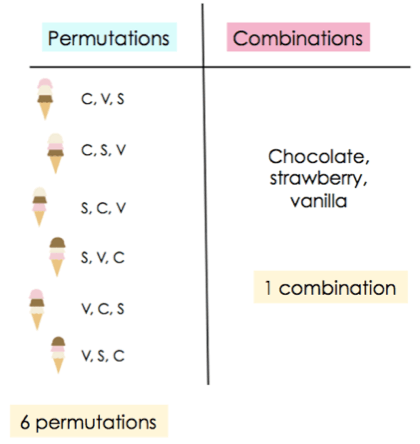
Combinations are very similar to permutations as they are also trying to find how many smaller groups can be made out of a larger set of elements. Just like how permutations have permutation notation, combinations have combination notation:
nCr
Where n is the number of elements in the overall set, and r is the number in each group that you’re trying to calculate. Once again, n will always be the larger number. The equation for combinations is very similar to permutations, but with one extra step:
nCr=(n−r)!⋅r!n!
In the denominator, you multiply (n−r)! by r! . This is the only part that is different in this equation compared to the one for permutations.
Let’s run through a problem just to understand the use of this equation.
In music, a triad is defined as any combination of 3 notes. Between each octave on a keyboard there are 12 different notes that can be played. How many different chords could be played within one octave?
In this case n=12 notes per octave, and r=3 notes in each triad.
12C3=(12−3)!⋅3!12!=9!⋅3!12!
Once again, break each factorial into its own factors, and cancel out factors that are on both sides.
9!3!12!=9⋅8⋅7⋅6⋅5⋅4⋅3⋅2⋅1⋅3⋅2⋅112⋅11⋅10⋅9⋅8⋅7⋅6⋅5⋅4⋅3⋅2⋅1=3⋅2⋅112⋅11⋅10=61320=220
The denominator shows 9! immediately followed by 3!. There is no need to separate them as each factor is being multiplied. In this problem, the (3⋅2⋅1) from 3! cancels out with the same set from the 12! in the numerator, as does (9⋅8⋅7⋅6⋅5⋅4) from 9!, but there is still (3⋅2⋅1) left over at the end. This is because that set of numbers is repeated in the denominator, but not in the numerator, and therefore will not get cancelled out.
If you're still a little uncomfortable with the idea, here is a video that goes over both Permutations and Combinations in depth by Brandon Foltz on YouTube.