সূচকের উলটো অপারেশন কী?

Illustrated · 3 min

We've learned a bit about exponents recently, from exponential decay, to solving exponential equations, to graphing exponential equations. Now, we'll dive into a similar, yet different, topic.

In mathematics, there is always a way to reverse an action. For addition, we have subtraction; for multiplication, we have division; likewise, for exponents, we have logarithms.

Believe it or not, logarithms are important to our daily lives! They run many of the things we take for granted. Logarithms are involved in a lot of behind-the-scenes for our daily lives. For example, they are used in traffic signalling, earthquake detectors, food processing, and medicine. They also correspond to the geometric sequences.

Logarithms put everything on a smaller scale. For example, it is nearly impossible for us to imagine what a million or a billion people would look like; however, logarithms help us visualize those great quantities by depicting them as simply powers of a number.

Here is the notation for a logarithm: log⁡b(a)=c\log_{b}(a)=c

Here, bb is known as the "base" for the logarithm, aa is the "argument", and cc is the "answer" or the exponent.

Basically what this log⁡\log (logarithm) is saying is that when bb is raised to the power of cc, we get aa. Another way or perhaps a simpler way of thinking of it is that "in order to get aa, bb has to be raised to the cc power".

One specific type of logarithm is the natural log, which you'll learn about later.

In that way it is the reverse of an exponential equation. A logarithm shows what exponent you need to raise a number to in order to get another specified number, whereas an exponential equation shows what you get once you raise a number to your exponent.

That is also how logarithms bring everything to a scale that we can comprehend. While an exponential equation shows the results of raising a number to a power, a logarithmic equation brings you back to your exponent by saying that in order to get, for example, one million, you need to raise ten to the 6th power. Logarithms can reduce the complexity of a problem! We can all visualize what six looks like, which makes it much more manageable.

In an exponential equation, we would see the same information, but presented in a different way. The exponential equation would say that "when you raise ten to the sixth power, you get a million". Our output from that equation would be a million, which is a quantity that few can visualize. The logarithm's output would be simply "six" which is better to work with and we can visualize that.

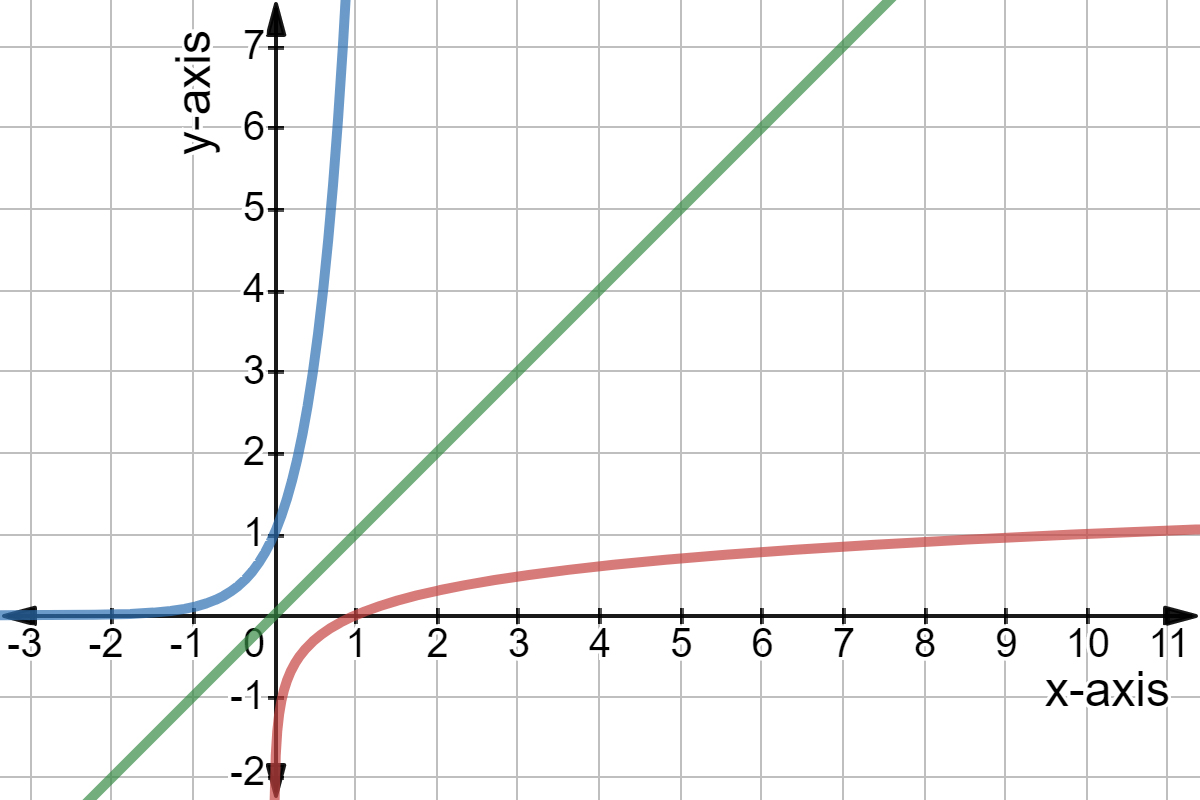
A logarithm is the inverse of an exponential function. If we talk graphically, that means that if you reflect an exponential function across the line y=xy=x, it will result in its corresponding logarithmic function. For example, here is a graph of the function f(x)=10xf(x)=10^{x}, y=xy=x, and log⁡10(x)\log_{10}(x); the exponential function is in blue, y=xy=x is in green, and the log is in red:

Exponential functions and logs are inverses.

Made using Desmos

Looking Further

As we continue to move through learning about logs, we will tackle some fun topics. You'll learn the formula for changing the base, which gives you more freedom to use different log equations. You'll also learn to take the log of a power, which is critical for more complicated growth and decay functions.

You'll then learn to solve the actual log equations. You'll start with solving log equations with the same base, but you'll then move into different log properties for the harder equations. You'l end this section with solving exponential equations with logs.

Let's get started!

Spot the idea in disguise

In a contest problem, this idea hides inside a situation you have not seen before. Learning to spot it is the real skill. These are real problems from the AMC 12 and AIME, the national math competitions for middle and high school students, each with a worked solution on LIVE by Po-Shen Loh.

Interactive · 3 questions

We already know how to use power statements. These are written in the form: x=ayx=a^{y} As with every equation, we can change the subject of the equation to solve different problems. If we were to change the subject of the above equation to aa, we would write it as a root: a=xya=\sqrt[y]{x} Let's find out what yy is.

This is where logarithms come in. A logarithm is a function. They can be written in the form: y=log⁡axy=\log_a x This answers the question "aa to the power of what gives xx?" (in this context, the what is y)

For example: log⁡3243=5\begin{align}\log_3 243\\=5\end{align}

Tip: To use log on a calculator, the button usually looks like log⁡■□\log_\blacksquare \square, but this may differ depending on model.

Use a calculator to find yy: y=log⁡72401y=\log_7 2401

Choose one answer

Video

(Video) Logarithms Explained

by Steve Kelly on Ted-Ed

In this video, we learn about the relationship between exponents and logarithms.

Summary\large{\text{Summary}}

The inverse operation of exponents is logarithms. TED Ed has an engaging video explaining what logarithms are and how they relate to exponents. The relation is: b  p=n              log⁡  b  n=pb\;^p=n\;\;\;\;\;\;\;\log\;_b\;n=p Also, because logs and exponents are inverses of each other, that means they cancel each other out if they have the same base. For example: b  log⁡bn=n              log⁡b(bn)=nb\;^{\log_bn}=n \;\;\;\;\;\;\;\log_b(b^n)=n It is good to recognize this and be comfortable switching between logs and powers.

Video

(Video) Logarithmic Functions

by mathman1024

Here's a video by mathman1024 explaining logarithmic functions.

Summary\large{\text{Summary}}

Remember that exponential functions were one-to-one. Because of this, we know that they have an inverse function. This inverse function is called the logarithmic function and it's given in the form: y=log⁡axy=\log_ax Logarithms are the inverses of exponents. That means:

y=log⁡ax⟺ay=xy=\log_ax\Longleftrightarrow a^y=x

Let's see some examples. The first he solves is: log⁡48=x\log_48=x. To solve this we convert the problem to its exponential form. log⁡48=x4x=8(22)x=232x=3x=32\begin{align} &\log_48=x\\ &4^x=8\\ &(2^2)^x=2^3\\ &2x=3\\ &x=\frac32 \end{align}

Try these next two on your own.

  1. log⁡x125=3\log_x125=3
  2. log⁡27x=43\log_{27}x=\frac43

Illustrated · 1 min

Logarithms

We are quite familiar with exponents, so we are going to take this a step further and look at a new way to examine exponents!

We have John Napier to thank for this concept: he is a 17th17th century Scottish mathematician who is most famous for discovering logarithms!

Logarithm
log_b(a)=x
b: base
a: argument
x: exponent

Image source: by Anusha Rahman

The common logarithm in math is a logarithm with a base of 1010. We often see: log10(100)=2log_{10} (100) = 2 We can verbally say this equation as: "log base 1010 of 100100 equals 22"

Looking forward

In the next few lessons, we will learn about rules of logarithms, graphing log functions, asymptotes of logs, and logs in the real world using log scales.

Type a concept, like “slope” or “photosynthesis”.

↑ ↓ to choose · Enter to openSearch explanations and problems