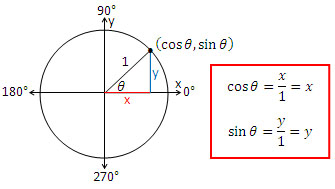
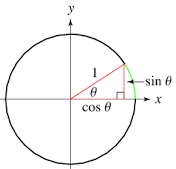
A Unit Circle is exactly what it sounds like: a circle with radius 1 unit. It is located at the origin, the intersection of the x and y axis:
You may be wondering what is the use of this circle, and how it relates to trigonometry. To see that, let's draw a triangle.
We know that sinθ=POPH. However, from the property that the radius of a unit circle is 1, we see that PO=1. Thus, sinθ=PH. Since PH is also the y coordinate of point P, we have that P=(x,sinθ).
Similarly to sin, you can find that cosθ=OH. Since OH is also the x coordinate of point P, we have that P=(cosθ,sinθ)
What about tanθ?
Can we simplify this any further? We don't know the lengths of either PH nor OH, so perhaps we can't. However, there is a clever geometrical interpretation: tanθ is simply the slope of line PO! (Make sure this makes sense.)
Now we've seen how the unit circle can simplify the definitions of sin
and cos a lot.
After seeing the intuition of using parts of the unit circle as sinθ and cosθ, I should introduce you to the Unit Circle Definition of Trig Functions.
Suppose we have a unit circle, and a point P on the outside perimeter of it. The angle that the line through P and the origin O makes with the x-axis is θ. We define the x coordinate of P to be cosθ and the y coordinate of P to be sinθ for all θ, not just acute θ. (Contributor Note: Someone who is proficient with the plotting tools should clean up this diagram and all the ones below.)
Why is this new definition useful? For one, it applies to all possible real values of θ, even negative ones and ones where θ>360∘! We certainly couldn't have done that with our right triangle trigonometry.
It also makes a few identities extremely obvious. For example, the identity sinθ=sin(180∘−θ).
Looking at the diagram, this is clearly true:
Another example is the famous sin2θ+cos2θ=1. From the unit circle, we see that any angle creates a right triangle, and so by the Pythagorean theorem we have that sin2θ+cos2θ=12=1, thus proved.
Congratulations! You have learned what the Unit Circle is, how it relates to trigonometric functions, and the usefulness of this new interpretation.
Click for Extras
Extras
We can also express all the other trigonometric functions on the unit circle too. Let's first do tanθ.
The labelled segment has length tanθ. This can be seen using similar triangles. If the length of the segment labelled tanθ is x, then by similar triangles, cosθsinθ=1x so x=tanθ.
We can also label the values of cscθ, secθ, and cotθ in a similar way:
See if you can mimic my proof of tanθ to prove that the other lengths indeed represent the trig functions.