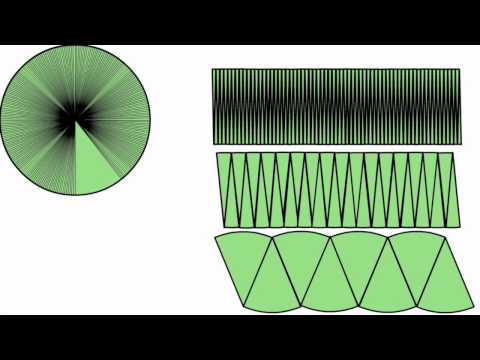
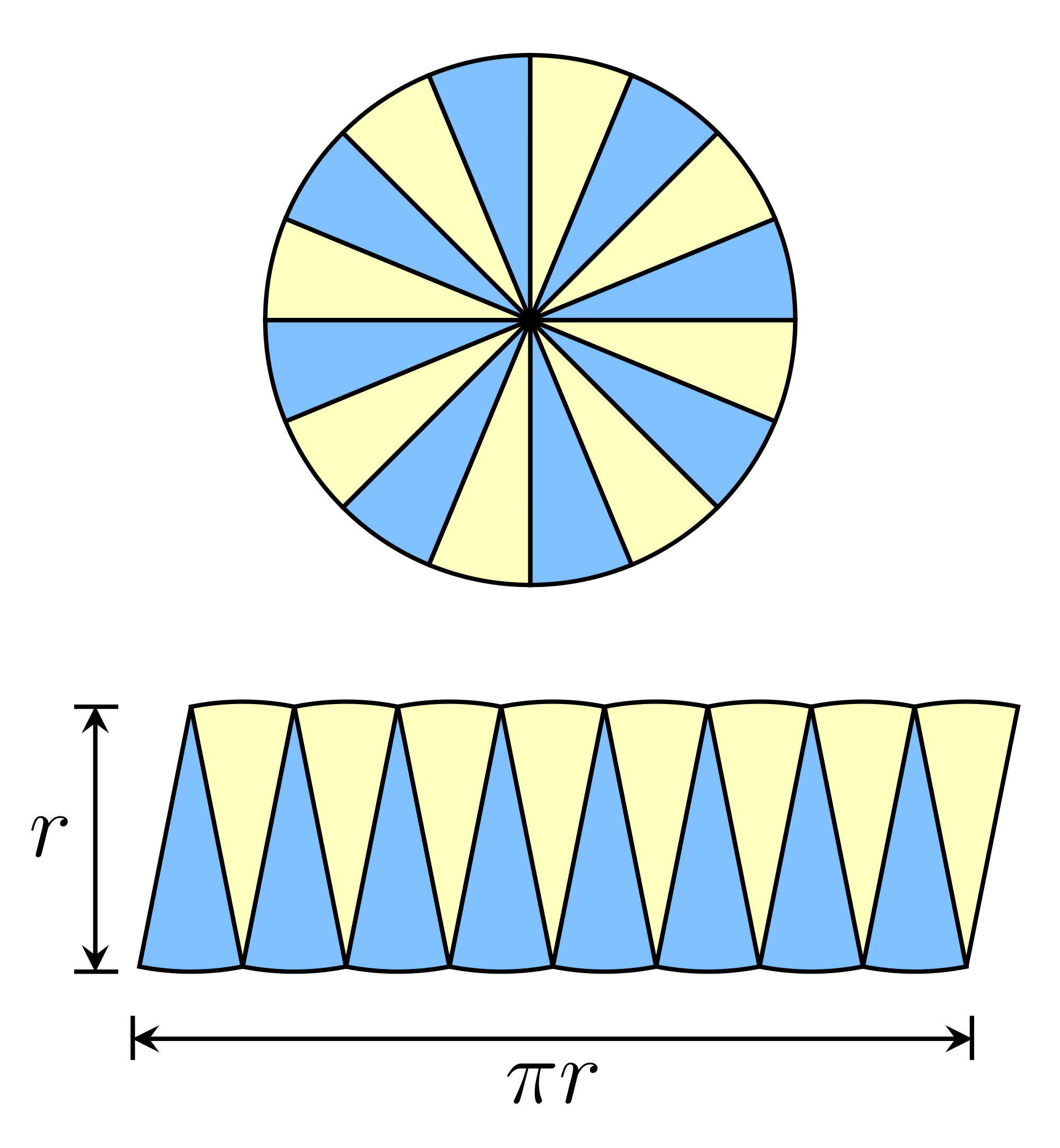
Interactive · 2 questions

The area of a circle is given by the following formula: where is the radius of the circle.
What is a radius? It's the distance from the center of the circle to any point on the edge of the circle.

The radius will always be the same length!
Here's more info on the radius of a circle.
Sometimes you will be given a circle's radius and asked to find its area.
What is the area of a circle with a radius of (Hint: Use the formula!)
To solve this problem, we follow three steps.
Step One: Identify r, the Radius:
This one's easy! We are given in the question that the radius is
Step Two: Substitute r Into the Area of a Circle Equation :
Step Three: Don't Forget the Units! :
Since we were given the radius in centimeters, the area will have the units of square centimeters, or The units for the area will always be the square of the units of the radius.
Sometimes, you will be given a circle's area and asked to determine its radius.
What is the radius of a circle with an area of
To solve this problem, we follow three similar steps as before:
Step One: Identify A, the Area:
We are given in the question that the area is
Step Two: Substitute A Into the Area of a Circle Equation :
Step Three: Don't Forget the Units! :
Since we were given the area in square millimeters, the radius will have the units of millimeters, or
Sometimes you will be given a picture and asked to solve for a certain area. Here's an example where you are asked to find the area of the orange shaded region. (Note: Don't worry about including units.)
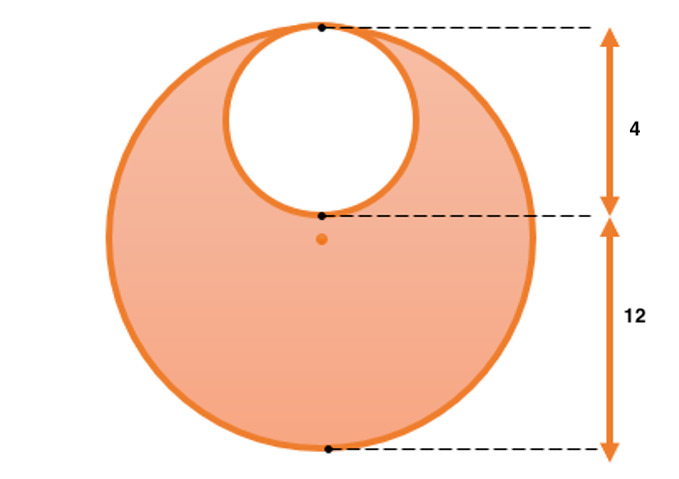
Find the area of the orange shaded region!
How do we find this area? First, we have to interpret the picture. Notice:
So, to find the area of the orange region () we first have to find the area of the small circle () and the area of the big circle ().
Step One: Find the Area of the Small Circle:
Take a look at the small circle. The diagram shows that the diameter of this circle is The radius is equal to half the diameter, so we can conclude that the radius of this circle is
Now we can substitute into our equation in order to find the area of the small circle.
So,
Step Two: Find the Area of the Big Circle:
Next, we need to find the area of the big circle. From the diagram, we can see that the diameter of the big circle is equal to the length of the diameter of the small circle, which is plus Since the diameter of the big circle is the radius is
Now we can substitute into our equation in order to find the area of the big circle.
So,
Step Three: Solve for the Area of the Orange Region:
Remember: which we can rewrite as:
Also remember:
Substituting and into our equation, we get:
So, the area of the orange region, is equal to